UPS vs Generator vs Solar – Which Backup Is Best for Home?
Battery, generator or panels? What each actually runs, what it costs over five years, and the safety rules — matched to how your outages behave.
The honest answer is that they solve different problems, and the right one is decided by two things you already know: what you need to run, and how long your outages last.
A quick orientation before the detail:
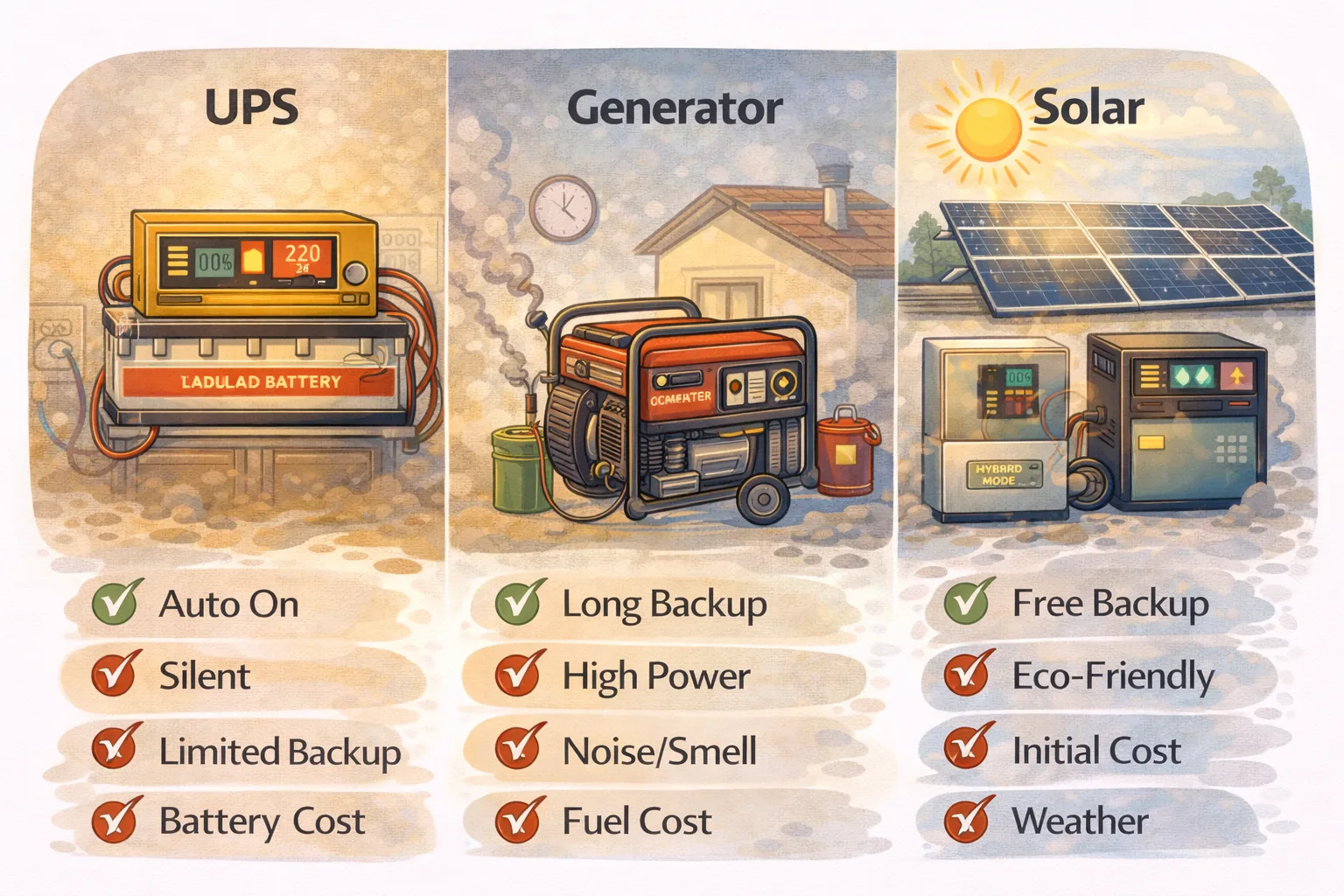
- UPS / inverter — silent, instant, no fuel. Best for fans, lights and Wi-Fi. Limited by battery size.
- Generator — handles heavy loads and long outages. Costs fuel, makes noise, and produces exhaust that is genuinely dangerous indoors.
- Solar + battery — highest upfront cost, lowest running cost, and the only option that refills itself during a daytime outage.
Start by splitting your load in two
Write down what must keep working, then sort it:
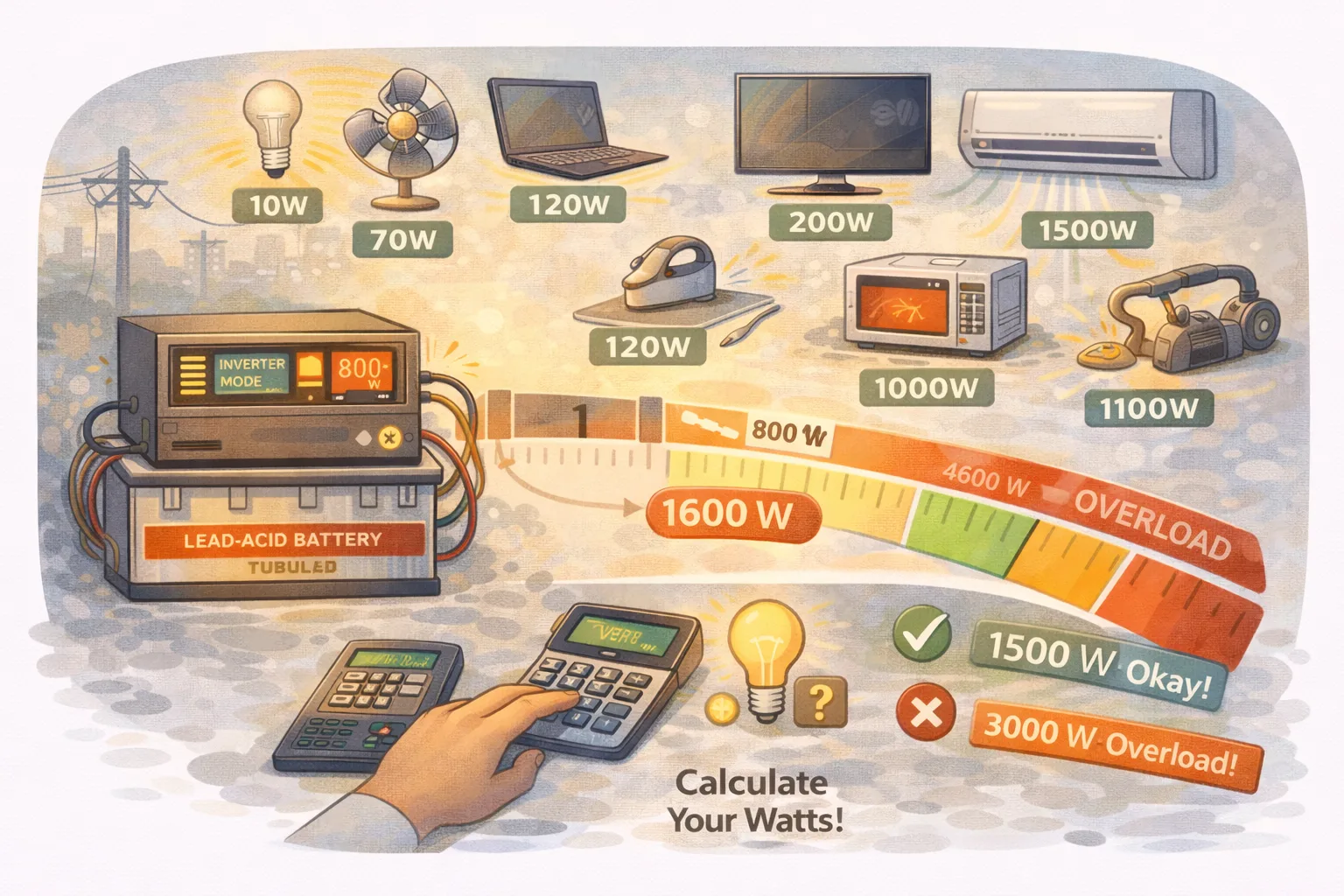
Essentials — fans, LED lights, Wi-Fi, phone charging, a television. Typically 250–450 W total.
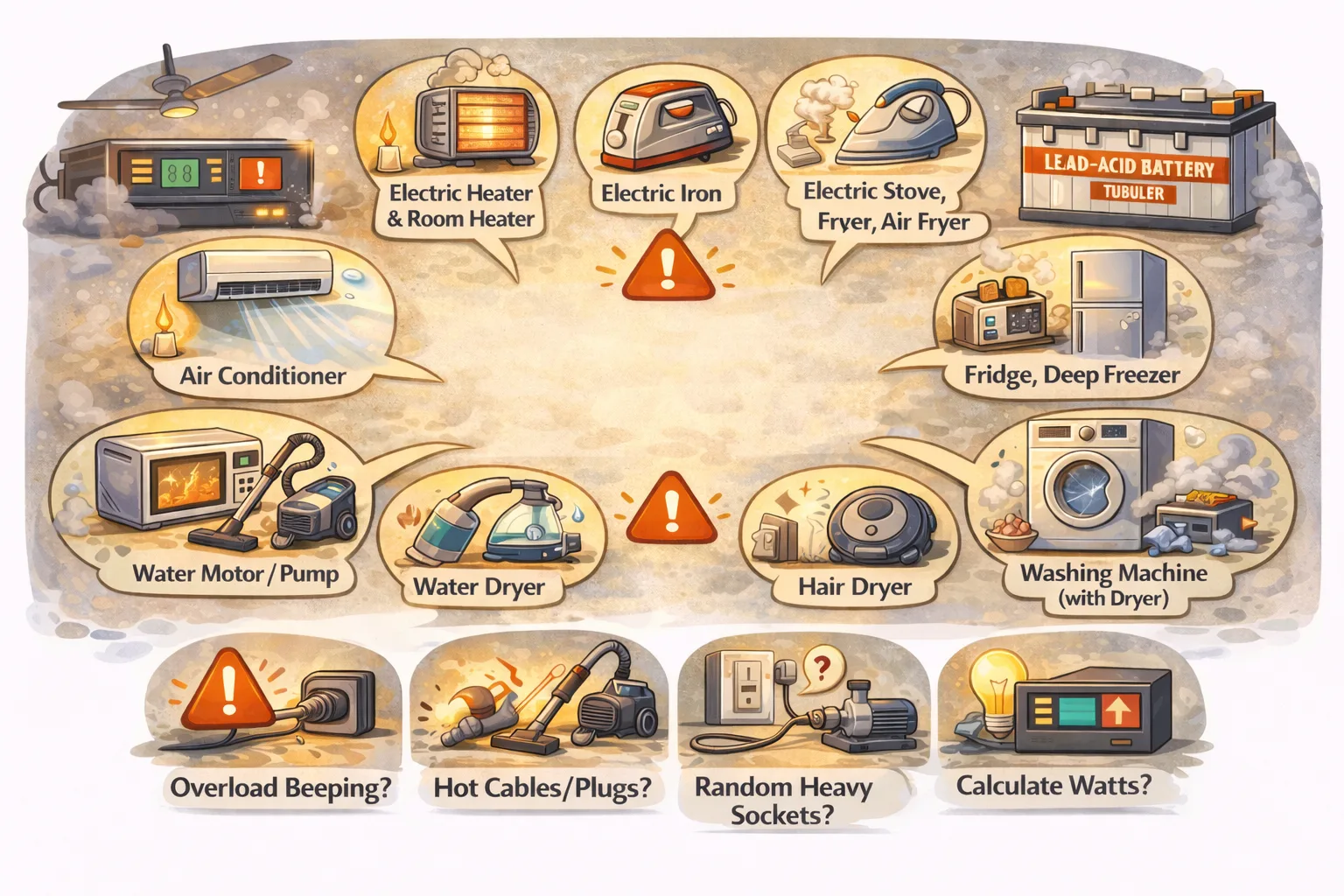
Heavy loads — refrigerator, water pump, iron, microwave, air conditioning. Individually 200 W to 2000 W, and the motor-driven ones demand several times that for a moment at start-up.
That split does most of the deciding. Batteries handle essentials comfortably. Heavy loads push you toward a generator or a properly sized hybrid system. If you are not sure which side something falls on, understanding inverter load works through the arithmetic.
Where the money actually goes
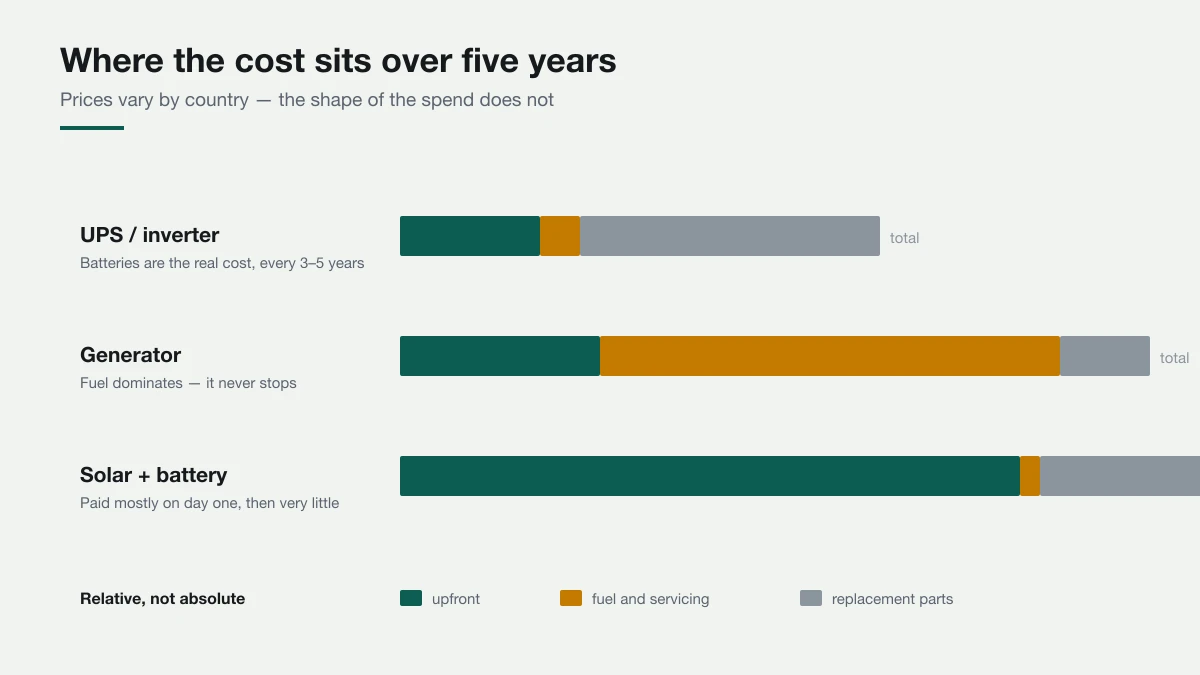
Sticker price is the worst way to compare these, because each one hides its cost somewhere different:
- UPS / inverter — modest upfront, small running cost, and then batteries every three to five years. Over five years the batteries usually cost more than the inverter did.
- Generator — moderate upfront, then fuel forever. For anyone with daily outages, fuel dominates everything else within a year or two, plus oil changes, filters and plugs.
- Solar + battery — the big cheque is written on day one. After that, running cost is close to nothing and you are also cutting your normal electricity bill, which none of the others do.
The practical consequence: the more hours you run backup, the more solar wins and the worse a generator looks. For rare outages, a generator that sits idle costs almost nothing to own; for daily four-hour cuts, it is the most expensive option available.
Option 1: UPS / inverter
The default choice, and for good reason. It switches over in milliseconds, makes no noise, needs no fuel and requires nothing of you during an outage.
What it does well: fans, lights, router, TV, laptops. Instant and automatic.
Where it struggles:
- Heavy loads. A pump or fridge start-up surge trips modest inverters. Details in can a UPS or inverter run a refrigerator safely.
- Long outages. Runtime is fixed by the battery bank, and deep daily discharge shortens battery life sharply.
- Waveform. Cheaper modified sine wave units make fans hum and run slower, and some electronics dislike them — see running a computer or TV on a modified sine wave UPS.
Before you buy: add up your essential load, decide how many hours you need, and size the battery bank from that — not from the inverter's rating. If you already own one and backup has fallen off, the batteries are the usual culprit rather than the inverter.
Option 2: Generator
The right tool when you need real power for a long time, and the wrong one in a dense neighbourhood.
What it does well: pumps, fridges, sometimes air conditioning. Runtime limited only by fuel, so a six-hour outage is no harder than a one-hour outage.
What it costs you: noise, fumes, fuel runs, and steady maintenance. In an apartment it is usually not an option at all.
Sizing: work out your total watts, add the largest start-up surge, then buy above that. Also avoid running a generator at a tiny fraction of its rating for long periods — light loading is bad for diesel engines in particular, which is why an enormous generator running two fans is a poor arrangement.
The safety part that is not optional
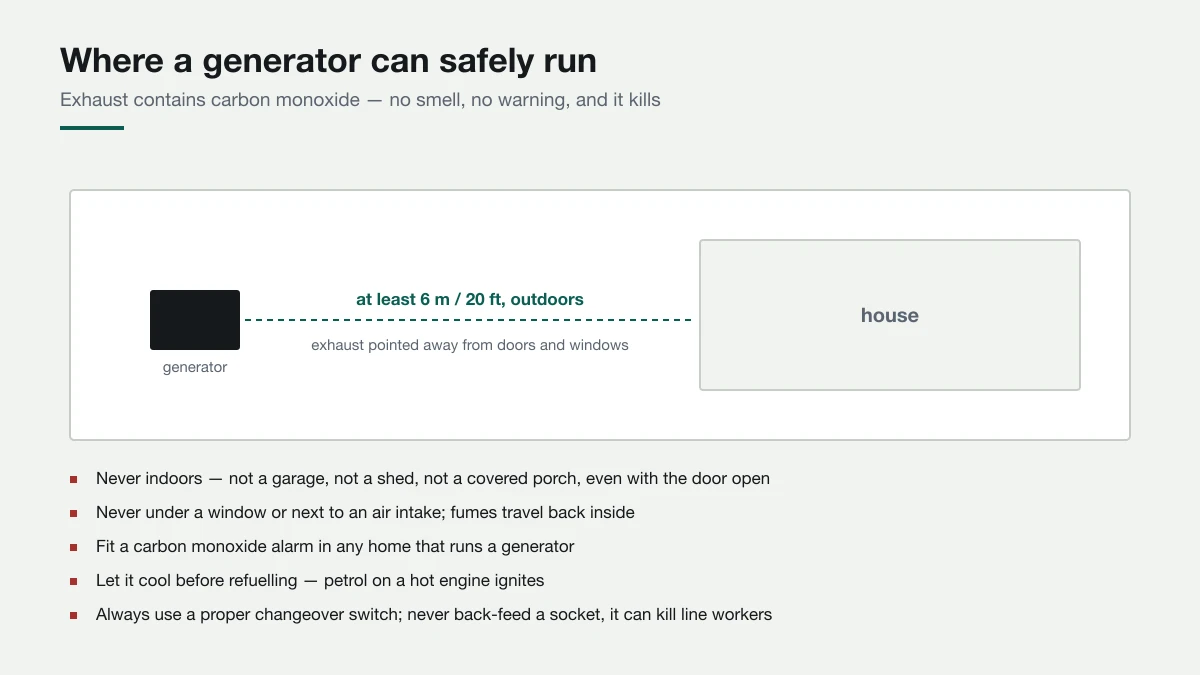
Generator exhaust contains carbon monoxide, which is colourless, odourless and lethal well before anyone notices symptoms. People die every year running generators in garages and covered porches during outages.
- Never run one indoors — not in a garage, shed or covered porch, and not with the door open
- Keep it at least 6 m / 20 ft from the building, exhaust pointed away from doors, windows and air intakes
- Fit a carbon monoxide alarm in any home that uses a generator
- Let the engine cool before refuelling; petrol on hot metal ignites
- Use a proper changeover switch. Never back-feed through a socket — it energises the street lines and can kill utility workers
Option 3: Solar with batteries
Solar has become the long-term answer for homes with frequent, lengthy outages, because it is the only option that both reduces your bill and keeps you running.
The distinction that catches people out
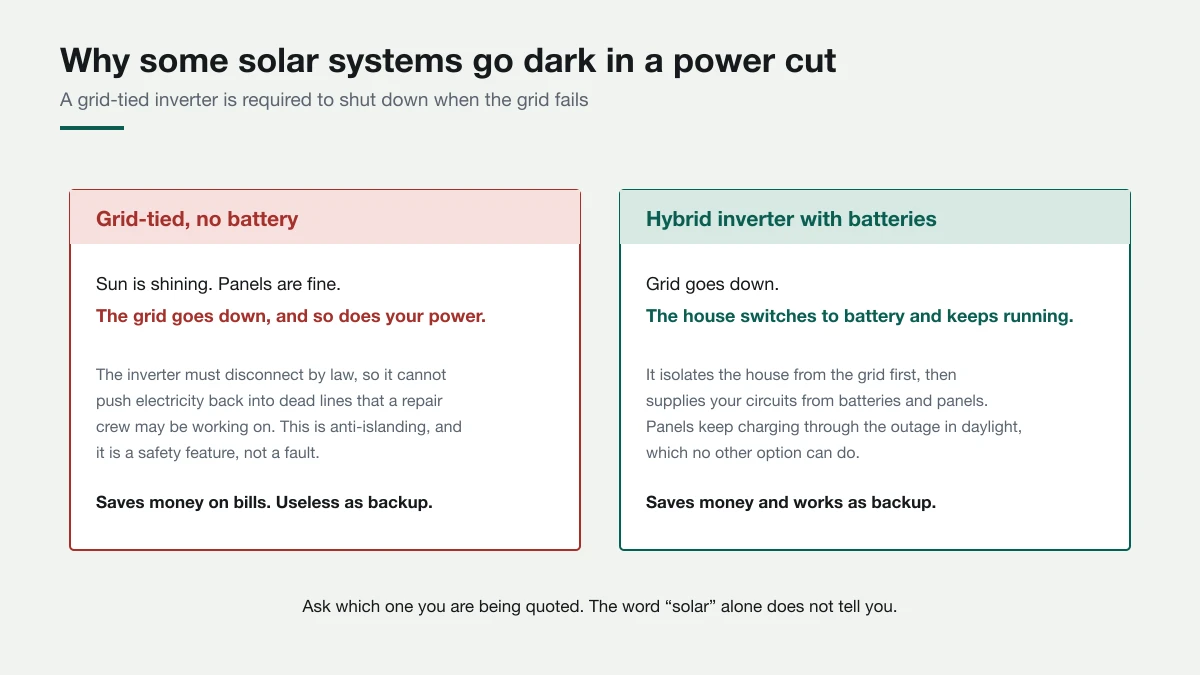
A plain grid-tied solar system shuts down during an outage, even in bright sunshine. This is not a fault — inverters are required to disconnect so they cannot energise lines that repair crews may be working on. It is called anti-islanding.
If you want solar that works as backup, you need a hybrid inverter with batteries. That combination isolates the house from the grid, then runs your circuits from batteries while the panels keep charging through the outage.
This one question — "does it keep working when the grid is down?" — separates two very different products that are both sold as "solar".
What it does well: daytime outages especially, because the panels carry the load directly and the batteries barely discharge. Silent, no fuel, and it cuts your normal bill.
What to watch: installation quality matters more than brand, output drops in winter and cloud (see solar producing less power in winter), and there is still a battery replacement cycle eventually.
Which kinds of solar system keep working in a power cut is explained in on-grid vs off-grid vs hybrid solar. A battery charged only from the grid is covered in home battery backup without solar.
Matching it to your situation
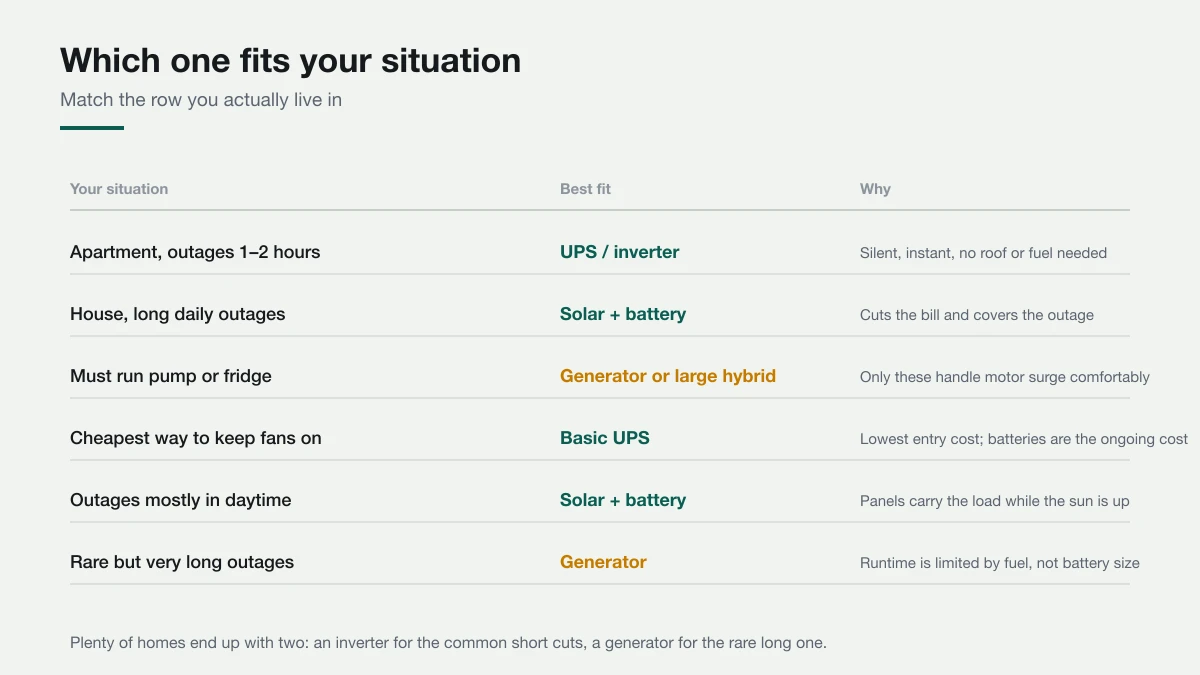
| Your situation | Best fit |
|---|---|
| Apartment, outages of 1–2 hours | UPS / inverter |
| House, long outages most days | Solar + battery |
| Must run a pump or fridge reliably | Generator, or a properly sized hybrid |
| Cheapest way to keep fans and lights on | Basic UPS / inverter |
| Outages mostly during daylight | Solar + battery |
| Rare outages, but very long when they happen | Generator |
Two of them together is often the real answer
Households with serious outage problems frequently end up running a combination, and it is usually the most sensible outcome rather than a compromise:
- Inverter plus generator. The inverter covers the common short cuts silently and automatically; the generator comes out for the rare long one, or when the pump has to run.
- Solar plus inverter. The most common upgrade path — an existing inverter and battery bank gains panels and a hybrid controller, so the same batteries recharge from sun instead of only from the grid.
- Solar plus generator. For places where outages are long, daily, and sometimes overnight in winter.
A decision you can make in five minutes
- Add up your essential load in watts. Under ~500 W means a UPS is viable.
- Time your typical outage. Under two hours favours batteries; six hours or more starts favouring fuel or solar.
- Do you need a motor load — pump, fridge, AC? If yes, a basic UPS is out.
- Can you site an engine safely? No outdoor space at a safe distance means no generator, regardless of everything else.
- Do you have roof access and daytime outages? Both yes points firmly at hybrid solar.
- Count the hours you will actually run backup each month. High numbers make fuel painful and make solar's upfront cost look reasonable.
If you land on batteries, the follow-ups worth reading are how long a full charge takes and lithium vs lead-acid, because battery choice determines most of what your backup will feel like to live with.
Work it out for your own setup
Common questions
Is a UPS or a generator better for home backup?
A UPS or inverter suits essentials such as fans, lights and Wi-Fi through outages of a few hours: silent, automatic and fuel-free. A generator suits heavy loads such as pumps and fridges, and long outages, at the cost of fuel, noise and carbon monoxide risk.
Does solar work during a power outage?
Only with a hybrid inverter and batteries. A plain grid-tied solar system must shut down when the grid fails, even in full sun, so it cannot energise lines that repair crews may be working on.
Which backup option is cheapest to run?
Solar with batteries has the lowest running cost and also cuts your normal bill, but the highest upfront price. A UPS costs mainly battery replacements every three to five years. A generator's fuel cost dominates for anyone with daily outages.
Can I combine an inverter with a generator?
Yes, and it is often the best arrangement: the inverter covers everyday short cuts silently and automatically, and the generator comes out for long outages or heavy loads. Connect the generator through a proper changeover switch, never by back-feeding a socket.