Is It Safe to Run a Computer or TV on a Modified Sine Wave UPS?
A TV usually copes. A modern desktop often will not — active PFC power supplies expect a smooth input. Which devices mind, and how to tell what you have.
The blanket answers are both wrong. "Modified sine wave destroys electronics" is scaremongering, and "it's fine, everyone does it" ignores a real failure mode that has become more common, not less.
The honest position: a television usually runs on it without trouble. A modern desktop computer often will not — and the reason is a change in how power supplies are built.
What the waveform difference actually is
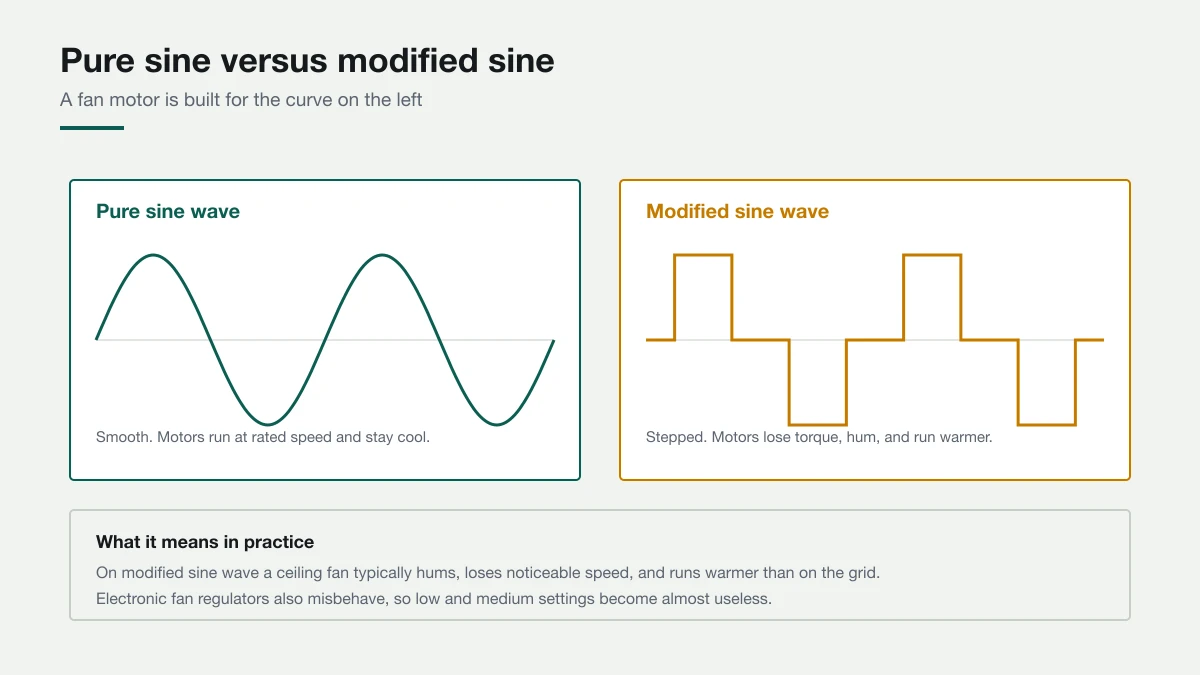
Grid power is a smooth sine wave. A modified sine wave inverter produces a stepped approximation — cheaper to build, and adequate for a great many things.
Simple loads do not care. A heating element, an LED bulb or a phone charger sees an approximately correct average voltage and behaves normally. The trouble starts with devices that do something clever with the incoming waveform.
Which devices actually mind
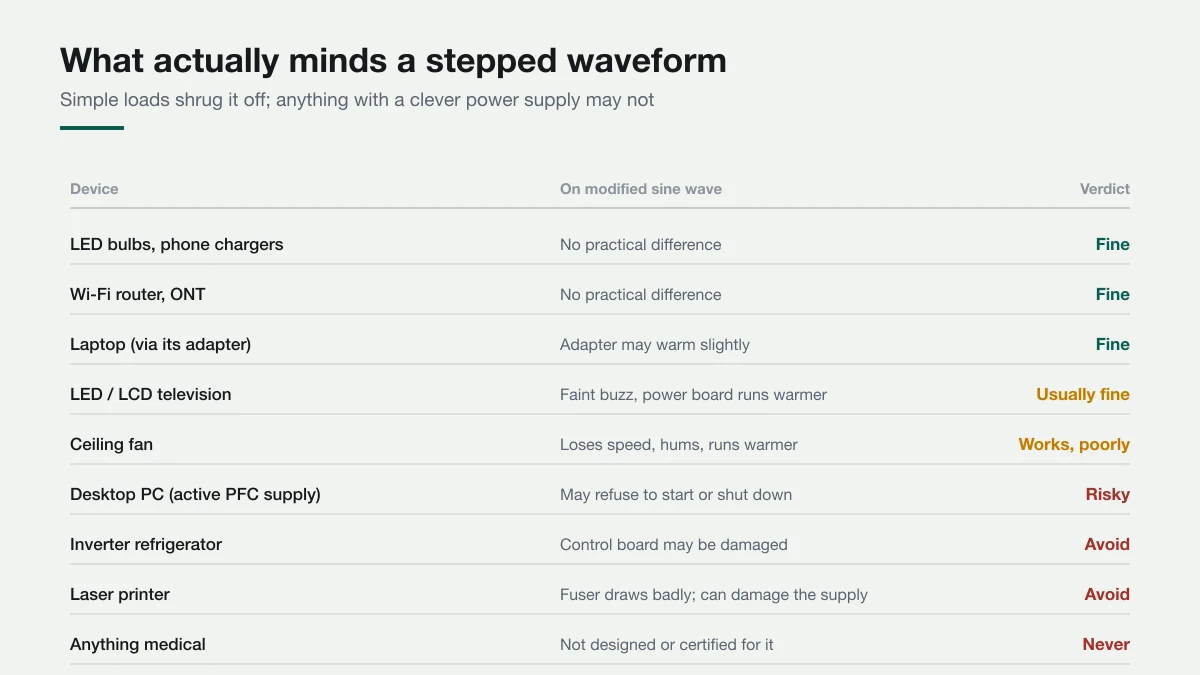
| Device | On modified sine wave | Verdict |
|---|---|---|
| LED bulbs, phone chargers | No practical difference | Fine |
| Wi-Fi router, ONT | No practical difference | Fine |
| Laptop via its adapter | Adapter may warm slightly | Fine |
| LED / LCD television | Faint buzz, power board warmer | Usually fine |
| Ceiling fan | Loses speed, hums, runs warmer | Works, poorly |
| Desktop PC with active PFC | May refuse to start or shut down | Risky |
| Inverter refrigerator | Control board may be damaged | Avoid |
| Laser printer | Fuser draws badly | Avoid |
| Anything medical | Not designed or certified for it | Never |
Laptops are the safe answer. The adapter is an isolated switch-mode supply with a wide input tolerance, and the battery buffers everything anyway. If you have the choice between running a desktop and a laptop on backup, the laptop is not a compromise — it is simply better suited.
The modern problem: active PFC
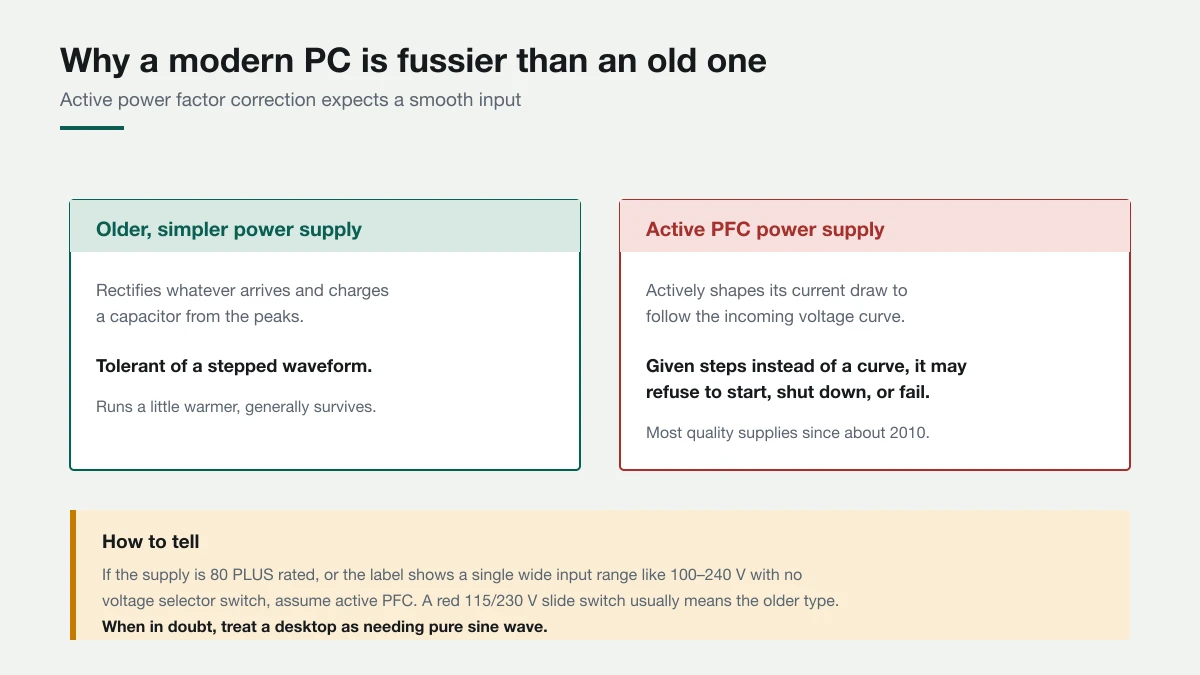
Older PC power supplies simply rectified whatever arrived and charged a capacitor from the peaks. Crude, tolerant, and largely indifferent to a stepped waveform.
Power supplies with active power factor correction work differently. They actively shape their current draw to follow the incoming voltage curve, which is what makes them efficient and well-behaved on the grid. Fed steps instead of a curve, that circuit can misbehave — refusing to start, shutting down under load, or in some cases failing.
This is why advice from fifteen years ago does not transfer. Nearly every 80 PLUS-rated supply sold since around 2010 uses active PFC, so newer, better power supplies are the ones more likely to object.
How to tell what you have: if the supply is 80 PLUS rated, or its label shows a single wide input range like 100–240 V with no voltage selector, assume active PFC. A red 115/230 V slide switch on the back usually indicates the older, more tolerant design. When in doubt, treat a desktop as needing pure sine wave.
Televisions: usually fine, worth watching
Most LED and LCD televisions run on modified sine wave without complaint, which is why so many households do it daily.
Things to watch for over time:
- A faint hum or buzz from the set or its external adapter
- The power board area running noticeably hotter than on grid power
- The TV restarting when battery voltage sags late in an outage
- A power supply that fails earlier than you would expect
Larger and smarter sets carry more electronics and tend to be less tolerant.
A simple test: run the TV for 30–45 minutes on backup, then feel the back near the ventilation slots. Much hotter than after the same time on grid power is a genuine warning. Listen for buzzing too — a transformer that hums on backup and is silent on the grid is telling you something.
One thing that misleads people: your meter
If you measure inverter output with an inexpensive multimeter, the reading may be wrong. Average-responding meters are calibrated assuming a sine wave, and a stepped waveform breaks that assumption — readings can be off by 10% or more in either direction.
Only a true-RMS meter reads modified sine wave correctly. If you are diagnosing a voltage problem and the numbers look strange, suspect the meter before the inverter.
What actually goes wrong, and how fast
Modified sine wave rarely destroys anything instantly. The realistic failure is cumulative heat in a power supply that was designed for smooth input, shortening its life over months of daily use.
That distinction matters for the decision. Occasional short outages? The exposure is small. Four hours every evening, every day? That is the pattern where power supplies start failing early, and where a pure sine wave inverter stops being a luxury.
What to do about it
If your outages are short and occasional, a modified sine wave unit running a TV, router and lights is a reasonable arrangement. Keep desktops off it.
If you run backup for hours daily, a pure sine wave inverter is the right answer. It also fixes fans running slow and humming, and makes running a refrigerator viable — so it usually solves three complaints at once.
If replacing the inverter is not on the table:
- Use a laptop instead of a desktop on backup
- Keep the TV off backup during long outages, or accept the shortened power-supply life
- Never put a laser printer or an inverter refrigerator on it
- Watch for heat and buzzing as your early warning
If you are buying now, buy pure sine wave. The price gap has narrowed considerably, and it removes an entire category of problem — including compatibility with modern appliances that increasingly assume clean power.
Quick reference
Safe: LED lights, routers, phone chargers, laptops.
Usually fine, monitor for heat: televisions, small electronics.
Works badly: ceiling fans — slower, humming, warmer.
Avoid: desktops with active PFC, inverter refrigerators, laser printers, anything medical.
If most of what you run falls in the last two rows, the inverter is the wrong tool for your household rather than a bargain.
Work it out for your own setup
Common questions
Can a modified sine wave UPS damage my TV?
Rarely straight away. Most LED and LCD TVs run on it, but the power supply can run warmer and buzz, and daily hours of use can shorten its life. Check the back of the set after 30–45 minutes on backup: noticeably hotter than on grid power is a warning.
Why does my desktop PC shut down on a modified sine wave UPS?
Most modern PC power supplies use active power factor correction, which shapes their current draw to follow a smooth sine wave. Fed a stepped waveform, it can refuse to start or shut down under load. A pure sine wave inverter solves it; a laptop is the simple alternative.
How can I tell if my inverter is pure sine wave?
The specification label or manual says so. A practical clue: if ceiling fans hum and run noticeably slower on backup than on grid power, the inverter is very likely modified sine wave.
Is it safe to charge a laptop from a modified sine wave inverter?
Yes. A laptop adapter tolerates a wide range of input and the laptop's own battery buffers everything, which makes a laptop one of the safest things to use on backup.