Solar Panels Producing Less Power in Winter – Is It Normal?
Yes — expect roughly half of summer output. The sum that tells you whether your drop is normal, or whether dust, shading or settings cost you more.
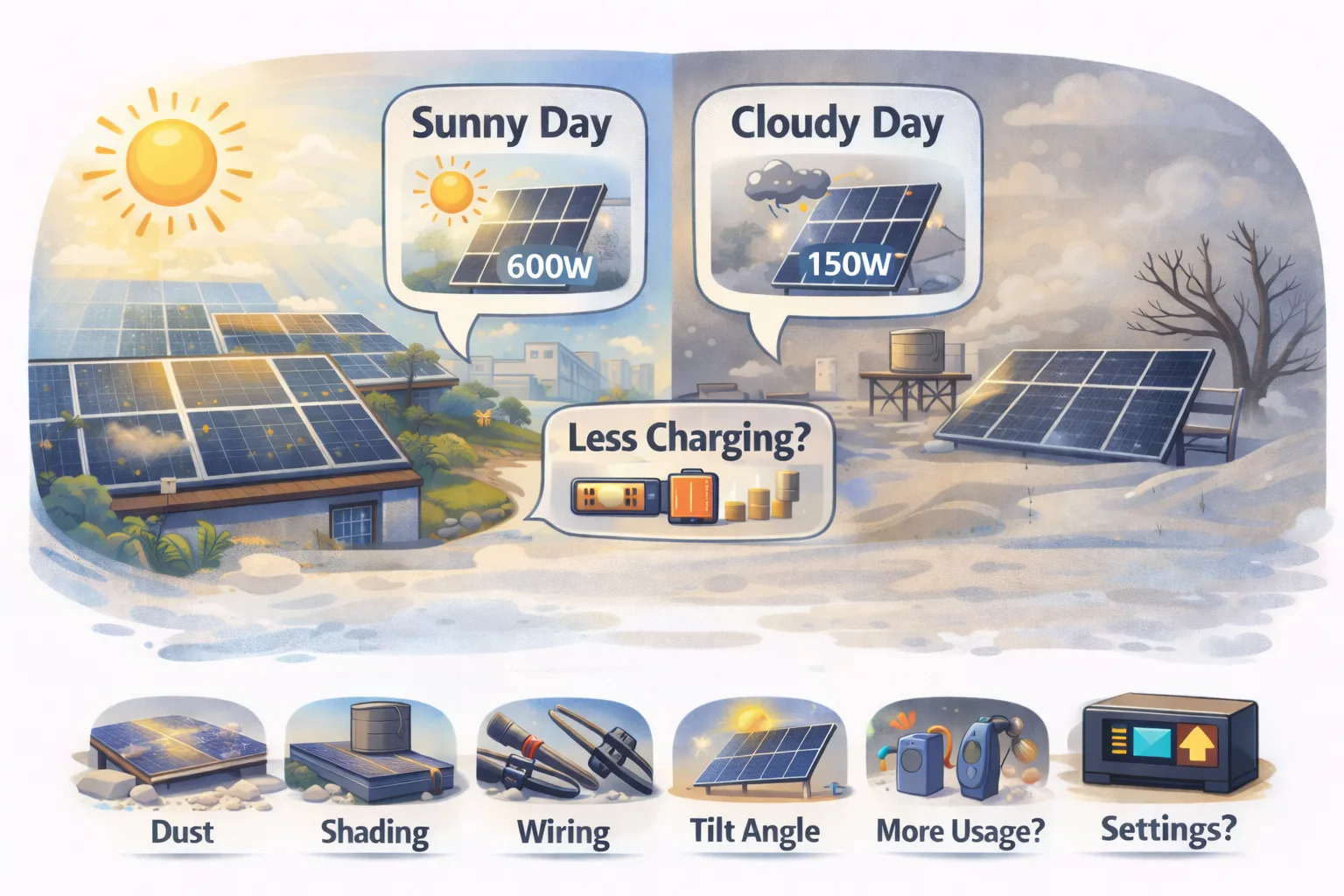
Yes, it is normal — and the useful question is how much. Roughly half of your midsummer output on a clear winter day is expected. Down to a quarter or less means something fixable is costing you more than the season is.
There is a sum that settles it in two minutes, and it is worth doing before assuming the panels are faulty.
What the seasonal drop actually looks like
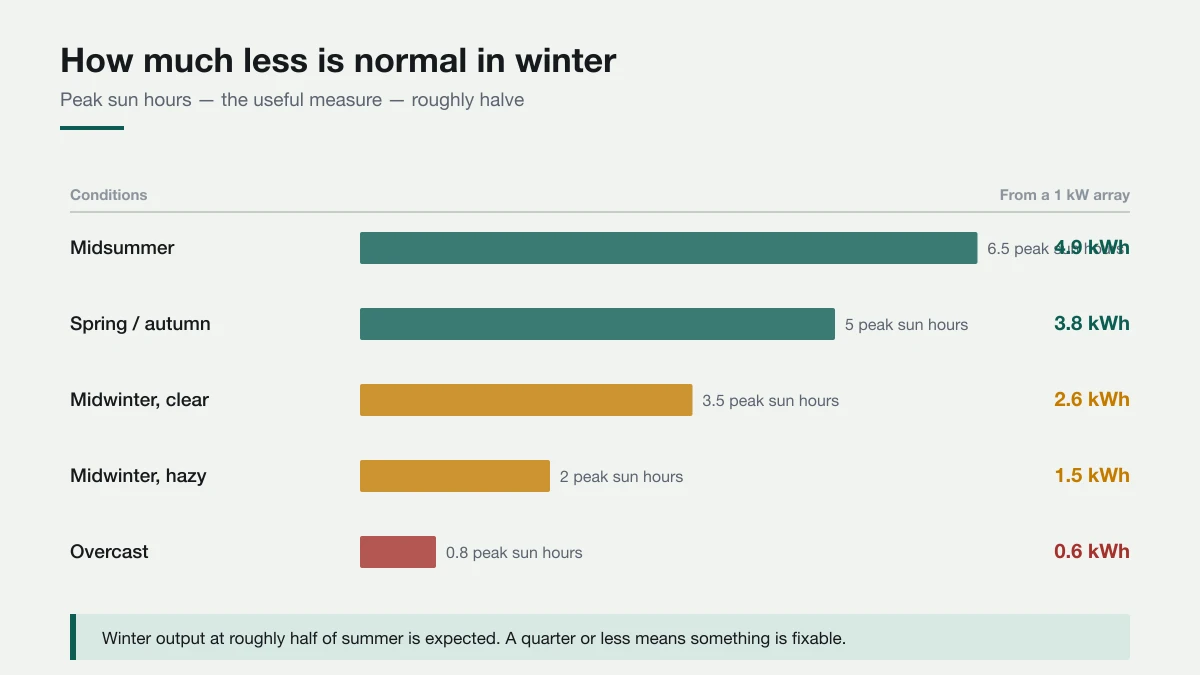
The measure that matters is peak sun hours — not hours of daylight, but the equivalent hours of full-strength sun the array receives.
| Conditions | Peak sun hours | From a 1 kW array |
|---|---|---|
| Midsummer | 6.5 | 4.9 kWh |
| Spring / autumn | 5.0 | 3.8 kWh |
| Midwinter, clear | 3.5 | 2.6 kWh |
| Midwinter, hazy | 2.0 | 1.5 kWh |
| Overcast | 0.8 | 0.6 kWh |
Three things stack up in winter: fewer hours, a lower sun angle so light passes through more atmosphere, and haze. None of them is a fault.
The part that surprises people: cold helps
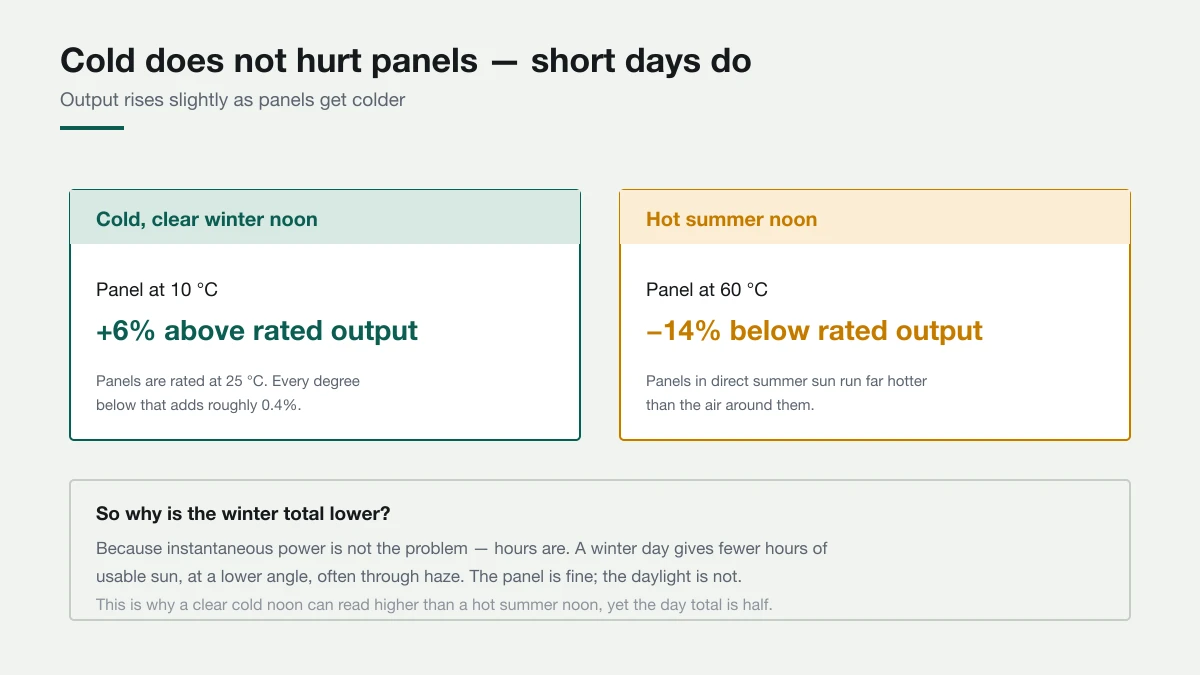
Solar panels are more efficient when cold. They are rated at 25 °C, and output rises roughly 0.4% for every degree below that. A panel at 10 °C on a clear winter noon can read about 6% above its rating — while the same panel at 60 °C in July sits around 14% below it.
So a clear cold day can show a higher instantaneous reading than a hot summer day, even though the day's total is half. The panel is not weaker in winter. The daylight is.
This is why "it's cold, so solar doesn't work" is wrong, and why a low midday reading on a clear winter day genuinely does point to a problem rather than the season.
Check whether your drop is normal
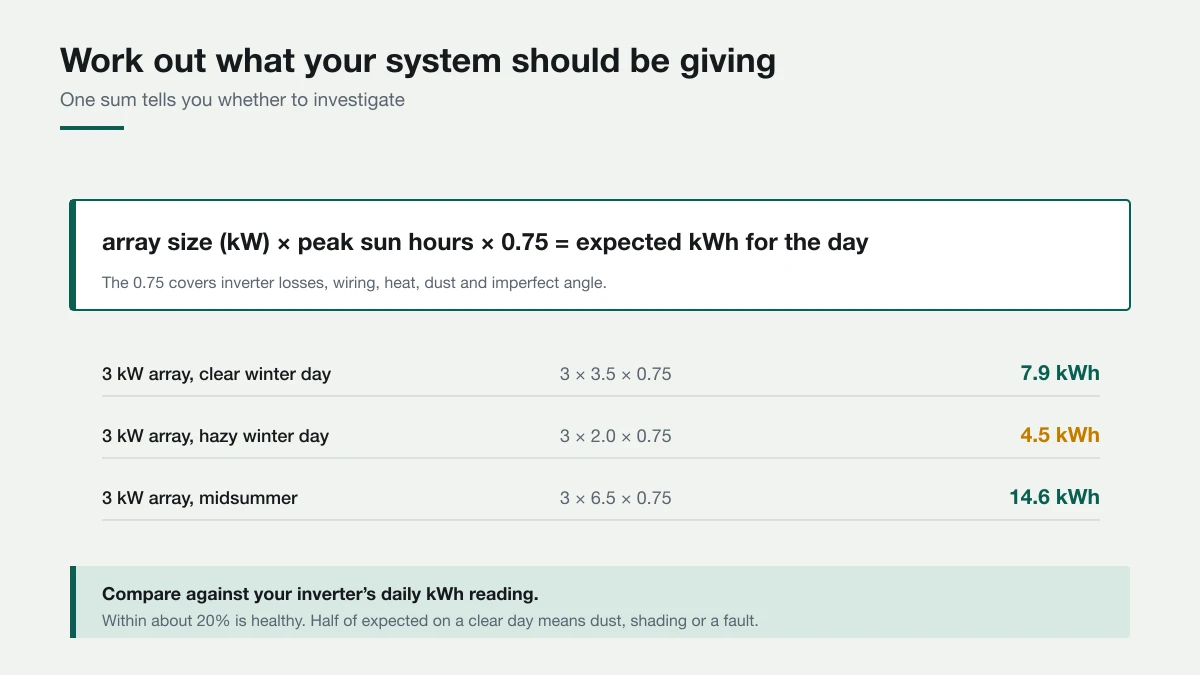
Array size (kW) × peak sun hours × 0.75 = expected kWh for the day.
A 3 kW array on a clear winter day: 3 × 3.5 × 0.75 = 7.9 kWh. On a hazy one: 3 × 2.0 × 0.75 = 4.5 kWh.
Compare that against the daily total your inverter reports. Within about 20% is healthy. Getting half of expected on a genuinely clear day is worth investigating, and the causes below are in the order they are usually found.
Cause 1: dust on the panels
The most common and the easiest to fix. Soiling typically costs 5–15%, and considerably more in dusty regions or where winter fog binds dust into a film that does not blow off.
Clean in the early morning or late afternoon, never on hot glass. Plain water and a soft cloth or brush. No harsh chemicals, no abrasive pads, and do not stand on the panels.
A quick test: clean one panel and leave the rest, then compare the inverter's reading before and after. If it jumps, you have found your answer and a cleaning schedule is worth more than any equipment.
Cause 2: winter shadows that did not exist in summer
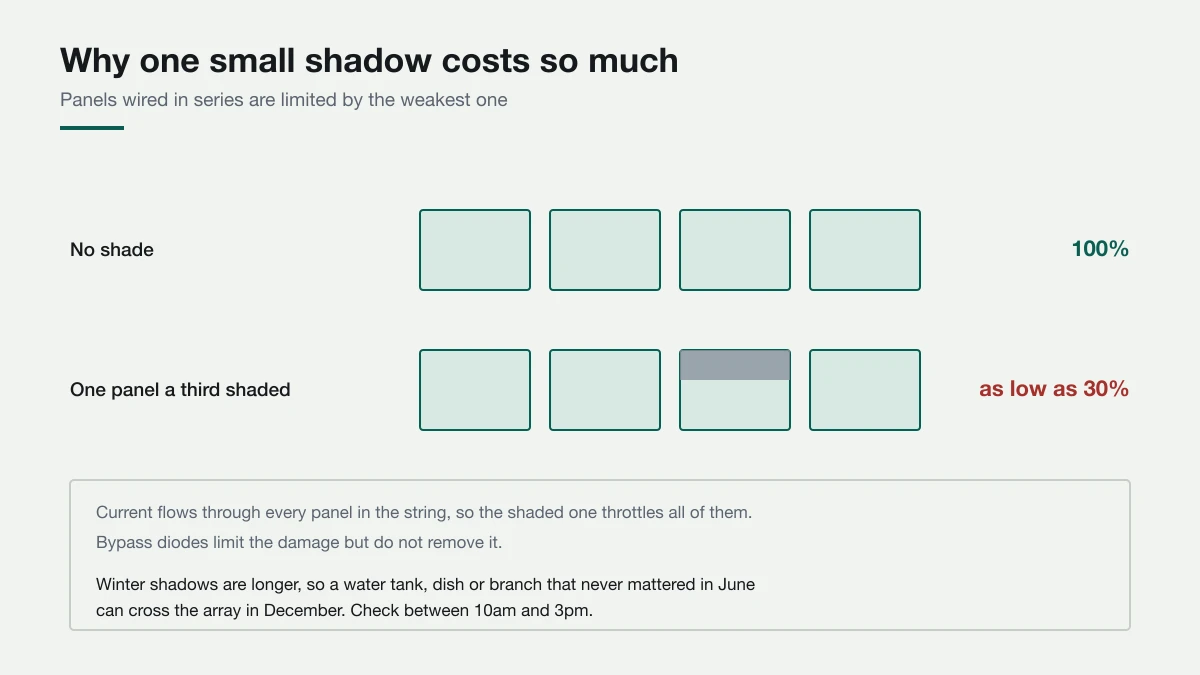
This is the cause people most often miss, because the array was fine when it was installed.
Panels wired in series share a single current path, so a shaded panel limits every panel in the string. Bypass diodes reduce the damage but do not remove it — shading a third of one panel can drop the string far more than a third.
The low winter sun casts much longer shadows. A water tank, dish antenna, parapet wall, clothesline or tree branch that cleared the array in June can cross it in December.
Go and look between 10am and 3pm on a clear day. That is the only reliable way to find it. Trim what can be trimmed, move what can be moved, and if the obstruction is permanent, ask your installer about re-stringing or panel-level optimisers.
Cause 3: inverter settings
Hybrid inverters have priority modes — solar first, utility first, battery first — plus charge current limits and time schedules. Wrong settings make solar look weak when the inverter is simply preferring the grid.
Worth confirming:
- Is solar set as the priority source?
- Is battery charging from solar actually enabled?
- Is the charge current capped low?
- Is there a schedule limiting when it charges?
If someone changed settings recently, that is the first place to look.
Cause 4: your usage moved, not your production
Winter changes when you use power. Longer evenings mean more hours of lighting after dark, which is exactly when solar contributes nothing and the batteries carry everything.
That feels like weak solar, but it is a load pattern problem. The fix is to move what you can into daylight: laundry, pumping water into a tank, charging devices. Every unit used while the sun is up is a unit the batteries do not have to store and give back at a loss.
Cause 5: connections
Loose or corroded MC4 connectors, damaged insulation and poor terminals all cost output, and they get worse in wet weather.
Look for corrosion, connectors that are not fully seated, damaged cable, and any burnt smell or discolouration near the inverter terminals. If you see melting or scorching, stop and call a technician — DC arcing is a fire risk and is not a DIY repair.
Three myths worth retiring
"Panels don't work in winter." They work. They produce less because the day is shorter and the light weaker, not because the panels stop.
"Cold reduces output." The opposite, as above. Heat is what costs you efficiency.
"Low output means faulty panels." Panel failure is rare. Dust, shading and settings account for the large majority of complaints.
Getting more out of the winter you have
- Clean more often — every two to four weeks in a hazy or dusty area
- Clear the shadows you can reach
- Shift heavy use into daylight — pumps, laundry, charging
- Trim the evening load, since winter nights are long and the batteries carry them alone
- Ask about winter tilt. Optimal tilt is roughly your latitude, and steeper in winter helps; the solar tilt angle calculator gives the year-round and winter angles for where you live. Only adjust if the mounting is designed for it and it can be done safely.
If the batteries are what is really struggling rather than the panels, why an inverter battery drains fast overnight and how long a full charge takes are the places to look next.
When to call a technician
- Output far below expected on a clear day at noon
- PV errors, or the inverter disconnecting repeatedly
- Connectors that look burnt, or cables that get hot
- A sudden drop with no change in weather
Ask them to check string voltage and current against specification, MPPT configuration, connector quality, and whether the string layout still suits the shading you now have.
Work it out for your own setup
Learn it by playing
Common questions
How much less do solar panels produce in winter?
About half of midsummer output on a clear winter day is normal, because there are fewer peak sun hours and the sun is lower. Output down to a quarter or less on a clear day points to dust, shading or settings rather than the season.
How do I work out what my solar panels should produce today?
Array size in kW × peak sun hours × 0.75. A 3 kW array on a clear winter day with 3.5 peak sun hours should give about 7.9 kWh. If your inverter reports within about 20% of that, the system is healthy.
Do solar panels work better in cold weather?
Yes. Panels are rated at 25 °C and output rises about 0.4% for every degree colder. A clear, cold winter noon can beat a hot summer noon in instantaneous output, even though the day's total is lower.
Why did my solar output drop sharply this winter?
The most common causes are dust, and new shadows from the low winter sun: a tank, parapet or tree that cleared the panels in summer can cross them in winter. Check the array between 10am and 3pm on a clear day, then check the inverter's priority and charging settings.