Lithium Battery vs Lead-Acid for UPS – Is It Worth the Upgrade?
It turns on how often you deep-discharge. Cycle life, usable capacity and charging compared, plus the compatibility checks that catch people out.
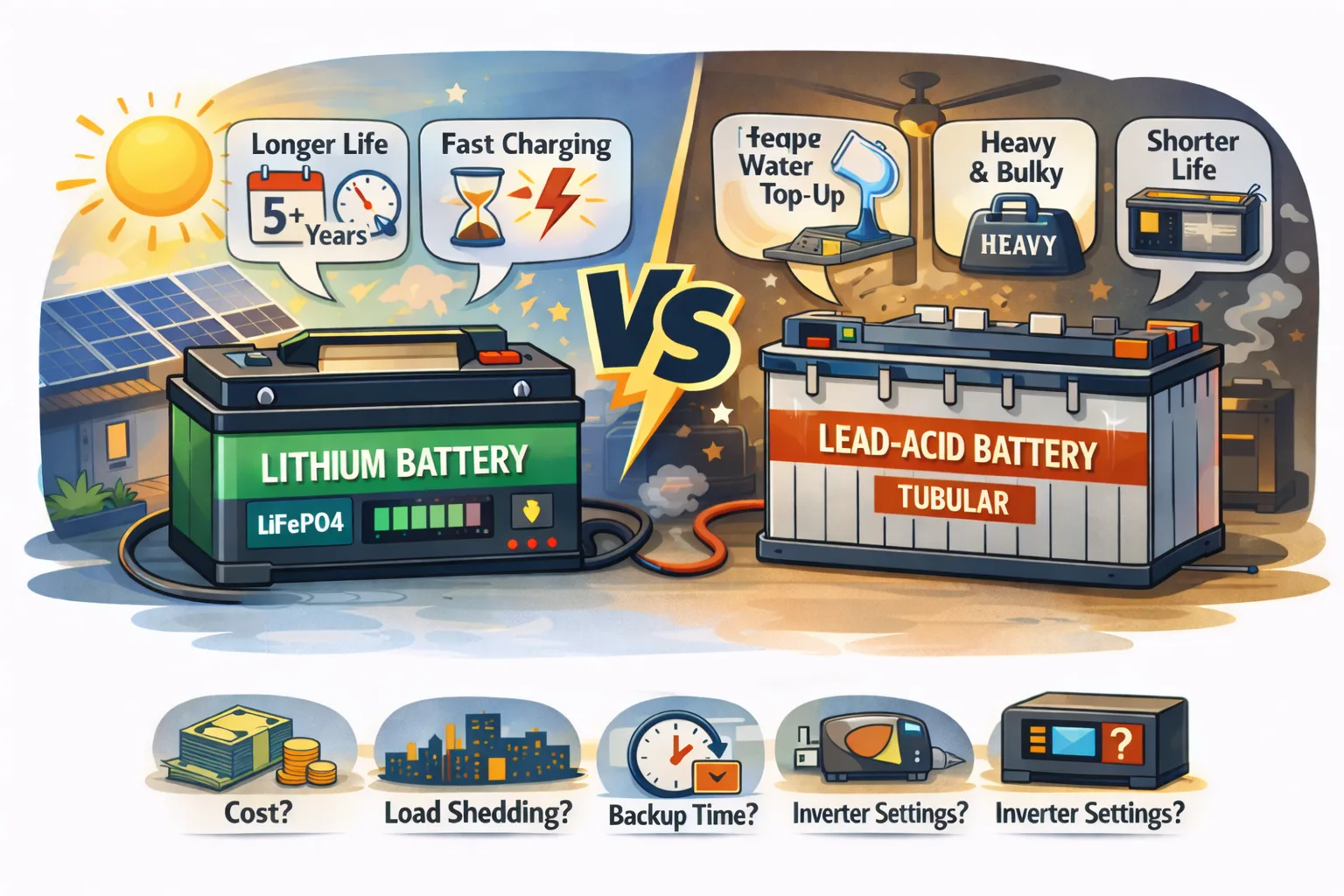
The decision turns on a single question: how often do you drain the battery deeply?
If your backup handles the occasional short cut, a good tubular lead-acid battery is the sensible choice and will last years. If you are flattening it most nights, lead-acid is being consumed at a rate that makes lithium cheaper within a few years — despite costing several times more on the day you buy it.
Here are the numbers behind that.
First: the capacity comparison is misleading
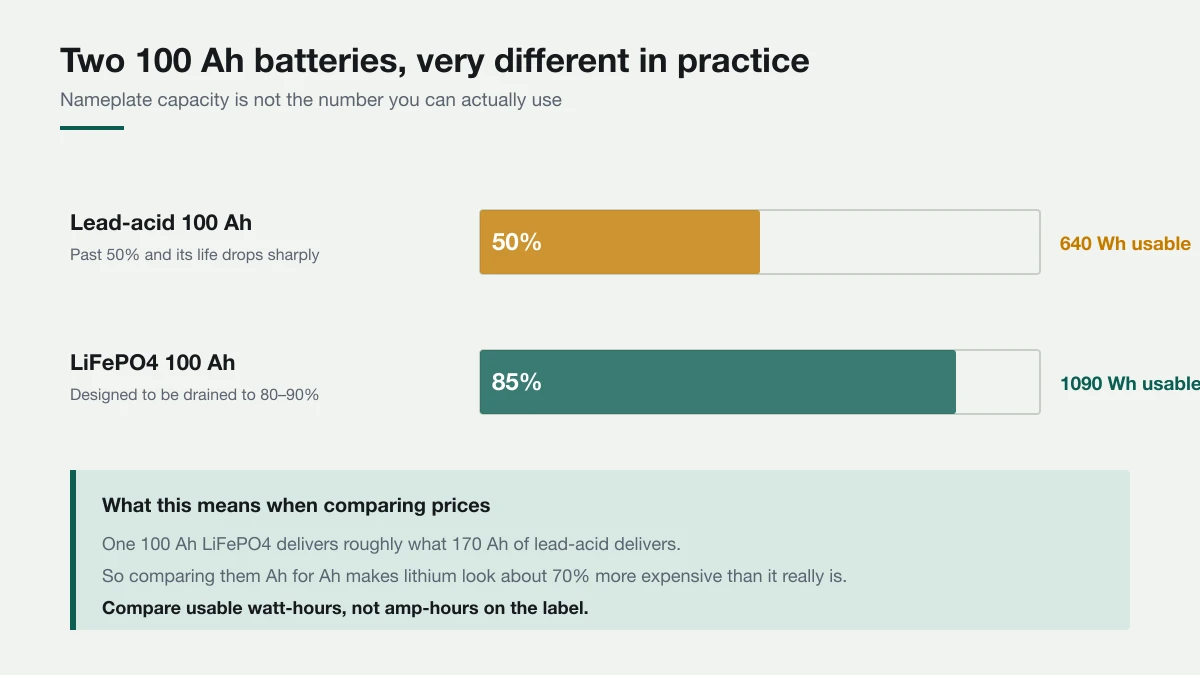
Two batteries both labelled 100 Ah do not hold the same usable energy.
- Lead-acid should not routinely go below 50% state of charge. Usable: about 640 Wh.
- LiFePO4 is designed to be drained to 80–90%. Usable: about 1090 Wh.
So one 100 Ah lithium pack does the work of roughly 170 Ah of lead-acid. Comparing them amp-hour for amp-hour makes lithium look about 70% more expensive than it actually is. Compare usable watt-hours.
The number that decides the economics: cycle life
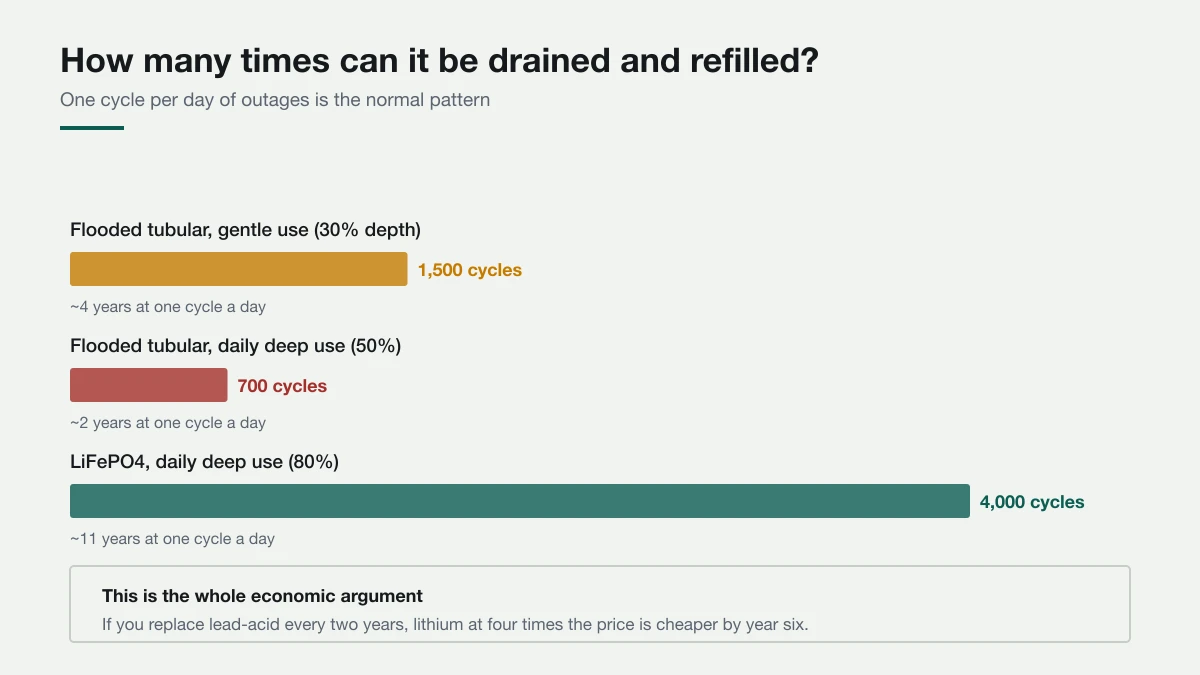
A cycle is one meaningful discharge and recharge. Daily outages mean roughly one cycle a day, which turns cycle ratings into years:
| Battery and usage | Cycles | Roughly |
|---|---|---|
| Tubular, gentle use (30% depth) | ~1500 | 4 years |
| Tubular, daily deep use (50% depth) | ~700 | 2 years |
| LiFePO4, daily deep use (80% depth) | ~4000 | 11 years |
Note what depth does to lead-acid: the same battery lasts twice as long if you only take a third out of it. That is the single biggest lever on lead-acid life, and it is why a bank sized generously outlives a bank sized tightly.
The arithmetic that matters: if you are replacing lead-acid every two years, lithium at four times the price has paid for itself somewhere around year six — and then keeps going.
If you are replacing lead-acid every four or five years, that crossover moves out far enough that lead-acid remains the better financial call.
Charging behaviour, and why lead-acid never feels full
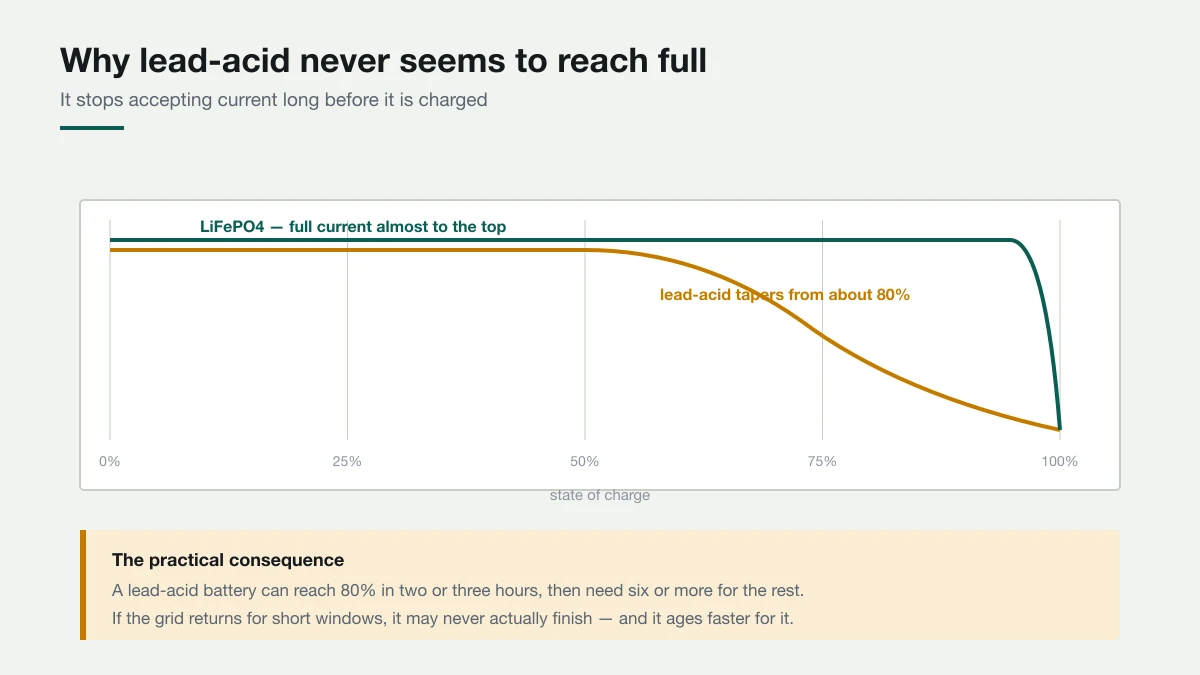
Lead-acid accepts charge quickly up to about 80%, then the rate collapses. The last fifth can take six hours or more, and it cannot be rushed — pushing harder just gasses the electrolyte away, which is the subject of why battery water runs out so fast.
Where the grid returns only in short windows, a lead-acid battery may never actually finish charging. It starts each outage below full, gets drained deeper as a result, and ages faster. Many "the battery is weak" complaints are really this.
LiFePO4 accepts close to full current almost to the top, so a two-hour window of grid power puts back a genuinely useful amount. In areas with fragmented supply, that alone can matter more than cycle life. Full detail in how long it takes to fully charge an inverter battery.
The other practical differences
Voltage under load. Lead-acid sags as it discharges and as load rises, which is why fans slow down toward the end of a long outage. LiFePO4 holds a nearly flat voltage until it is almost empty, so performance stays consistent.
High discharge rates. Lead-acid delivers noticeably less than its rating when discharged quickly — a 150 Ah battery run hard behaves like a smaller one. Lithium is far less affected, so heavy loads get closer to the advertised capacity.
Round-trip efficiency. Lead-acid returns about 80–85% of what you put in; LiFePO4 around 95%. On solar that difference compounds daily.
Maintenance. Flooded lead-acid needs water checks, terminal cleaning and ventilation for hydrogen. Lithium is sealed with none of that.
Weight and space. Lithium is roughly a third of the weight for the same usable energy, which matters on an upper floor or in an apartment.
Heat. Both dislike it, but lead-acid loses water and life to it, while a decent BMS gives lithium some self-protection. Neither belongs in a sealed cabinet — see inverter and battery overheating.
Cold. One point in lead-acid's favour: LiFePO4 must not be charged below 0 °C. Packs sold for cold climates include low-temperature protection or internal heating, but a plain pack in an unheated space in winter is a genuine limitation.
When lithium is worth it
- Outages are long and daily, so the bank is deeply cycled most nights
- You are replacing lead-acid every one to two years
- The grid returns in short windows, so slow charging is costing you real capacity
- You have solar, where the efficiency and depth advantages compound
- Weight or space is a constraint
- You want to stop watering batteries entirely
When lead-acid still makes sense
- Outages are occasional and short, and the bank rarely drops below 70%
- The load is modest — a couple of fans, lights, Wi-Fi
- Budget is tight. Buying lithium at the cost of fixing bad wiring or undersized cable is the wrong order — bad wiring wastes any battery
- Your inverter cannot charge lithium correctly and replacing it is not on the table
The mistake that ruins lithium upgrades
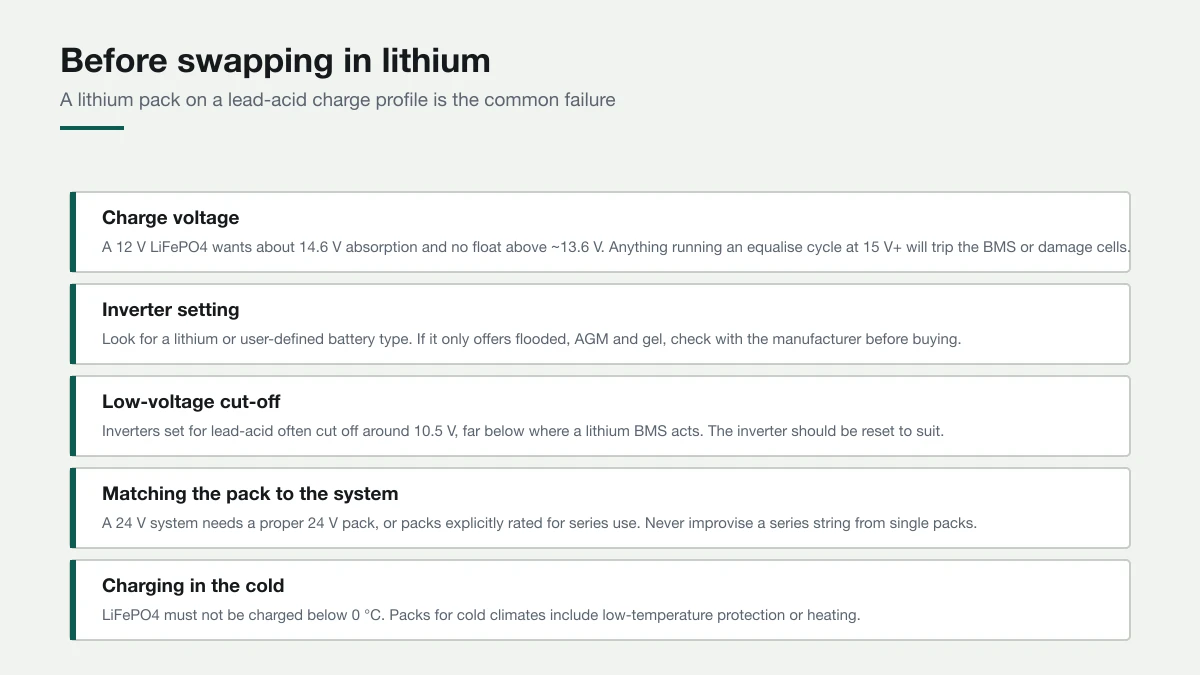
A lithium upgrade is not a battery swap. The charger has to change with it.
- Charge voltage. A 12 V LiFePO4 wants around 14.6 V absorption and no sustained float above ~13.6 V. Any inverter running an equalise cycle at 15 V or more will trip the BMS or damage cells.
- Battery type setting. Look for a lithium or user-defined profile. If the inverter only offers flooded, AGM and gel, check compatibility before buying.
- Low-voltage cut-off. Inverters set for lead-acid often cut out near 10.5 V, well past where a lithium BMS intervenes. Letting the BMS do the protecting means abrupt blackouts instead of a warning.
- Pack voltage. A 24 V system needs a proper 24 V pack, or packs explicitly rated for series connection. Do not improvise a series string from packs that were not designed for it.
Symptoms of getting this wrong: the pack never reaches full, the state-of-charge display is nonsense, and the system cuts out suddenly because the BMS disconnected to protect itself.
Tubular, sealed (dry) and lithium batteries are compared side by side in which battery is best for a UPS.
Three checks before you decide
1. How deep do you actually go? If your inverter reaches its low-battery alarm most nights, you are deep-cycling daily and lead-acid is being consumed fast. That is the strongest single argument for lithium.
2. What does a fixed load actually give you? Fully charge, then run one fan, the router and two lights, and time it. Compare against what you got a year ago. A large drop means the existing battery is already near the end, which changes the maths — you are choosing a replacement, not an upgrade.
3. Is the wiring sound? During an outage, carefully feel the battery cables near the terminals. Warm is acceptable; hot means loose terminals, undersized cable or overload. Fix that first — it wastes energy and shortens the life of whatever battery you buy.
The short version
Short, occasional outages: keep lead-acid, and size the bank generously so you rarely go below 50%. That alone doubles its life.
Long daily outages, short charging windows, or a replacement cycle you are tired of: lithium usually wins on total cost within about five to six years, and on daily behaviour immediately. Just confirm the inverter can charge it properly before you buy.
Work it out for your own setup
Learn it by playing

Common questions
Is a lithium battery worth it for a home inverter?
If you drain the battery deeply most days and replace lead-acid every one to two years, usually yes: LiFePO4 at around four times the price tends to pay for itself by about year five or six and keeps going. For occasional short outages, a generously sized tubular lead-acid battery remains the better value.
Can I use a lithium battery with my existing inverter?
Only if its charging can be set for lithium. A 12 V LiFePO4 pack wants about 14.6 V absorption, no sustained float above about 13.6 V and no equalise cycle. Look for a lithium or user-defined battery profile before buying; an inverter offering only flooded, AGM and gel settings may not charge it properly.
How long does a LiFePO4 battery last compared with lead-acid?
Cycled daily, a LiFePO4 battery rated for about 4000 cycles at 80% depth lasts around eleven years. A tubular lead-acid battery cycled to 50% daily manages about 700 cycles, roughly two years, or around four years at gentle 30% depth.
Is a 100 Ah lithium battery the same as 100 Ah lead-acid?
No. You can use 80–90% of a lithium battery but only about half of a lead-acid one, so a 100 Ah LiFePO4 pack does the work of roughly 170 Ah of lead-acid. Compare usable watt-hours, not amp-hours.