Home Battery Backup Without Solar: Does It Make Sense?
Yes, for outages: a grid-charged battery runs the essentials with no fuel or noise. How to size one, what it costs to run, and your options.
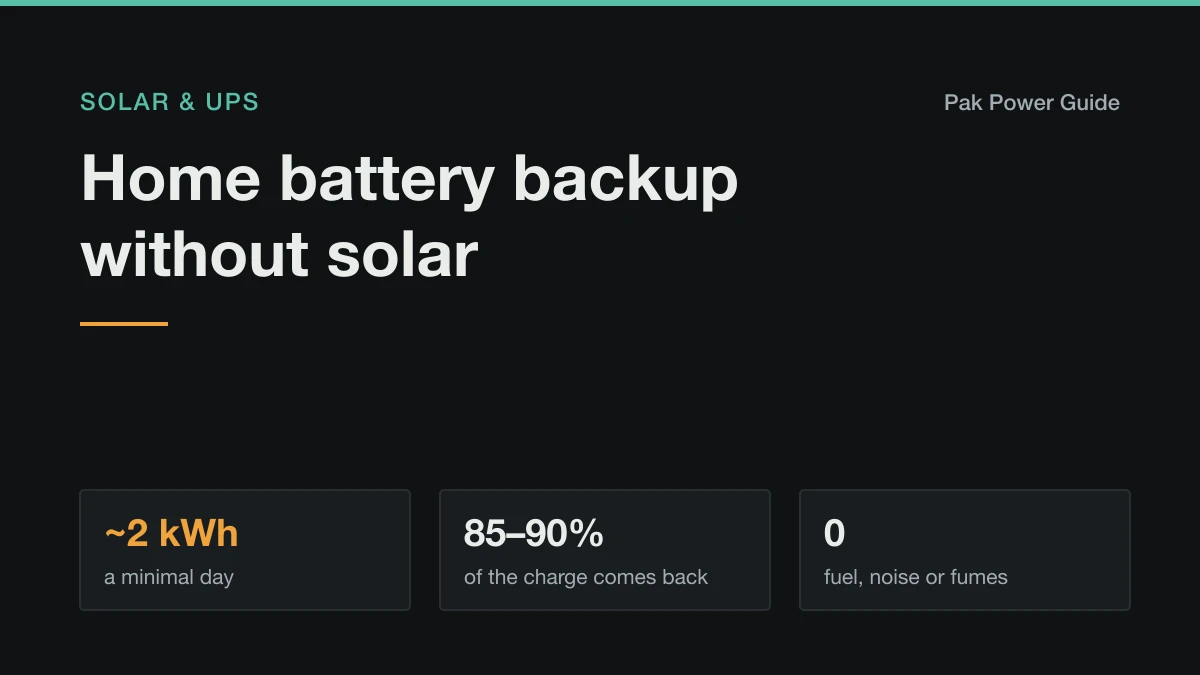
A battery does not need solar panels. It charges from the grid while the power is on, and takes over the instant it fails: no fuel, no noise, no fumes, and nothing to start. Solar can be added later. For outage backup alone, a grid-charged battery is often the simplest answer there is.
What it is good for
- Outages of a few hours to a day. Fridge, lights, internet, phones, a CPAP, a furnace blower or fans.
- Homes where a generator is impractical: apartments, dense streets, anyone who cannot store fuel or run an engine safely outdoors.
- Time-of-use tariffs, where you can charge cheaply at night and use the energy at the evening peak.
What it is not good for is running heating, cooling or cooking for long. A 1500 W space heater, a central AC or an electric oven empties even a large home battery in a few hours.
Your options
| Option | Typical size | Switches over | Best for |
|---|---|---|---|
| Portable power station | 0.5–5 kWh | Instantly to 30 ms, if it has a UPS mode | Apartments, a few essentials, taking it with you |
| Home inverter with a battery bank | 1–10 kWh | 10–20 ms | Fans, lights and a fridge on a backup circuit; the standard answer across South Asia |
| Whole-home battery system | 10–15 kWh per unit, stackable | Automatic, near-instant | Installed essentials or whole-house backup, often with space for solar later |
A home inverter with batteries is by far the cheapest per hour of backup. A whole-home battery is the most seamless, and the most expensive. Prices vary too much between countries to quote, so compare them per kWh of usable capacity. Power station vs home UPS compares the first two in detail.
How to size it
Two numbers, as for any backup system:
- Watts: what must run at the same time. This sets the inverter, including the start-up surge of a fridge, pump or furnace blower. The inverter size calculator works it out from your appliance list.
- Watt-hours: for how long. Running watts × hours, with fridges and freezers counted at about 40% because their compressors cycle.
A minimal day of essentials, meaning a fridge, lights, internet and phone charging, comes to about 2 kWh. Add a furnace blower in winter and it can double. Then allow for losses: about 85% of a battery's stored energy reaches the sockets.
| Usable capacity | At 300 W | At 500 W | At 1000 W |
|---|---|---|---|
| 2.5 kWh | 7 h | 4 h | 2 h |
| 5 kWh | 14 h | 8½ h | 4 h |
| 10 kWh | 28 h | 17 h | 8½ h |
| 13.5 kWh | 38 h | 23 h | 11½ h |
Those assume a lithium battery whose rated capacity is usable. For a lead-acid bank, use about half its nameplate capacity. The backup time calculator does both.
What it costs to run
Charging from the grid costs what the electricity costs, plus the loss: roughly 85–90% of what goes in comes back out. With occasional outages that is pennies. The real cost is the battery itself and its wear, which the generator vs battery cost calculator compares with running a generator through the same outages.
Saving money with a grid-charged battery needs a time-of-use tariff with a gap wide enough to beat the round-trip loss and the wear on the battery. On a flat tariff it is backup, not savings. Incentives for home batteries without solar exist in some places and not others, and they change often, so check what applies where you live before counting on one.
Battery or generator?
| Grid-charged battery | Generator | |
|---|---|---|
| Starts by itself | Yes, in milliseconds | Only with an automatic transfer switch |
| Noise and fumes | None | Loud; deadly carbon monoxide |
| Runs for | As long as its stored energy | As long as it has fuel |
| Indoors | Yes | Never, not even in a garage |
| Upkeep | Almost none | Fuel, oil, regular test runs |
For outages of hours, the battery wins on almost every count. For outages of several days with no sun, a generator, or a battery plus a generator to recharge it, is safer. The storm season guide and the winter outage guide plan for both.
Adding solar later
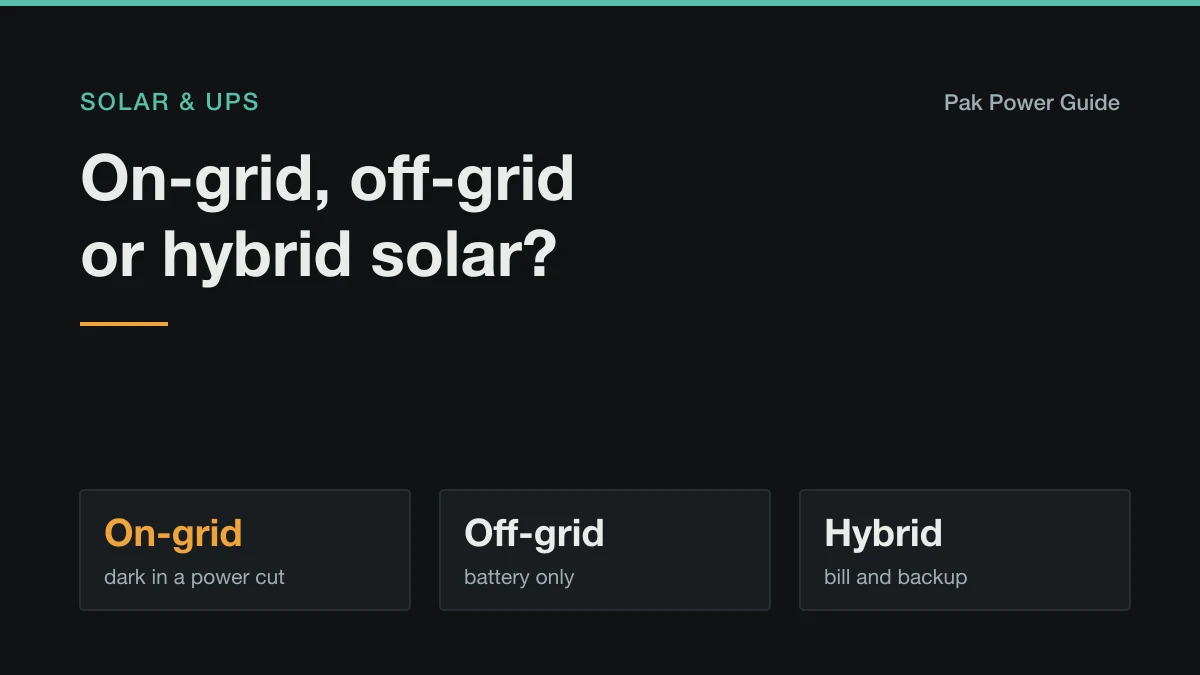
If you might add panels one day, choose a battery system or inverter that accepts solar input, a hybrid, now. Solar turns a battery that only covers outages into one that also cuts the bill and recharges itself during long cuts. On-grid vs off-grid vs hybrid solar explains the choice.
Work it out for your own setup
Common questions
Can you have a home battery without solar panels?
Yes. The battery charges from the grid while the power is on and takes over when it fails. Whole-home batteries, home inverters with battery banks and portable power stations all work this way. Solar is an option you can add later, not a requirement.
How long will a home battery last in a power outage?
Divide the usable capacity by what you run. A 10 kWh battery powering essentials of about 500 W, such as a fridge, lights, router and a few outlets, lasts roughly 17 hours after inverter losses; at 2 kW it lasts about 4 hours. Heating and cooling empty any home battery fast.
Is a battery or a generator better for home backup without solar?
A battery is silent, starts itself in milliseconds, needs no fuel and is safe indoors, but it only lasts as long as its stored energy. A generator runs as long as it has fuel and suits multi-day outages, but it is noisy, needs refuelling and must be run well away from the house because of carbon monoxide.
Does charging a home battery from the grid save money?
Only where electricity is much cheaper at some hours than others. About 85–90% of the energy you put in comes back out, so the peak price has to beat the off-peak price by more than that loss, and the battery wear, before it pays. On a flat tariff a grid-charged battery is backup, not savings.