Can a UPS or Inverter Run a Refrigerator Safely?
Often you do not need to — a closed fridge stays cold for about 4 hours. When you do, it comes down to surge rating, waveform and duty cycle.
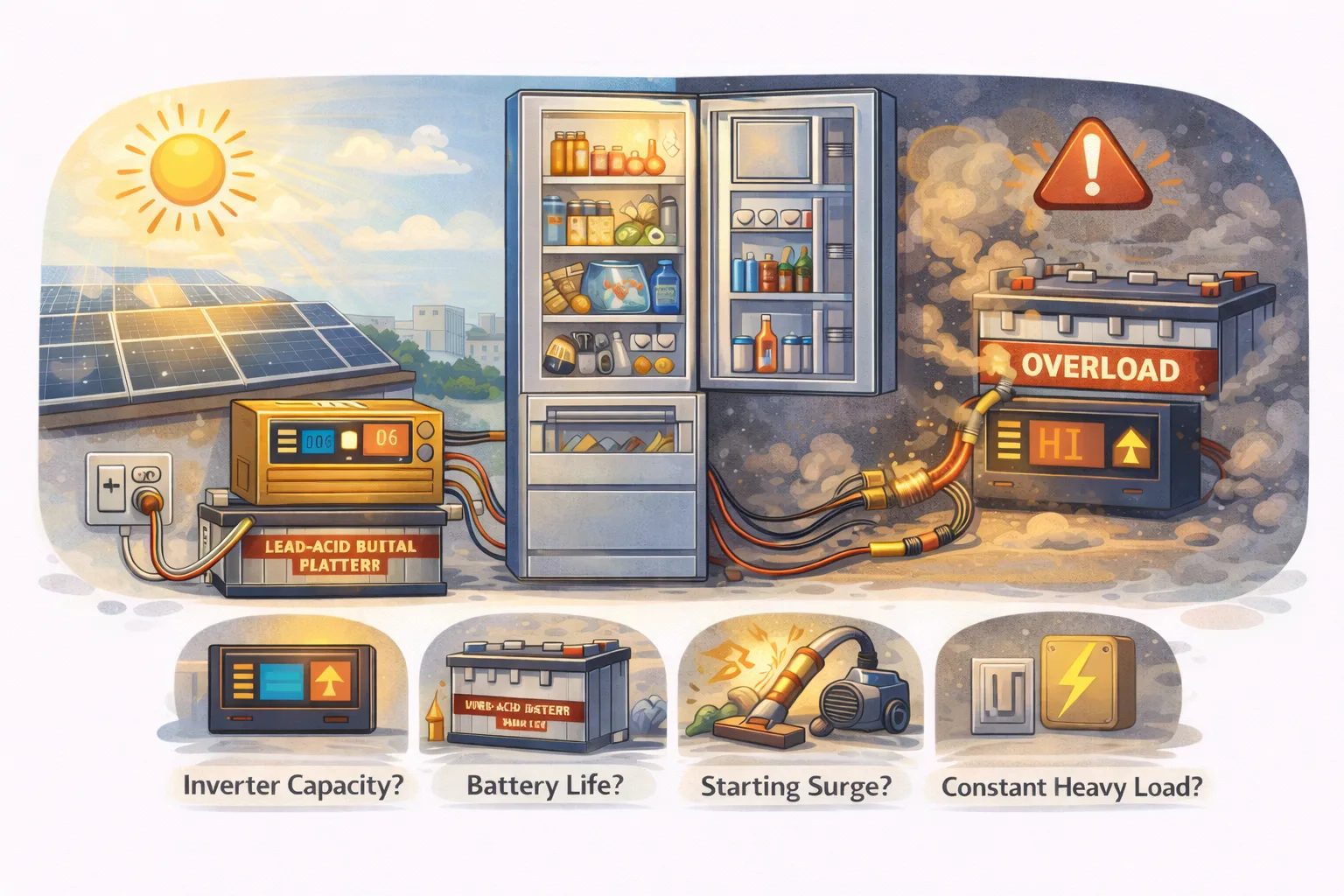
Start with the question behind the question: for most outages you do not need to run the fridge at all.
A closed refrigerator holds food safely for about four hours. A full freezer holds for 48 hours. If your outages are the usual two or three hours, the correct action is to leave the door shut and run nothing.
That said, long or repeated outages are a real problem, and a fridge can be run on backup — if the inverter can meet the surge, the waveform suits the compressor, and the battery bank is big enough.
First, how long you actually have
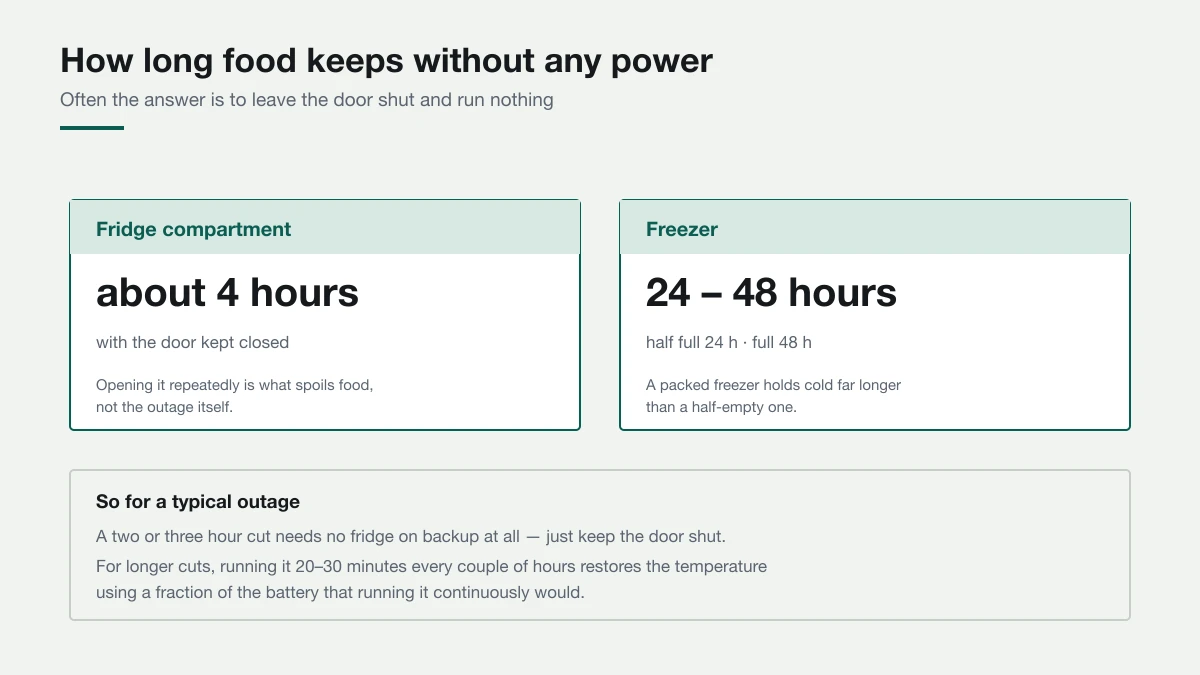
- Fridge compartment: ~4 hours with the door closed
- Freezer, half full: ~24 hours
- Freezer, full: ~48 hours
A packed freezer holds cold far longer than an empty one, which is why filling gaps with bottles of water is worth doing if outages are frequent.
The practical consequence: for anything under about four hours, keeping the door shut costs nothing and works better than a marginal inverter cycling on and off.
The surge is what decides it
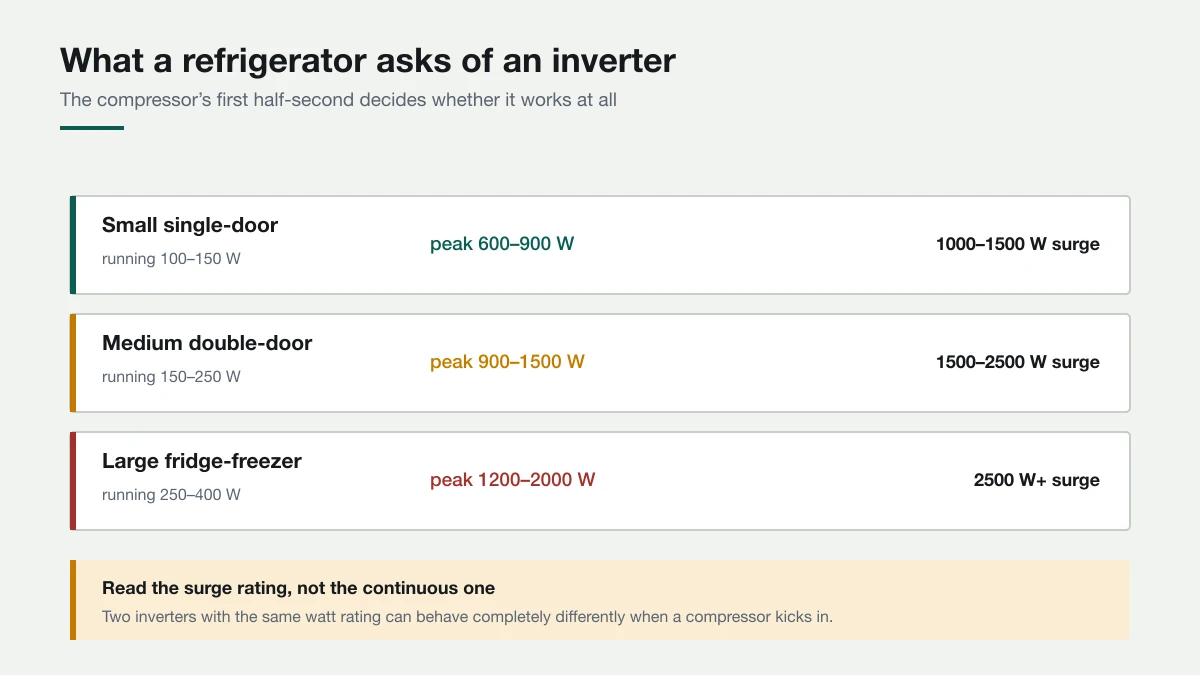
A compressor draws several times its running current for the fraction of a second it takes to start. A fridge that settles at 200 W can demand 800–1200 W to get moving.
| Fridge | Running | Start-up peak | Inverter surge needed |
|---|---|---|---|
| Small single-door | 100–150 W | 600–900 W | 1000–1500 W |
| Medium double-door | 150–250 W | 900–1500 W | 1500–2500 W |
| Large fridge-freezer | 250–400 W | 1200–2000 W | 2500 W+ |
This is why an inverter rated comfortably above the running watts still trips. Your arithmetic used the running figure; the inverter met the surge. Check the surge or peak rating in the specifications — two inverters with identical continuous ratings can behave completely differently here.
Waveform matters more than it used to
Older fridges use a simple fixed-speed compressor. They tolerate modified sine wave, though they often run warmer and buzz audibly.
Modern inverter refrigerators are a different matter. They use a variable-speed compressor driven by their own electronics, and that control board expects a clean sine wave. On modified sine wave they may buzz loudly, throw an error, refuse to start, or suffer damage to the driver board over time.
If your fridge is an inverter model, use a pure sine wave inverter. This is the single most important compatibility rule here, and it applies to most fridges sold in the last several years. A loud buzz from the compressor on backup is the warning sign — do not keep running it to see what happens.
The number that makes fridges viable: duty cycle
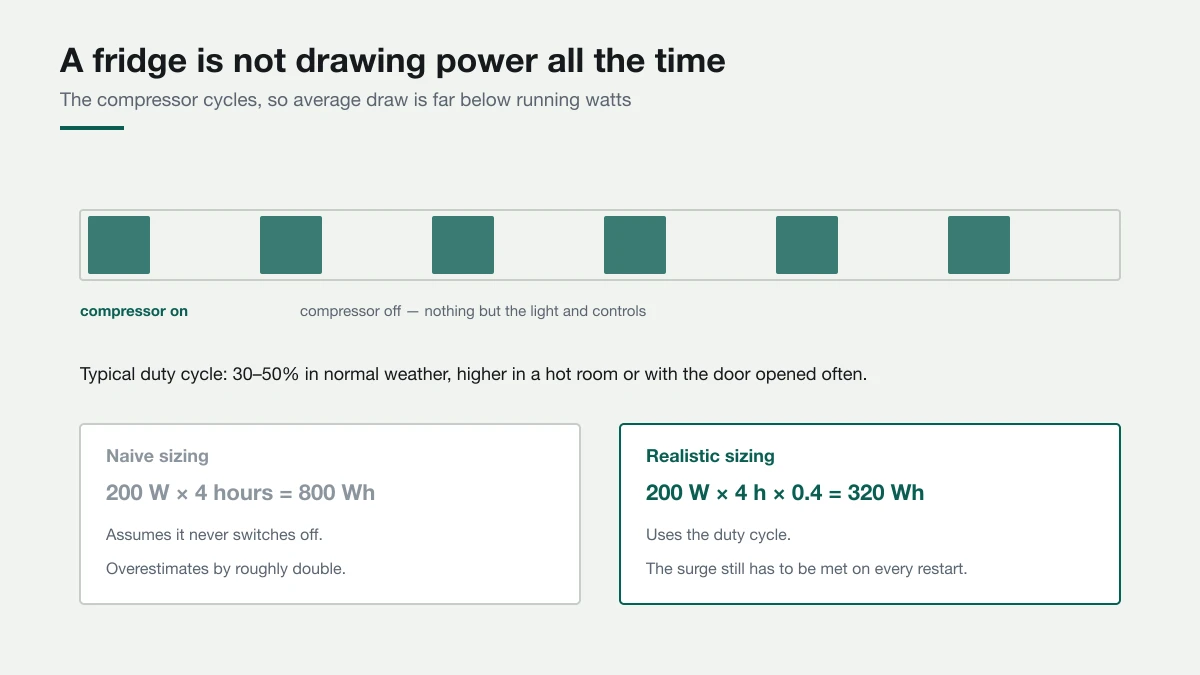
A fridge does not draw its running watts continuously. The compressor cycles: roughly 30–50% of the time in normal conditions, more in a hot room or with the door opened often.
That changes the sizing arithmetic considerably:
- Naive: 200 W × 4 hours = 800 Wh
- Realistic: 200 W × 4 hours × 0.4 duty cycle = 320 Wh
For context, one 12 V 150 Ah lead-acid battery gives about 765 Wh usable — so a fridge alone is manageable, while a fridge plus fans plus lights is where it gets tight. The full calculation is in understanding inverter load.
The catch: duty cycle reduces the energy but not the surge. Every time the compressor restarts, the inverter has to survive the peak again. A system that can supply the energy but not the surge will trip repeatedly, which is worse for the compressor than not running it.
When it is reasonable
All four of these should be true:
- Pure sine wave output — mandatory for an inverter fridge, strongly preferred otherwise
- Surge rating that clears the table above, with margin
- A battery bank of at least two batteries, ideally at 24 V. Single 12 V systems sag badly under compressor surge
- Nothing else heavy on the line — no pump, iron or kettle competing for the same headroom
When it is not
- A computer UPS. These are built to hold a PC up for a few minutes during a clean shutdown, not to start motors. It will trip, overheat, or destroy its battery.
- Modified sine wave with an inverter fridge. Risk of damage to the control board.
- Tired batteries. Voltage collapses on surge, the inverter cuts out, and the compressor gets repeated stalled starts — the hardest thing you can do to it.
- A fridge that already struggles on grid power. If it needs a stabiliser to behave, backup power will be worse.
A controlled test, done safely
Do this in daylight, when you can watch it, not at midnight.
- Take everything else off the backup circuit — leave the router and a light.
- Switch to inverter mode.
- Let the fridge start on its own or plug it in.
Then watch for:
- Does it start cleanly, or does the inverter click, beep or trip?
- Battery voltage — a sharp dip on compressor start means the bank is too small or too weak.
- Sound — a smooth hum is fine, a harsh buzz is not.
- Inverter temperature after fifteen minutes — warm is fine, very hot is not.
- Any burning smell — stop immediately.
If it trips, stop. Do not keep retrying. Repeated stalled starts heat the compressor windings fast, and that is how a fridge gets damaged by a backup system.
Getting the most from a small system
Keep the door closed. Every opening costs more than any setting you can change.
Fill the freezer. Frozen mass is stored cold. Bottles of water in the gaps genuinely extend how long it holds.
Use rest cycles on long outages. Rather than running the fridge continuously, run it 20–30 minutes every couple of hours. That restores the internal temperature for a fraction of the battery, because you are paying for the compressor's on-time rather than the standby hours between.
Give it a clear start. Do not let the fridge and a water pump start together — the combined surge trips systems that either one alone would not.
Plug it into a proper wall socket. Long thin extension leads drop voltage exactly when the compressor needs it most, turning a marginal start into a failed one.
The short version
For outages under four hours, keep the door shut. For longer ones, a fridge is reasonable on a pure sine wave inverter with genuine surge headroom and at least two batteries — and unwise on anything less, particularly if it is a modern inverter fridge. If the compressor buzzes harshly or the system trips on start, that is the answer, and continuing will cost you a compressor.
Related: what to avoid running on a UPS or inverter and running an air conditioner on backup.
Work it out for your own setup
Common questions
What size inverter do I need to run a refrigerator?
Size it for the start-up surge, not the running watts. A medium double-door fridge running at 150–250 W can need 900–1500 W to start, so look for an inverter with a surge rating of about 1500–2500 W, pure sine wave output, and ideally a battery bank of two batteries at 24 V.
How long can a fridge run on one inverter battery?
Because the compressor only runs 30–50% of the time, a 200 W fridge uses roughly 80 Wh an hour. One healthy 12 V 150 Ah lead-acid battery gives about 765 Wh usable, so around nine hours for the fridge alone in normal conditions, and less in a hot room or with the door opened often.
Can I run an inverter refrigerator on a modified sine wave UPS?
No. Inverter fridges drive their compressor with their own electronics, which expect a clean sine wave. On modified sine wave they may buzz, show an error, refuse to start or suffer control board damage over time. Use a pure sine wave inverter.
Is it harmful if the inverter keeps tripping when the fridge starts?
Yes. Each failed start pushes a stalled current through the compressor windings and heats them. If the system trips on start, switch the fridge off rather than letting it retry, and fix the surge capacity or battery first.