On-Grid vs Off-Grid vs Hybrid Solar: Which System Do You Need?
On-grid solar cuts the bill but goes dark in a power cut, off-grid runs on batteries alone, and hybrid does both. How to choose, and the hybrid trap.
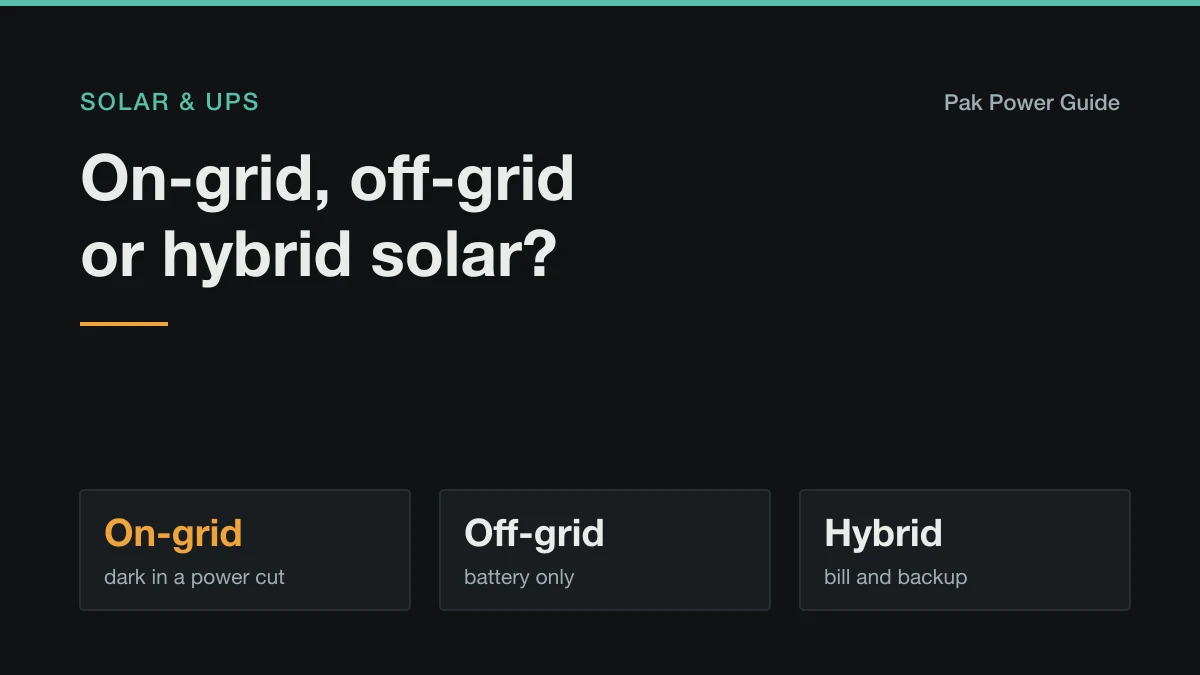
The three names describe one question: what happens to your solar when the grid goes down, and what happens to your spare solar when the battery is full?
- On-grid (grid-tied): no battery. It cuts the bill and exports surplus, but it switches off in a power cut.
- Off-grid: batteries and panels only. It keeps running whatever the grid does, but everything has to come from the sun and the battery.
- Hybrid: panels, a battery and the grid together. It cuts the bill and keeps the house running in an outage.
Side by side
| On-grid | Off-grid | Hybrid | |
|---|---|---|---|
| Battery | None | Essential, large | Yes, sized for backup |
| Works in a power cut | No | Yes | Yes |
| Exports surplus to the grid | Yes, with net metering | No | Yes, if it is a true on-grid hybrid |
| Cost | Lowest | Highest | In between |
| Best for | Cutting the bill where the grid is reliable | No grid, or a grid you cannot rely on | Frequent outages plus a big bill |
On-grid: cheapest, and dark in an outage
An on-grid inverter synchronises with the grid and feeds your solar straight into the house, with any surplus exported. It has no battery, which keeps it cheap and simple and gives the fastest payback where electricity is expensive.
The catch surprises people: when the grid fails, it switches off, even at noon in full sun. This is a safety requirement called anti-islanding: it must not push power into lines that engineers may be repairing. So on-grid solar does nothing at all during load shedding or a storm outage. The comparison of UPS, generator and solar shows what it covers and what it does not.
Off-grid: the battery is everything
An off-grid system is not connected to the grid for supply. The panels charge a battery bank, and the inverter runs the house from it.
It has to be sized for the worst case: several cloudy days in winter, with nothing else to fall back on. That means a large array and a large battery, and it is usually the most expensive way to run a house. It makes sense where there is no grid connection, or where the grid is so unreliable that it cannot be counted on at all. Many off-grid inverters can also charge from a generator or the grid, but they never send power back.
Hybrid: bill savings and backup
A hybrid system does everything. By day the panels run the house and charge the battery. In an outage the battery takes over, usually within 10–20 milliseconds, so fans and lights keep running. Surplus solar can be exported, and the grid refills the battery when the sun cannot.
It costs more than on-grid because of the battery and a more capable inverter. It is the system that makes sense where outages are frequent and the bill is high, which describes much of Pakistan and South Asia, and more and more homes elsewhere that see long storm outages.
The trap in the word "hybrid"
Two quite different products are sold as hybrid inverters:
- On-grid hybrid. Grid-tied, with a battery. It can export surplus solar for net metering and keeps the house running in an outage.
- Off-grid inverter with grid charging. Very common in South Asia, and often sold as hybrid. It runs the house from solar and battery and uses the grid as a charger and backup source, but it cannot export.
If net metering matters to you, ask directly whether the inverter can export to the grid and whether it is approved by your utility. Net-metering rules and buyback rates change, in Pakistan and elsewhere, so check the current terms with your distribution company before counting on export income.
How to choose
- How often does the grid fail, and for how long? Rarely: on-grid. Daily or for days at a time: hybrid. Never available: off-grid.
- What must keep running in an outage? That sets the battery and inverter size. The inverter size calculator works it out from your appliances.
- How big is the bill, and is export paid for? That sets the payback. The solar payback calculator works it out in any currency.
- Can you add a battery later? A hybrid-ready inverter keeps that option open if you start on-grid.
Whichever you choose, the panels need the right angle and a clear view of the sun: the tilt angle calculator gives it for your city, and winter solar output explains what to expect in the cold months.
Work it out for your own setup
Common questions
Does on-grid solar work during a power cut?
No. A grid-tied inverter must switch off when the grid fails, so it cannot send power into lines that engineers may be working on. With no battery, the house goes dark even in full sun. For power during outages you need a hybrid or off-grid system with a battery.
What is the difference between hybrid and off-grid solar inverters?
Both have a battery and keep the house running in an outage. An on-grid hybrid inverter can also export surplus solar to the grid for net metering. Many inverters sold as hybrid, especially in South Asia, are really off-grid inverters with a grid charger: they use the grid as a backup source but cannot export.
Which solar system is best for load shedding?
A hybrid system with a battery. It runs the house from the panels by day, keeps the essentials going from the battery through the cuts, and recharges from solar or the grid. An on-grid system alone does nothing during load shedding.
Is off-grid solar cheaper than on-grid?
No. Off-grid needs enough battery and panels to cover the worst week of the year with no grid at all, which usually makes it the most expensive option. It makes sense where there is no grid connection, or the grid is too unreliable to count on.