What Appliances Should You Avoid Running on a UPS/Inverter?
Nothing is truly forbidden, but an iron uses a whole evening of backup in half an hour. What each appliance costs in runtime, and what to move off.
It helps to stop thinking in terms of allowed and forbidden, and start thinking in runtime. Your battery holds a fixed amount of energy. Every appliance spends it at a different rate, and some spend it startlingly fast.
A typical 12 V 150 Ah battery gives about 765 Wh of usable energy. That is your whole evening. An electric iron spends it in half an hour.
What each appliance actually costs you
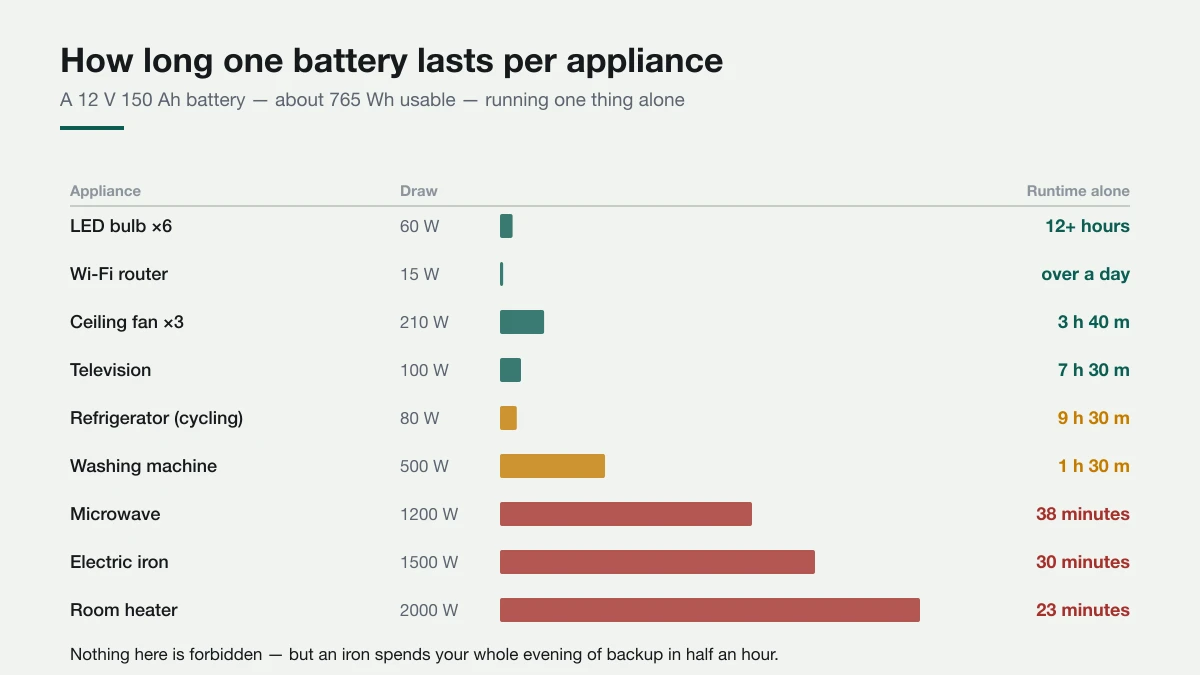
| Appliance | Draw | How long one battery lasts |
|---|---|---|
| Wi-Fi router | 15 W | over a day |
| 6 LED bulbs | 60 W | 12+ hours |
| Television | 100 W | 7 h 30 m |
| 3 ceiling fans | 210 W | 3 h 40 m |
| Washing machine | 500 W | 1 h 30 m |
| Microwave | 1200 W | 38 minutes |
| Electric iron | 1500 W | 30 minutes |
| Room heater | 2000 W | 23 minutes |
Read that as a price list. Ten minutes of ironing costs you a third of the evening's fans and lights. Whether that trade is worth it is your call — but it should be a decision rather than a surprise.
Three different problems, three different fixes
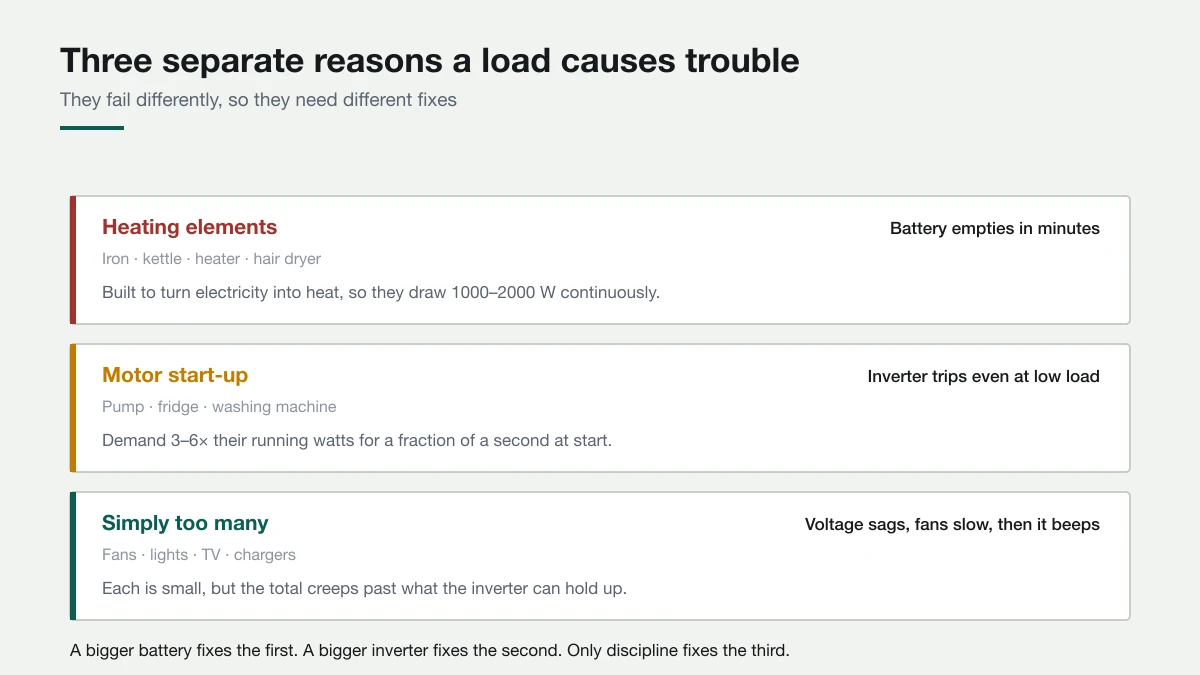
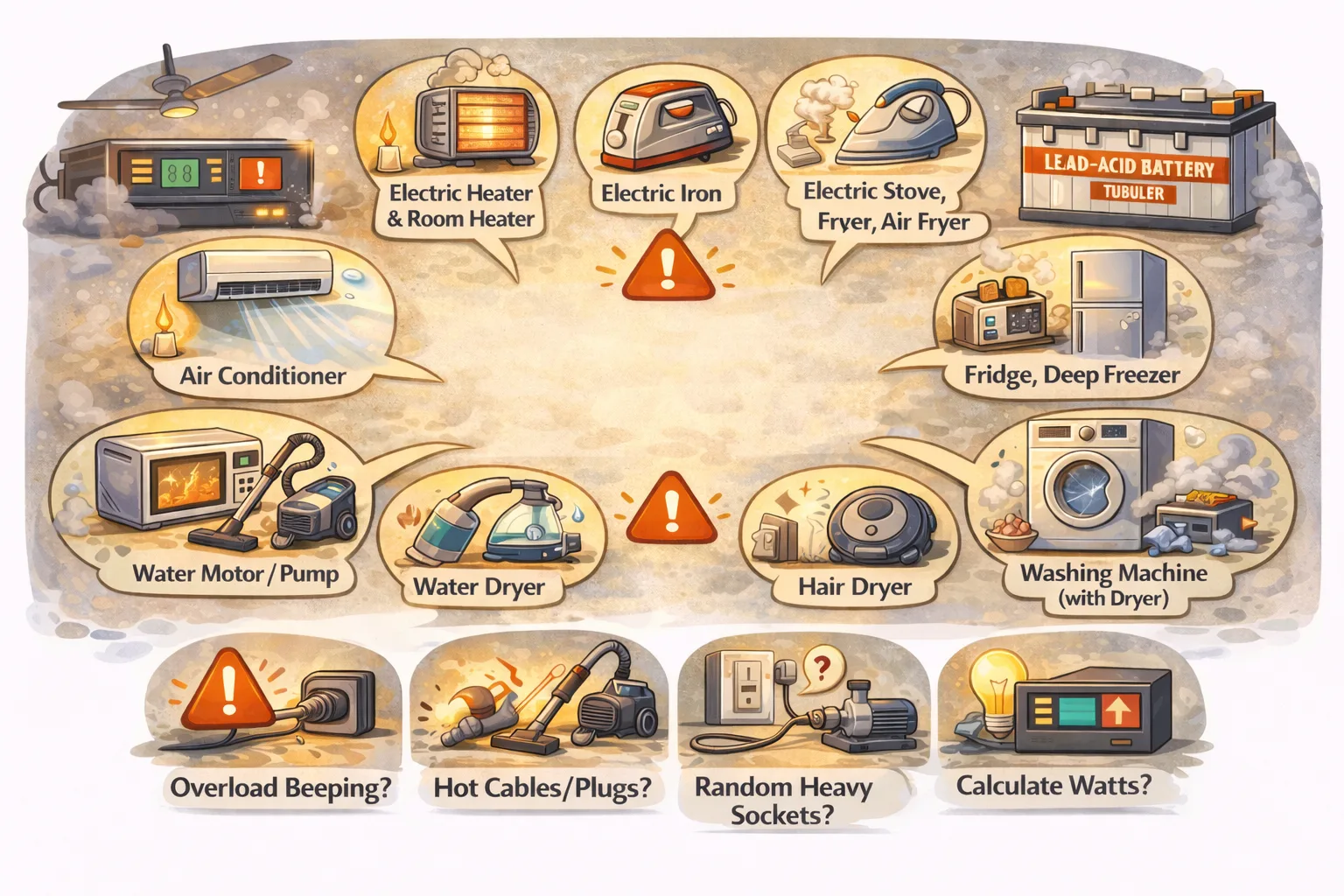
Heating elements — iron, kettle, toaster, hair dryer, room heater. These exist to turn electricity into heat, so they draw 1000–2000 W continuously. They do not usually trip a decent inverter; they simply empty the battery. A bigger battery is the only fix.
Motor start-up — pump, refrigerator, washing machine, vacuum cleaner. These demand three to six times their running watts for a fraction of a second at start. They trip inverters that were coping fine a moment earlier. A higher surge rating is the fix.
Too many small things — fans, lights, TV, a row of chargers. Individually trivial, collectively past what the inverter can hold. The symptom is sagging voltage and fans slowing down before anything beeps. Only discipline fixes this one.
The specific offenders
Iron, kettle, toaster, air fryer, electric stove. The worst value on the list. High draw, and no version of this gets better with a bigger inverter — the energy simply is not there.
Room heater and hair dryer. Same problem, same maths. Blankets cost nothing and last all night.
Microwave. High draw plus a rough load that many inverters dislike. Even when it runs, a few minutes is expensive.
Water pump. The surge is the issue rather than the running watts. Pumps trip inverters instantly, and repeated failed starts are hard on the motor. If you need water during outages, an overhead tank filled while the grid is up solves it without electricity.
Air conditioner. Heavy continuous load plus compressor surge. Only viable on a large system deliberately designed for it — see running an AC on a home UPS or inverter.
Washing machine. Motor surge on spin, and heating on any hot-wash cycle. Wait for the grid.
Refrigerator. The nuanced one. Its duty cycle means average consumption is far lower than its running watts suggest, so energy is manageable — but the surge still has to be met every restart, and modern inverter fridges need a clean sine wave. Worth reading can a UPS or inverter run a refrigerator safely rather than treating it as a flat no.
What belongs on backup
- LED lights
- A reasonable number of ceiling fans
- Wi-Fi router and ONT
- Phone and laptop charging
- A small LED television
Even here the total matters. Three fans, a dozen lights and a TV is around 400 W, which is a comfortable load but roughly two hours on a single battery.
The socket that is secretly on your backup line
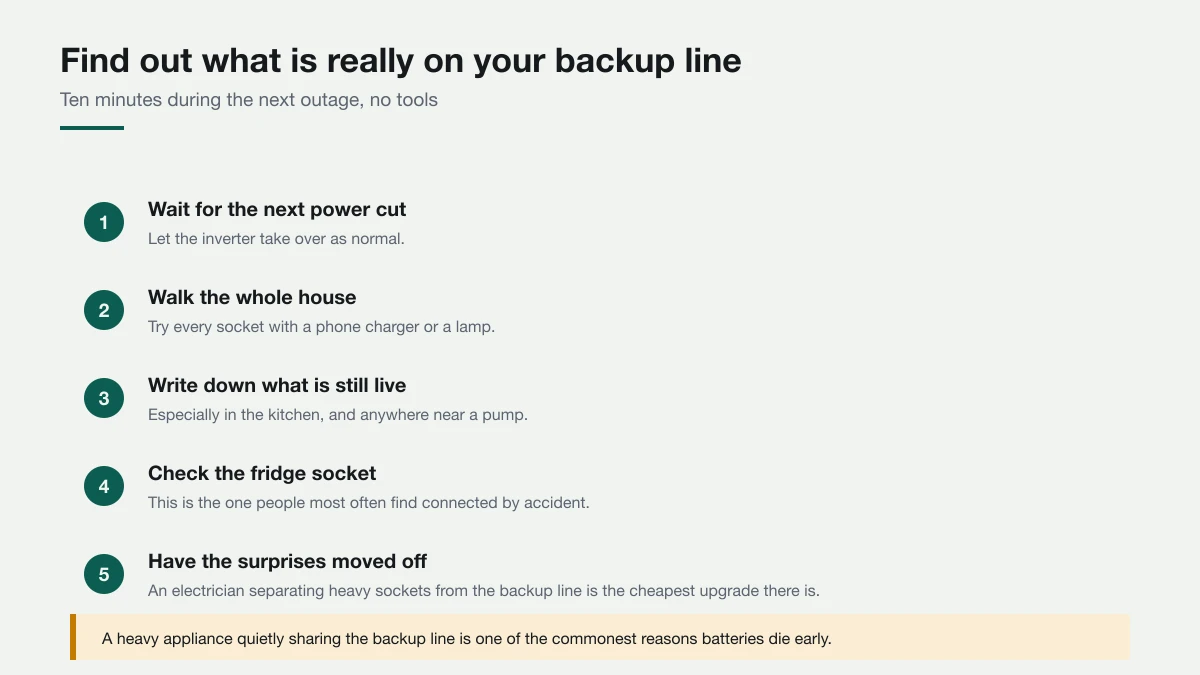
This is the most valuable thing in this guide, because it costs nothing and it explains a lot of mysteriously short battery lives.
Backup circuits are usually retrofitted, and over the years sockets get added to them. The result is a socket that looks completely ordinary but is on the backup line — and then someone plugs a fridge, an iron or a pump controller into it and the battery is being drained by something nobody realises is connected.
During the next outage, walk the house with a phone charger or a lamp and test every socket. Write down everything still live. Check the kitchen carefully, and check the fridge socket specifically.
Anything heavy that turns out to be on the backup line should be moved off it. An electrician separating those circuits is the cheapest meaningful upgrade available to most homes — no new equipment, and it often doubles effective backup time.
If the inverter beeps and cuts out the moment something starts, that is overload: UPS overload explains how to find the cause.
Warning signs to act on
The inverter beeps or shows overload when something switches on. That appliance does not belong there.
Anything is hot. After ten to fifteen minutes of use, check the plug, the extension lead and the battery cables. Warm is fine. Hot means overload or a loose connection, and loose connections start fires.
Burning smell, sparking, or scorch marks at a socket or terminal. Switch the backup load off and get it checked before using it again.
The inverter shuts down on loads it used to handle. Usually ageing batteries rather than a new appliance — the symptoms overlap with batteries draining fast overnight.
Establish your own baseline
Run only a fan, the router and two lights through a full outage and note how long it lasts. That is your reference. Add the TV next time and see what it costs.
Two evenings of that teaches you more about your system than any table, because it uses your batteries, your wiring and your actual load. From there, understanding inverter load lets you predict the rest instead of discovering it.
When to call an electrician
- Battery cables or sockets that get hot in normal use
- Terminals that spark, smell burnt, or show corrosion that keeps returning
- An inverter that shuts down often on a load it should manage
- Any suspicion that a fridge or pump socket sits on the backup line
Ask them to check cable thickness, terminal tightness, how the load is distributed across the backup circuit, and whether the inverter is sized for what you are actually asking of it.
Work it out for your own setup
Learn it by playing
Common questions
Which appliances should not be used on an inverter?
Heating appliances (iron, kettle, toaster, heater, hair dryer, electric stove) because they empty the battery in minutes; water pumps and washing machines because of motor surge; microwaves; and air conditioners unless the system is designed for them.
Can I use an iron on a UPS?
It will usually run, but a 1500 W iron empties a typical 12 V 150 Ah lead-acid battery in about 30 minutes. Ten minutes of ironing costs about a third of an evening's fans and lights.
Can I run a water pump on my inverter?
Usually not reliably. A pump draws three to six times its running watts at start-up, which trips most home inverters, and repeated failed starts harm the motor. Filling an overhead tank while the grid is on avoids the problem.
What should I run on backup power?
LED lights, a reasonable number of ceiling fans, the Wi-Fi router and ONT, phone and laptop charging, and a small LED television. Three fans, a dozen LED lights and a TV total around 400 W, about two hours on one 150 Ah battery.