How Long Does It Take to Fully Charge an Inverter Battery?
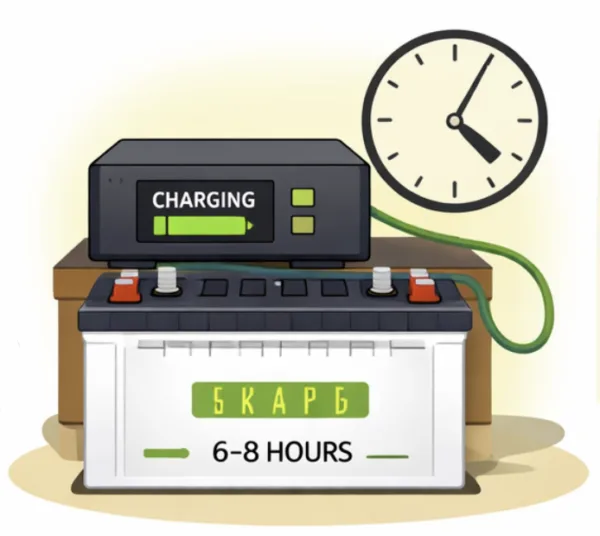
About ten hours for a 150 Ah battery from half empty on a 10 A charger, and the last fifth is the slowest. Why 'full' often is not, and what to check.
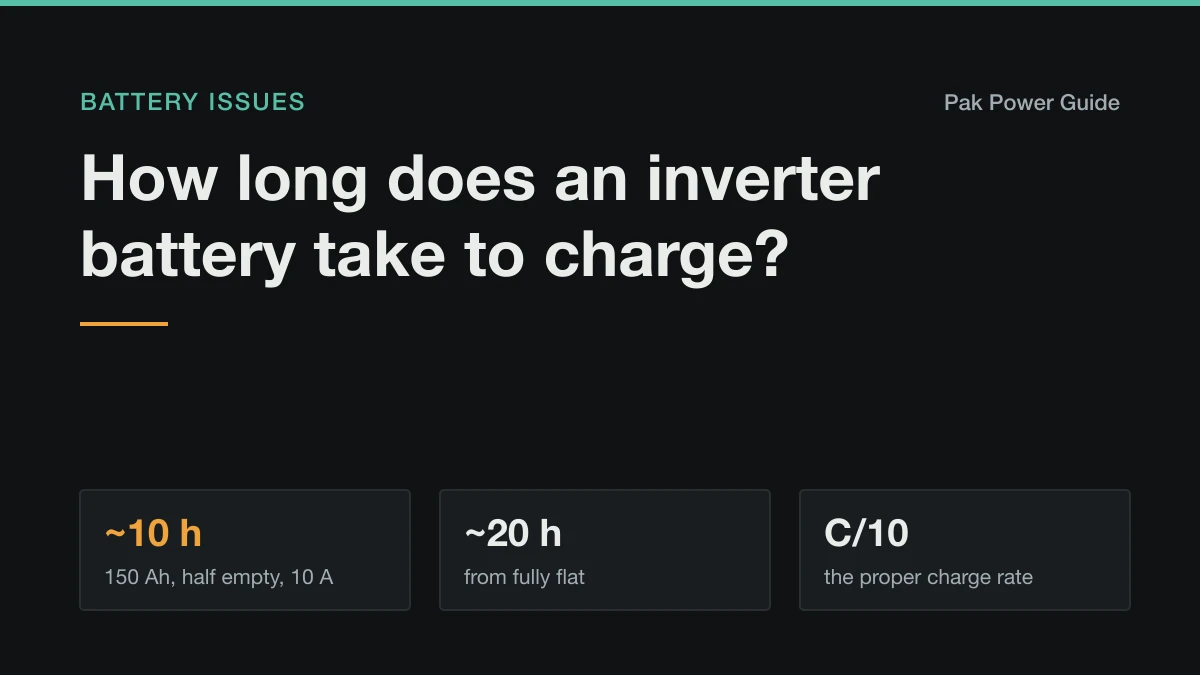
For a 150 Ah tubular battery from half empty on a typical 10 A charger: about ten hours. From fully flat, closer to twenty.
That surprises people, and it explains a great deal. If the grid returns for three or four hours between outages, a lead-acid battery may never actually finish charging — and a battery that lives permanently short loses capacity fast.
The numbers
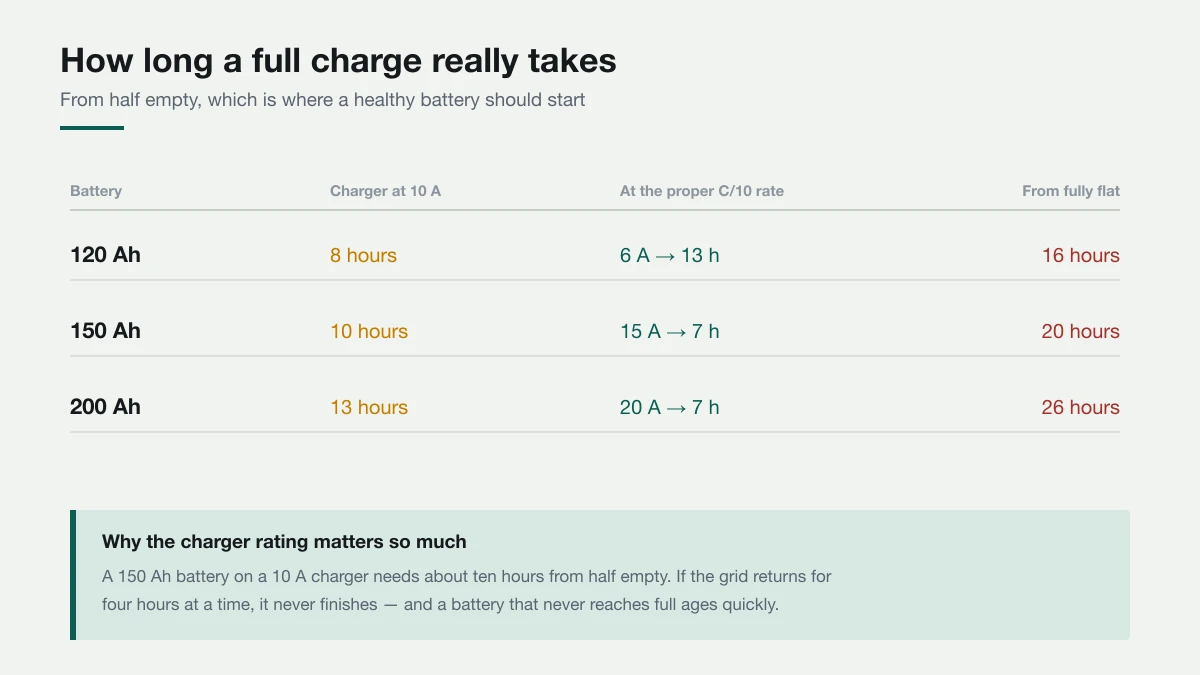
| Battery | On a 10 A charger | At the proper C/10 rate | From fully flat |
|---|---|---|---|
| 120 Ah | 8 hours | 6 A → 13 hours | 16 hours |
| 150 Ah | 10 hours | 15 A → 7 hours | 20 hours |
| 200 Ah | 13 hours | 20 A → 7 hours | 26 hours |
The rough formula: hours ≈ (amp-hours to replace ÷ charging amps) × 1.3. The 1.3 covers charging inefficiency and the slowdown near the top.
Working it for a 150 Ah battery half empty on a 10 A charger: (75 ÷ 10) × 1.3 ≈ 10 hours.
Note the middle column. A 150 Ah battery charged at its proper rate of about 15 A finishes in seven hours rather than ten. Undersized charging current is the most common reason charging feels endless — and many inverters ship set lower than the battery could accept.
Why the last stretch drags
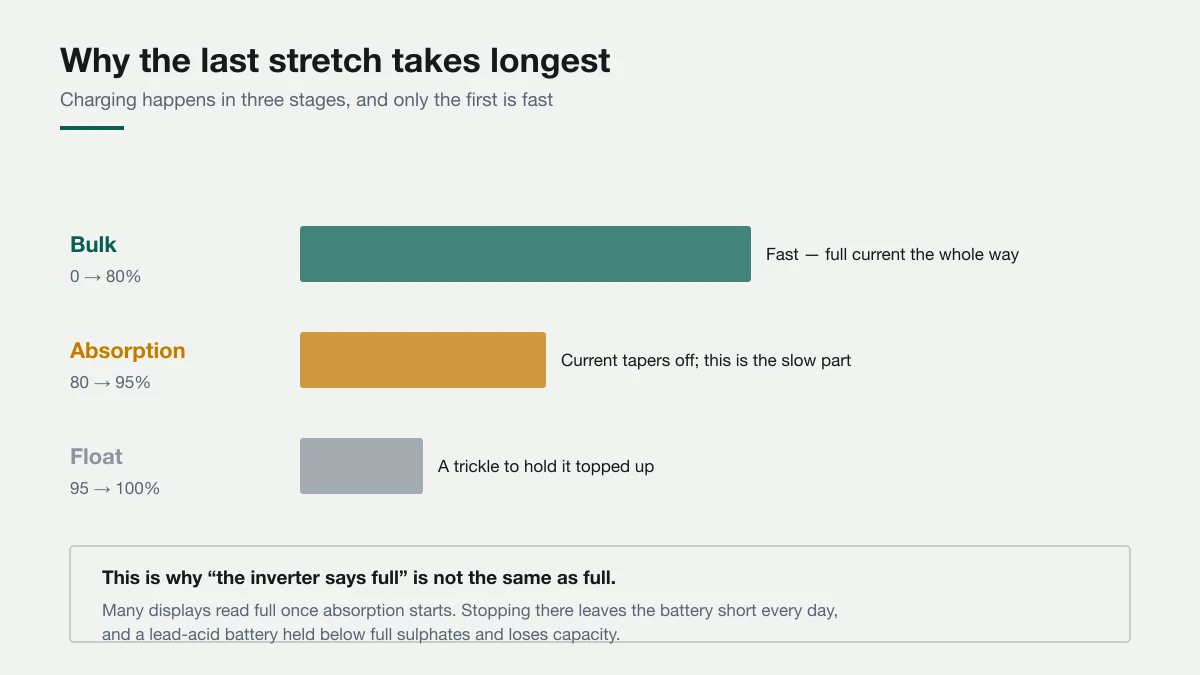
Lead-acid charges in three stages:
- Bulk (0 → 80%) — full current, and relatively quick
- Absorption (80 → 95%) — the charger tapers current to avoid gassing. This is where the hours go
- Float (95 → 100%) — a trickle that holds it topped up
The taper is not the charger being cautious for no reason. Pushing hard at high state of charge boils water out of the electrolyte, which is exactly the problem in why battery water runs out so fast.
This is why "full" on the display often is not. Many inverters show a full indication once absorption begins — at 80–85%. Stopping there every day leaves the battery permanently short, and a lead-acid battery held below full sulphates and loses capacity.
What decides your charging time
Charging current. The biggest factor, and the one most often wrong. Aim for about a tenth of capacity: 15 A for a 150 Ah battery. Many units charge at 8–10 A regardless of the battery fitted.
How empty it is. From 50% takes roughly half as long as from flat — one of several reasons not to drain a lead-acid bank deeply.
Load running while charging. The charger supplies your house first and the battery with whatever is left. Running fans and lights while charging can easily double the time. If you want a quick recharge between outages, take the load off.
Incoming voltage. Many inverters reduce or suspend charging when grid voltage is low. Charging time doubles quietly and nothing reports it.
Battery age. An old battery reaches "full" quickly because its real capacity has shrunk. Fast charging plus short backup is a worn battery, not a good one.
Temperature. Heat makes the correct charge voltage lower. A charger with no temperature compensation overcharges in summer, gassing away water — see inverter and battery overheating.
Checks you can do
Look at the charging amps if your inverter displays them. Low amps (2–5 A) with a flat battery means charging will take forever — check the charge-current setting first, then the cabling. Amps that start high and collapse within minutes suggest an ageing battery or low incoming voltage.
Time it properly once. Note the state when charging starts and when the display says full. Compare against the table above. Much longer means undersized current, load competing for the charge, or a battery on the way out.
Check the water level on flooded and tubular batteries, after a full charge. Plates must stay covered. Frequent topping up alongside slow charging usually points at overcharging in the absorption stage.
Feel the battery an hour in. Slightly warm is normal. Hot means the current is too high for the battery, or the battery is failing.
Check terminals. Loose or corroded terminals waste charge and heat up. This costs both charging speed and backup time.
If it never finishes between outages
A common and genuinely difficult situation: outages long, grid windows short, and the battery permanently at 70%.
Options, in order of cost:
- Take the load off while charging. Free, and often gains hours.
- Raise the charge current to the proper C/10 rate if your inverter allows it and the cabling supports it.
- Add battery capacity. A larger bank is discharged less deeply, so it needs less put back each time.
- Move to lithium. LiFePO4 accepts near-full current almost to the top, so a two-hour window puts back a genuinely useful amount. In fragmented-supply areas this matters more than cycle life — see lithium vs lead-acid.
If the battery voltage never rises at all with mains on, it is not charging: work through UPS not charging the battery.
A realistic routine
- Expect 8–12 hours for a typical 150 Ah tubular battery from half empty
- Do not trust a "full" indication that arrives suspiciously fast
- Keep the load off during charging when you can
- Charge at about a tenth of capacity, not the maximum available
- Check water monthly in summer, less often in winter
If backup is still short after all that, the problem has moved from charging to capacity — why an inverter battery drains fast overnight picks up from there.
Work it out for your own setup
Common questions
How long does a 150 Ah inverter battery take to charge?
About ten hours from half empty on a typical 10 A charger, around seven hours at the proper 15 A rate, and closer to twenty hours from fully flat. The rough formula is amp-hours to replace ÷ charging amps × 1.3.
Why does my inverter battery take so long to charge fully?
Lead-acid charges quickly to about 80%, then the charger tapers the current to avoid gassing, so the last fifth takes hours. Charge current set too low, load running while charging, and low incoming voltage all make it slower still.
What charging current is right for an inverter battery?
About a tenth of its capacity for a flooded tubular battery: 15 A for 150 Ah, 20 A for 200 Ah. Up to a fifth is survivable; higher than that boils water off.
Is my battery full when the inverter display says full?
Not necessarily. Many inverters show full when the absorption stage begins, at around 80–85%. A lead-acid battery repeatedly stopped there sulphates and loses capacity.