Common Mistakes to Avoid When Installing a Home UPS
Most poor UPS installs fail on two things: cable too thin for the current, and no fuse between battery and inverter. The numbers for both, and the rest.
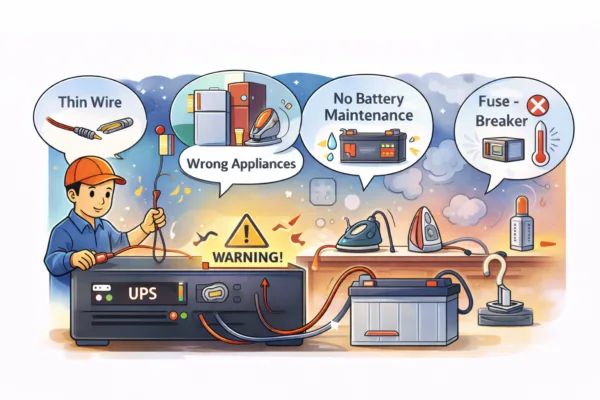
Most installations that disappoint were fine on day one. The problems show up over weeks: short backup, hot cables, batteries needing water constantly, an inverter that beeps at loads it used to manage.
Two mistakes cause a disproportionate share of it, and both are invisible until they bite.
Mistake 1: cable too thin for the current
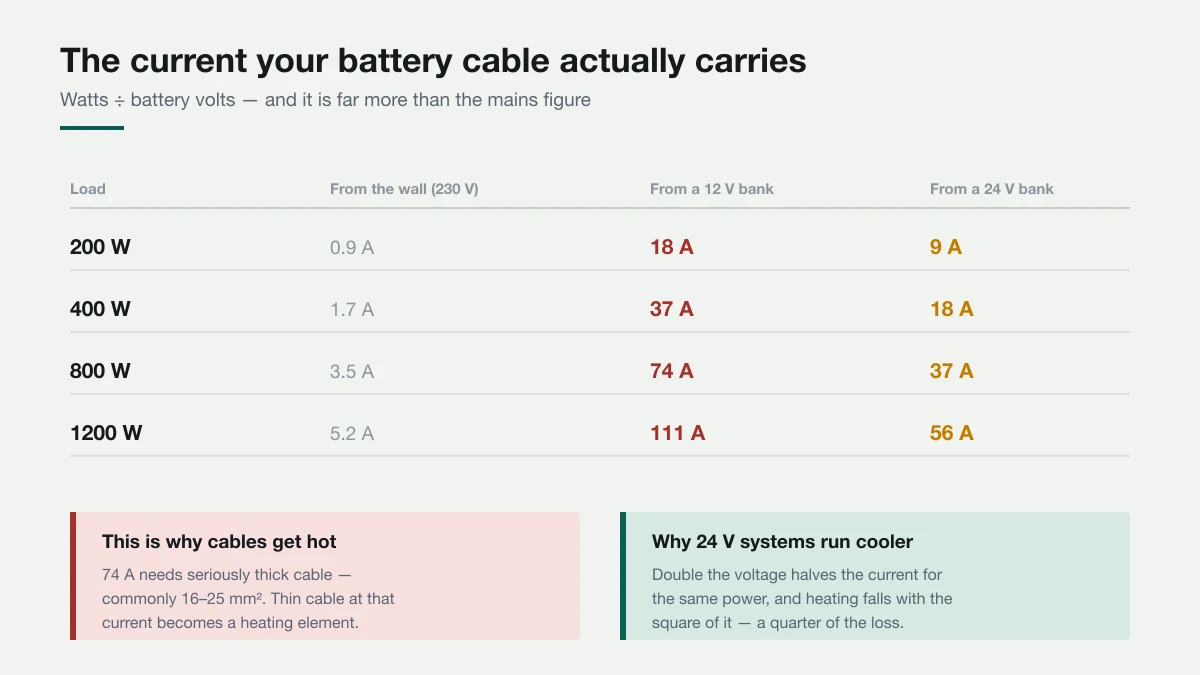
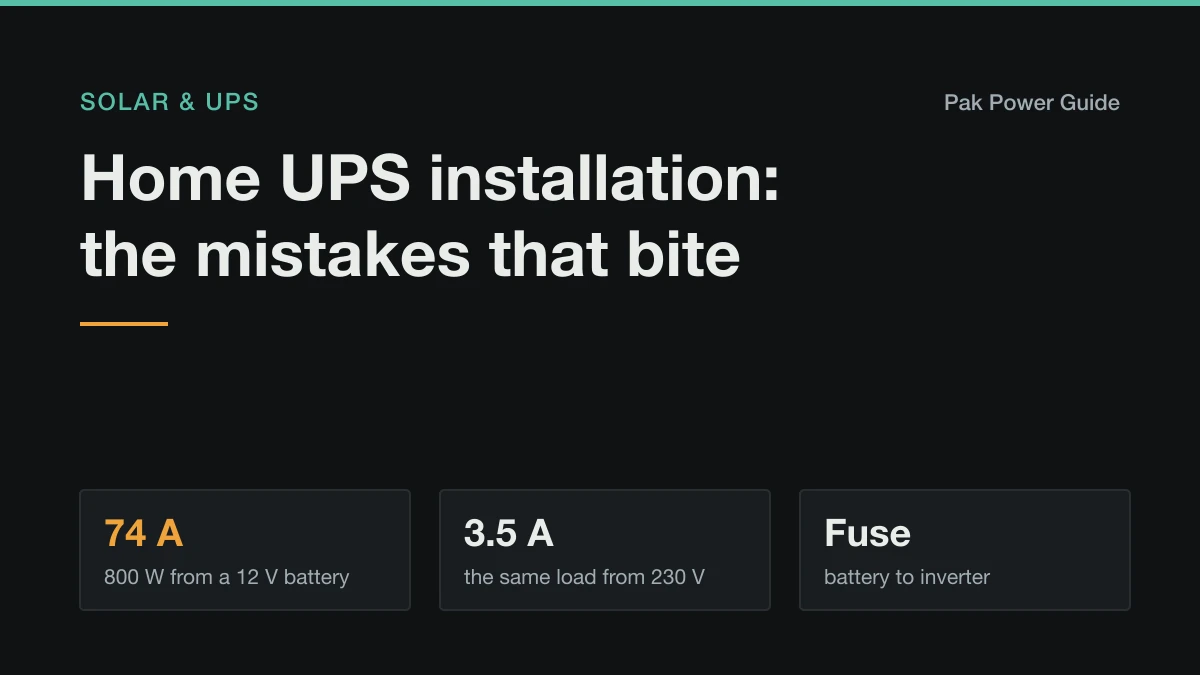
This is where the surprise lives. A load draws a small current from the mains and an enormous one from the battery, because the battery voltage is so much lower.
| Load | From the wall (230 V) | From a 12 V bank | From a 24 V bank |
|---|---|---|---|
| 200 W | 0.9 A | 18 A | 9 A |
| 400 W | 1.7 A | 37 A | 18 A |
| 800 W | 3.5 A | 74 A | 37 A |
| 1200 W | 5.2 A | 111 A | 56 A |
Household wiring is sized for the first column. The battery cable has to carry the third or fourth. 74 A needs seriously thick cable — commonly 16–25 mm². Thin cable at that current is a heating element: it wastes energy as heat, drops voltage so your fans run slow, and in the worst case melts its insulation.
Two rules that follow:
- Keep the battery cable short. Every extra metre adds resistance at very high current. The inverter belongs next to the batteries.
- Prefer 24 V over 12 V for anything beyond a token load. Doubling the voltage halves the current, and heating falls with the square of current — so a 24 V system loses a quarter as much in the cabling.
The check: during an outage with a normal load, carefully feel the battery cables along their length. Warm at the terminals is acceptable. Warm along the whole cable means it is undersized.
Mistake 2: no fuse between battery and inverter
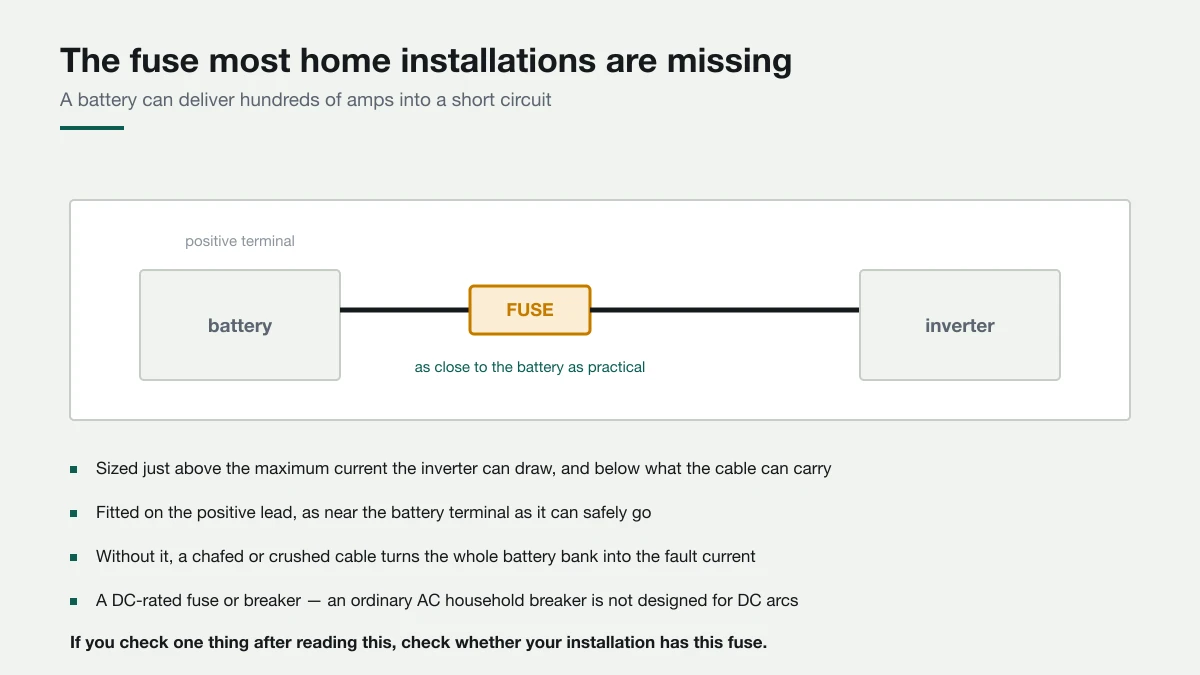
A lead-acid battery bank can deliver hundreds of amps into a short circuit. If a cable is ever chafed, crushed or pinched — by a shifting battery, a rodent, or a screw through insulation — that current flows through whatever the fault path is, with nothing to stop it.
A fuse or DC breaker on the positive lead, as close to the battery as practical, is what stops that. It should be rated just above the maximum current the inverter can draw, and below what the cable can safely carry.
Two details matter: it must be DC-rated (an ordinary AC household breaker is not designed to break a DC arc, which does not self-extinguish the way AC does), and it belongs near the battery, because cable between the battery and the fuse is unprotected.
If you check one thing after reading this, check whether your installation has this fuse. Many do not.
Mistake 3: the wrong battery for the job
Car batteries are built to deliver a big current for a few seconds and then be recharged immediately. They are not built to be discharged deeply, night after night, and they lose capacity within months when used that way.
Tubular lead-acid is the standard choice for home backup because it tolerates deep cycling. If you cycle deeply every night, lithium is worth comparing, since it accepts 80% depth where lead-acid wants 50%.
Mistake 4: sizing by guess
"A 220 Ah battery is enough for everything" is not a specification. Backup time depends on your actual load, the depth you are willing to discharge to, and inverter efficiency.
The arithmetic is short: usable watt-hours ≈ volts × amp-hours × 0.5 × 0.85 for lead-acid. A 12 V 150 Ah battery gives about 765 Wh — roughly two hours at 385 W. Understanding inverter load works it through.
Size the inverter for the surge, not just the running watts, or a fridge or pump will trip it.
Mistake 5: loose or corroded terminals
Loose terminals create resistance exactly where the current is highest. Resistance makes heat, heat makes corrosion, corrosion makes more resistance.
Symptoms are easy to mistake for a dying battery: weak charging, short backup, warm terminals, and intermittent clicking from the inverter.
The check: with everything switched off, try to rotate each lug by hand. It should not move. Look for white or green powder and clean it properly rather than just wiping it.
Mistake 6: heavy sockets on the backup line
The most common wiring error, and the reason many batteries die early. A socket that looks ordinary turns out to be on the backup circuit, and one day someone plugs an iron or a fridge into it.
Do the socket audit: during the next outage, walk the house and test every socket. Anything heavy that is live should be moved off the backup line. It is the cheapest meaningful upgrade available, since it needs no new equipment.
Mistake 7: putting it somewhere with no air
Inverters and batteries both make heat, and both suffer for it. An inverter needs 15–30 cm of clearance on vented sides. Batteries need ventilation because flooded types release hydrogen while charging, which is explosive at 4% in air.
A sealed cabinet fails both requirements at once. Keeping them apart helps too, since otherwise each warms the other. Lead-acid life roughly halves for every 10 °C above 25 °C — see overheating.
Mistake 8: leaving charge settings at default
An inverter set for the wrong battery type charges at the wrong voltage. Too high boils water away; too low means it never reaches full and sulphates.
Confirm the battery type setting matches what you actually fitted, and that charge current is about a tenth of capacity — 15 A for a 150 Ah battery. Related: why battery water runs out so fast.
A commissioning checklist
- Battery type setting matches the batteries fitted
- Charge current set to about C/10
- DC fuse or breaker on the positive lead, near the battery
- Battery cable thick enough for the current, and as short as practical
- All terminals tight, clean, and coated against corrosion
- Inverter and batteries have clearance and airflow, and are not sharing a sealed box
- Only intended circuits on the backup line — verified by walking the house during an outage
- Backup time measured with a known load, and written down as your baseline
That last one matters more than it sounds. Without a baseline measured when everything was new, you have no way to tell later whether the battery has degraded or the load has crept up.
Work it out for your own setup
Learn it by playing

Common questions
What size cable do I need between the battery and inverter?
It depends on the current, which is far higher than from the wall. An 800 W load draws about 74 A from a 12 V battery, which commonly needs 16–25 mm² cable, kept as short as practical. The battery cable size calculator works it out for your inverter and cable length.
Do I need a fuse between the battery and the inverter?
Yes. A battery bank can push hundreds of amps into a short circuit. Fit a DC-rated fuse or breaker on the positive lead, as close to the battery as practical, rated above the inverter's maximum current and below what the cable can carry.
Can I use a car battery with a home UPS?
Not for regular backup. Car batteries are designed for short bursts of high current and quick recharging, and lose capacity within months when discharged deeply night after night. Tubular lead-acid or lithium batteries are built for that job.
How much space does an inverter need around it?
Allow about 15–30 cm of clearance on vented sides, and keep it out of sealed cabinets. Flooded batteries also need ventilation because they release hydrogen while charging, and are better kept apart from the inverter so each does not heat the other.