Why Do I Have to Refill My Inverter Battery Water So Often?
Topping up every few weeks means something is wrong: usually charge voltage set too high, heat, or too much charge current. The numbers to check each.
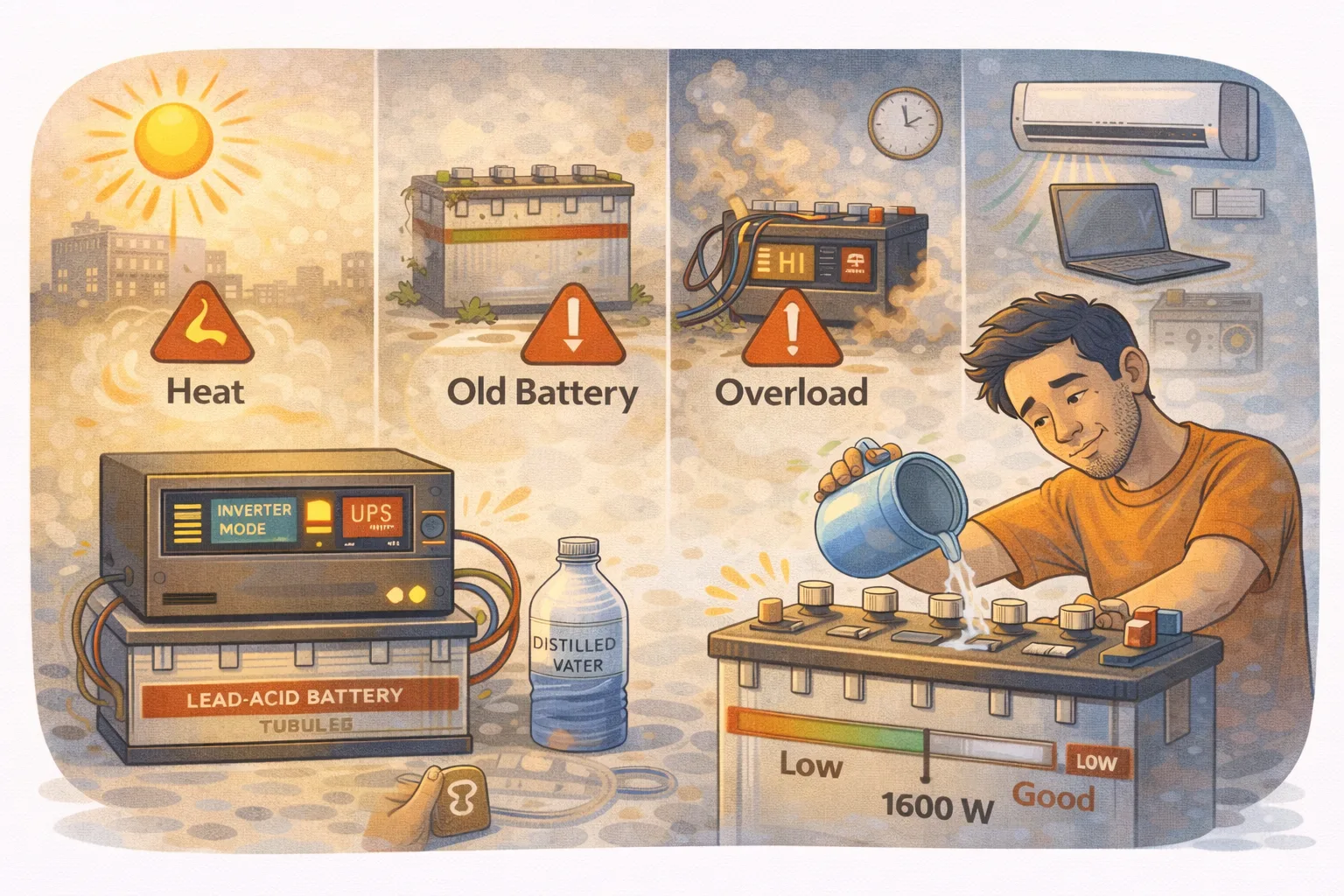
A healthy flooded inverter battery needs topping up every three to six months. If you are refilling every two or three weeks, the battery is not thirsty — it is being boiled dry, and something in the charging is wrong.
The water is leaving as gas. Every charge splits a little water into hydrogen and oxygen, which vent out through the caps. A small, slow loss is normal. Rapid loss almost always traces back to one of three things: charge voltage set too high, a battery sitting somewhere hot, or charge current set higher than the battery can take.
This guide gives you the actual numbers to check each one.
How much water loss is normal?
There is no single figure, but there is a useful range.
| How often you top up | What it usually means |
|---|---|
| Every 4–6 months | Normal for a well-set-up battery |
| Every 2–3 months | Acceptable in a hot room with daily outages |
| Every 3–4 weeks | Charging is too aggressive, or the battery is ageing |
| Every 1–2 weeks | Something is wrong — check before the plates are damaged |
One more clue matters as much as frequency: is one cell dropping faster than the others? Even loss across all cells points at charging or heat. One cell that always needs more is usually a failing cell, and no amount of water will fix it.
Which batteries need water at all?
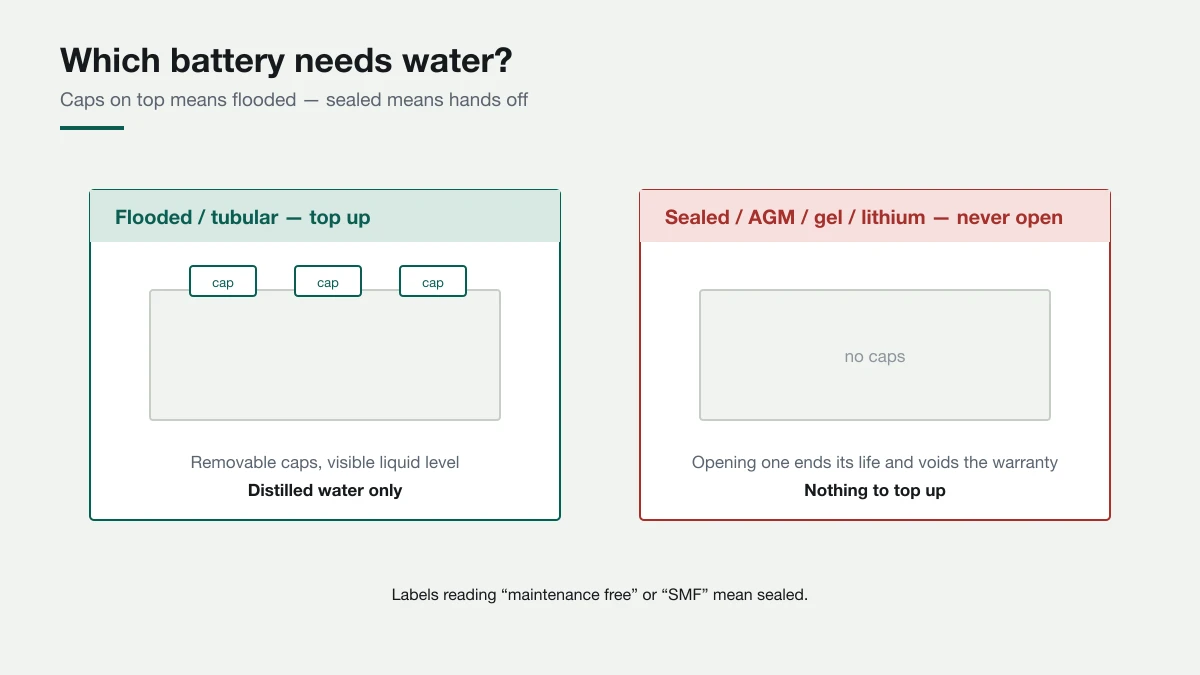
Caps on top — top it up. Flooded, wet-cell and tubular batteries all have removable caps and liquid you can see. These are the standard choice for home inverters and they need water.
No caps — leave it alone. Sealed maintenance-free (SMF), AGM, gel and lithium batteries are closed systems. Opening one lets the electrolyte escape, ends the battery's life early and voids the warranty. If the label says "maintenance free" or "SMF", there is nothing to fill.
Use distilled water, and only water
Two rules, and the second one is the expensive one to get wrong.
Use distilled or demineralised water. Tap water, filtered water, mineral water and RO reject water all carry dissolved salts and metals. Those settle on the plates, create internal discharge paths and permanently cut capacity. A bottle of distilled water is cheap; a battery is not.
Never add acid. This is the mistake that kills batteries fastest. Only water leaves the battery — the sulphuric acid stays behind. Topping up with acid instead of water raises the concentration, corrodes the plates and destroys the battery. Acid goes in once, at the factory or at first commissioning, and never again.
Fill to the mark, not to the top
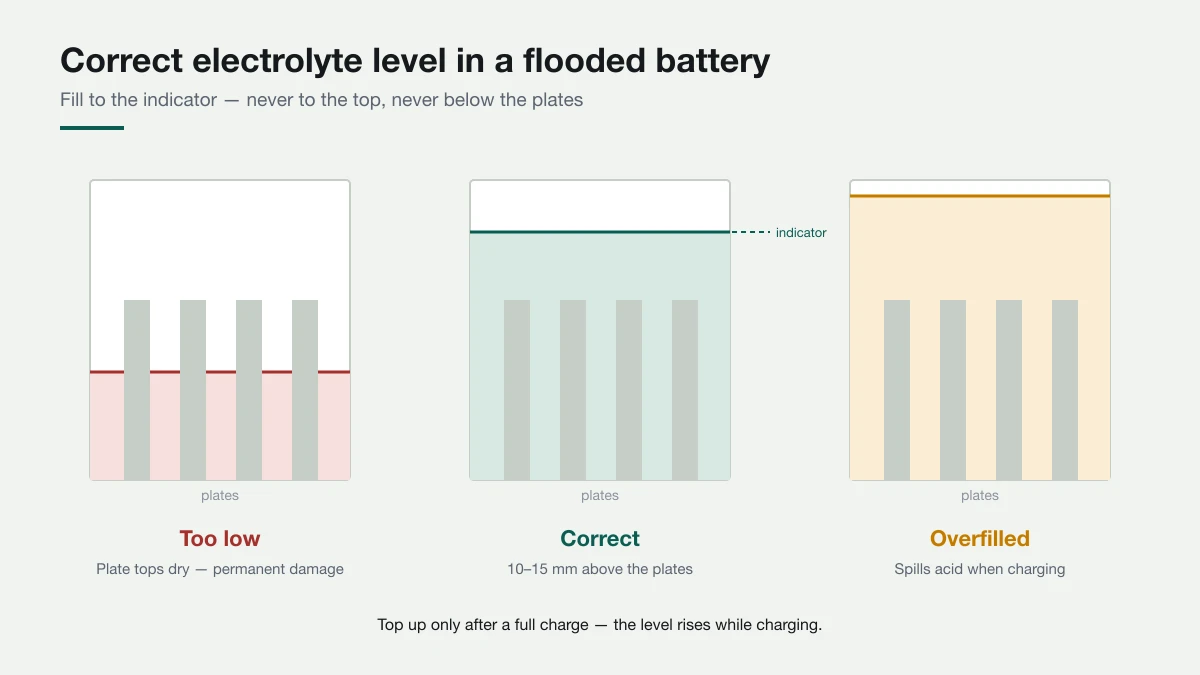
The correct level is roughly 10–15 mm above the top of the plates, or up to the indicator if your battery has one. Most tubular batteries have a float or a plastic tube showing exactly where to stop.
Two habits make a real difference:
- Top up after a full charge, not before. Electrolyte expands as it charges. Fill a cell to the mark while the battery is flat and it will overflow once charging starts — which looks like water loss, and is really acid on your floor.
- Do not overfill. Beyond the mark you are diluting the acid, which lowers capacity, and creating spill-over that corrodes the terminals and the tray.
If the plates have been exposed to air, the damage is already done and is not reversible. Top up immediately, but expect that battery to have lost capacity for good.
Cause 1: charge voltage set too high
This is the most common reason by a wide margin.
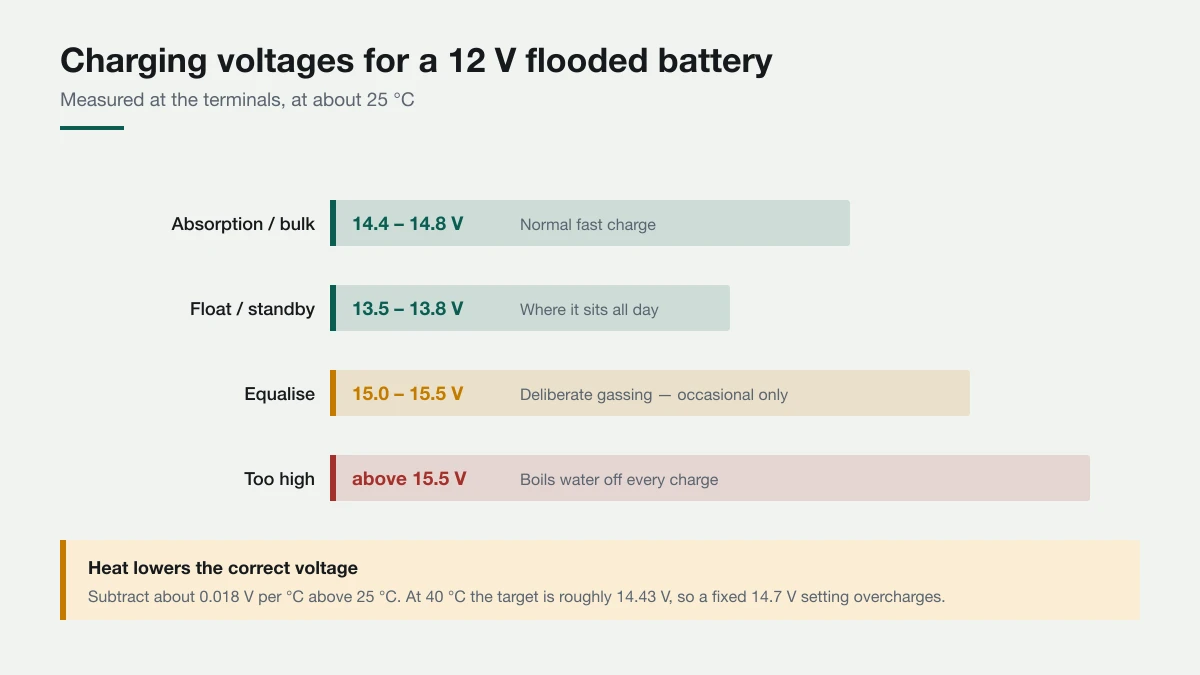
Measure at the battery terminals with a multimeter while it is charging:
- 14.4–14.8 V during the main charge is correct for a 12 V flooded battery
- 13.5–13.8 V is where it should settle once full
- Above 15.5 V for any length of time is boiling the water off
For a 24 V bank, double all of these. If your inverter shows a "battery type" setting, make sure it is set to flooded or tubular — a unit set to AGM or gel will often hold a float voltage that is wrong for your battery.
The heat trap most people miss. The correct voltage falls as the battery gets warmer — about 0.018 V lower per °C above 25 °C for a 12 V battery. At 40 °C the right absorption target is closer to 14.4 V than 14.7 V. A charger with no temperature compensation keeps pushing the same voltage all summer, so the same setting that behaves in January quietly overcharges in June. That is why water loss is so much worse in hot months.
Signs the voltage is too high: the battery is warm or hot an hour into charging, you can hear steady bubbling, there is a sharp acid smell near the caps, and terminals corrode again soon after cleaning.
Cause 2: too much charge current
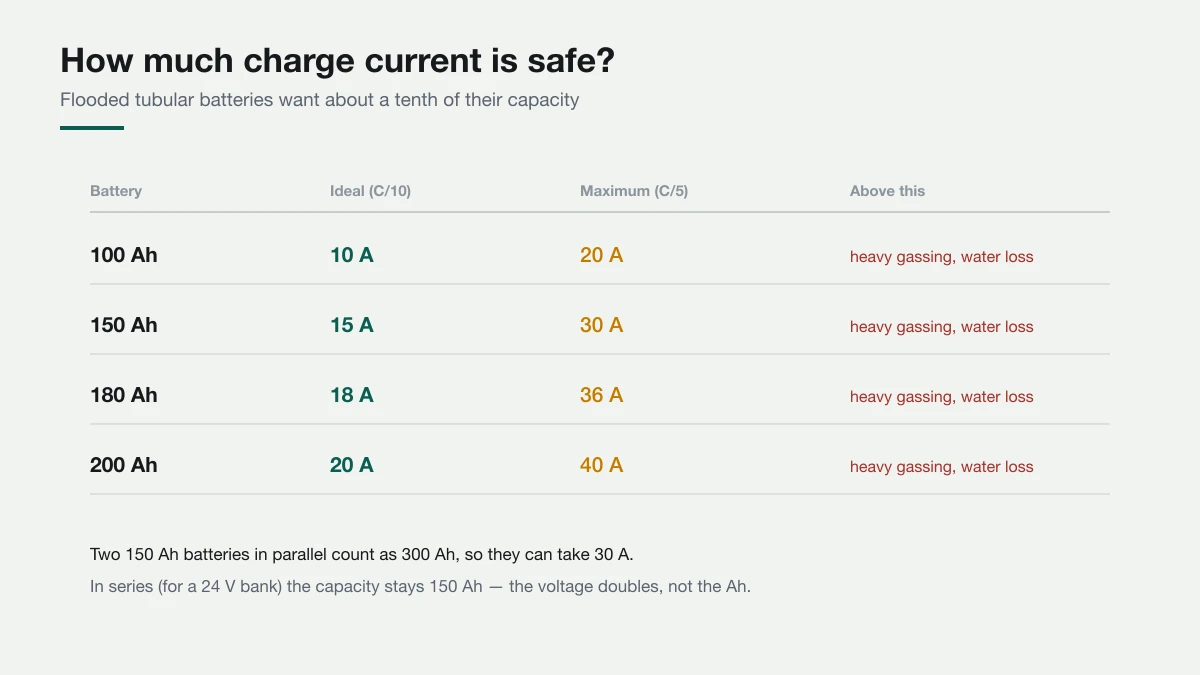
A flooded tubular battery wants about a tenth of its rated capacity in charging current — 15 A for a 150 Ah battery. Up to a fifth (30 A) is survivable. Beyond that the battery gasses hard on every charge and the water goes.
Many inverters have a charge-current setting labelled low/medium/high or in amps. People set it high to get back to full faster before the next outage, then wonder where the water went. Unless your installer specified otherwise, medium is the right default for a typical home battery.
Watch the arithmetic on multi-battery banks: two 150 Ah batteries in parallel are a 300 Ah bank and can take 30 A. Two in series for a 24 V system are still 150 Ah — the voltage doubles, the capacity does not. Setting 30 A on a series pair charges each battery at double the sensible rate.
Cause 3: heat and poor ventilation
Heat accelerates everything. It raises evaporation directly, it increases gassing at any given voltage, and it pushes the correct charge voltage down while your charger holds it fixed.
Batteries tucked into store rooms, closed cabinets, under stairs or beside the inverter's own hot air get the worst of it. You are looking for airflow, not cooling — even a partly open cabinet or a shifted position helps. Keep the battery off a bare concrete floor, out of direct sun, and away from the inverter's exhaust. The same heat is hard on the inverter itself, which is covered in keeping an inverter cool in hot weather.
Cause 4: deep discharge every night
The deeper you drain a battery, the longer and harder the charger has to work to refill it, and the more of that charge is spent gassing rather than storing.
A battery taken to 20% every night and charged hard every morning will lose far more water than one that rarely drops below 50%. If your backup is running more than lights, fans and a router, that is worth examining — see what to avoid running on a UPS or inverter and why an inverter battery drains fast overnight.
Cause 5: the battery is simply old
As plates shed material and internal resistance rises, an ageing battery heats more during charging and holds less. The charger responds by running longer and more often, which costs more water — and the battery still gives poor backup.
The tell is water loss plus falling performance. If backup time has dropped noticeably and you are also topping up constantly, the battery is near the end rather than badly set up. A battery that needs water every fortnight and gives half the runtime it used to is telling you the same thing twice.
Check the actual state of charge with a hydrometer
A multimeter tells you voltage; a hydrometer tells you what the acid is doing. They cost very little and settle arguments quickly.
| Specific gravity | State of charge |
|---|---|
| 1.265 – 1.280 | Fully charged |
| 1.225 | About 75% |
| 1.190 | About 50% |
| 1.120 or below | Discharged — do not leave it here |
Draw from each cell in turn, after a full charge. Readings within about 0.010 of each other across cells are healthy. A spread of 0.030 or more between the best and worst cell means that cell is failing, and it will drag the whole bank down with it.
Working safely around a flooded battery
A charging battery vents hydrogen, and hydrogen is explosive in air at concentrations as low as 4%. This is not a theoretical risk — it is why battery explosions happen in enclosed cupboards.
- No flames, no smoking, no switching things on and off right beside the battery while it is charging
- Ventilate the space before you open the caps
- Wear eye protection; acid splashes go upward when a cap comes off under pressure
- Keep a box of baking soda and plenty of water nearby to neutralise spills
- Turn the inverter and charger off before opening caps, and remove rings and watches
If a battery is hot, visibly swollen or hissing, leave it alone and let it cool. Do not open a swollen battery.
The routine that keeps it simple
- Every 4–6 weeks in summer, 8–10 in winter: check the level in every cell, after a full charge.
- Top up to the mark with distilled water only. Never acid.
- Once a season, measure charge voltage at the terminals against the figures above.
- Once a season, check specific gravity across all cells and compare them.
- Keep the battery ventilated and off the floor.
If you follow that and are still refilling every two weeks, the problem is the charger settings or the battery itself — not the routine.
When it is worth stopping altogether
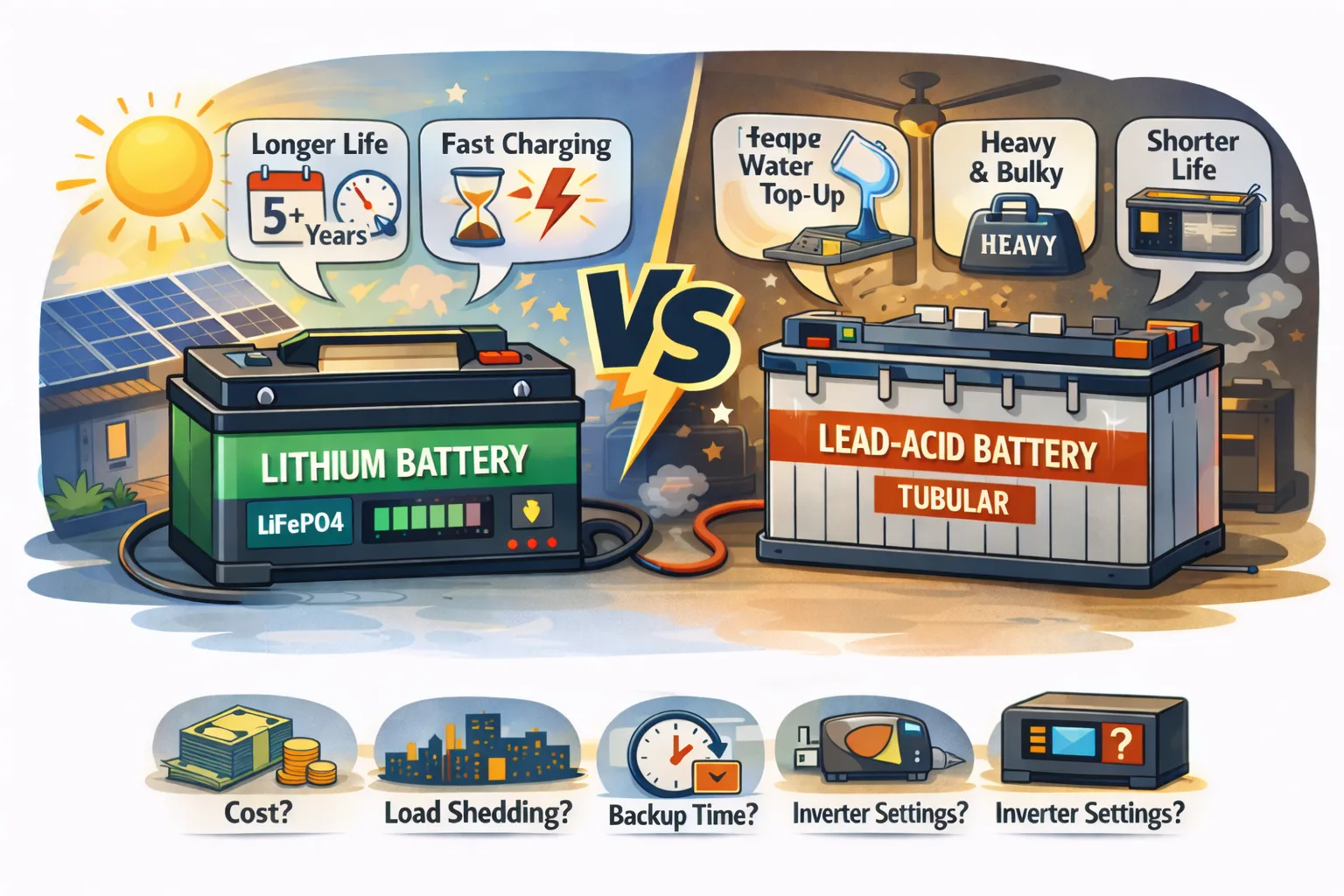
Watering is a maintenance cost, and it is one of the reasons lithium (LiFePO4) has taken over at the top of the market. Lithium batteries are sealed, never need topping up, tolerate partial charging without complaint and last several times as many cycles. They cost significantly more upfront and need an inverter that can charge them correctly.
Whether that trade works out depends on how hard you cycle the battery. Lithium vs lead-acid for a home UPS works through the numbers. If you are staying with lead-acid, how long a full charge should take is the companion to this guide — charge time and water loss are two symptoms of the same settings.
Work it out for your own setup
Common questions
How often should I add water to an inverter battery?
A well set-up flooded or tubular battery needs topping up every four to six months, or every two to three in a hot room with daily outages. Needing water every few weeks means the charging is too aggressive or the battery is ageing.
Can I use tap water or RO water in an inverter battery?
No. Use only distilled or demineralised water. Tap, filtered, mineral and RO reject water carry dissolved salts and metals that settle on the plates and permanently cut capacity. Never add acid either: only water leaves the battery.
What charge voltage causes battery water loss?
For a 12 V flooded battery, about 14.4–14.8 V while charging and 13.5–13.8 V once full are correct. Sustained charging above about 15.5 V boils the water off. Double the figures for 24 V, and expect the correct voltage to be a little lower in hot weather.
How high should the water level be in an inverter battery?
About 10–15 mm above the top of the plates, or up to the indicator float if the battery has one. Top up after a full charge, not before, because the electrolyte expands as it charges.