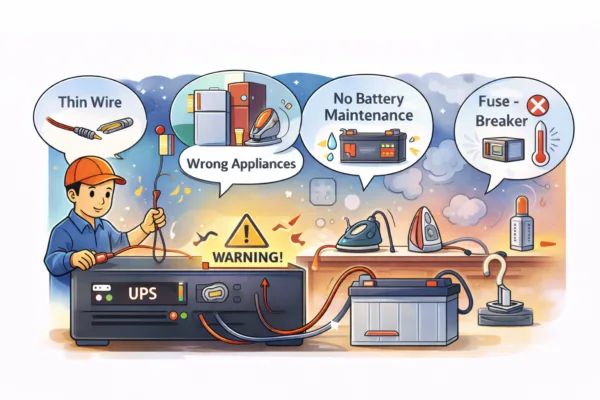
Most home inverter faults that are blamed on the inverter start in the cable between it and the battery. A cable that is too thin, too long or has no fuse wastes power as heat, lets the voltage sag so the inverter cuts out early, and in a short circuit leaves nothing between the battery and a fire.
How it works
- Current. Inverter watts ÷ (battery volts × 0.85 efficiency). This is the current the cable really carries at full load.
- Fuse. 125% of that current, rounded up to a standard DC fuse size.
- Cable by current. The smallest cable whose rating is at least the fuse, so the fuse always blows before the cable overheats.
- Cable by voltage drop. Enough copper that the voltage lost over the out-and-back length stays within the limit you chose.
The larger of steps 3 and 4 is the answer.
Before you buy cable
- Size for the inverter, not today's load. Loads grow. Replacing cable later is harder than buying the right size now.
- Use fine-stranded copper cable made for batteries or welding. It bends without cracking and fits proper lugs.
- Crimp lugs with the right tool. A loose or poorly crimped lug heats up at these currents just like a thin cable. Warm terminals after a long outage are the warning sign.
- Hot rooms and bundled cables carry less current. Go one size up if cables run through conduit, in a loft, or beside a hot inverter.
The ratings are for PVC-insulated copper clipped in open air at 30 °C, after IEC 60364-5-52. AWG equivalents are the nearest size at least as thick. Where your inverter manual specifies a larger cable or a particular fuse, follow the manual. The guide to common UPS installation mistakes covers the rest of a safe install.
Common questions
What size cable do I need for a 1000 W inverter on 12 V?
A 1000 W inverter can pull close to 100 A from a 12 V battery. With a 125 A fuse, that needs a cable rated above 125 A, which is 35 mm² (about 1 AWG) in open air. On 24 V the current halves and 16 mm² does the job.
What size fuse goes between the battery and inverter?
About 1.25 times the maximum continuous current, rounded up to a standard size, and never more than the cable can carry. Use a DC-rated fuse or breaker (ANL, MIDI, class T or a DC MCB) on the positive lead, as close to the battery as practical.
Why does battery cable need to be so much thicker than house wiring?
Power is volts times amps. At 12 V, the same 1000 W flows as roughly 20 times more current than at 230 V, and heat in a cable rises with the square of current. Thin cable at battery current wastes energy, sags the voltage and can melt.
Can I use a longer cable if I go up a size?
Yes. Voltage drop depends on length and thickness together, which is why the calculator may pick a thicker cable than the current alone needs. Keeping the inverter next to the batteries is still the better fix.
Put this calculator on your site
Free for installers, forums, schools and blogs. Paste this where you want it to appear. It stays up to date automatically and keeps a small credit link.
<iframe src="https://pakpowerguide.com/embed/battery-cable-size-calculator/" title="Battery to Inverter Cable & Fuse Size Calculator by Pak Power Guide" width="100%" height="820" style="border:1px solid #dde2dd;border-radius:2px;max-width:100%" loading="lazy"></iframe>