How Many Solar Panels Do You Need to Run a 1.5 Ton AC?
About five or six 550 W panels run a 1.5 ton inverter AC through a sunny day. The method for any AC size, plus the inverter and what it takes at night.
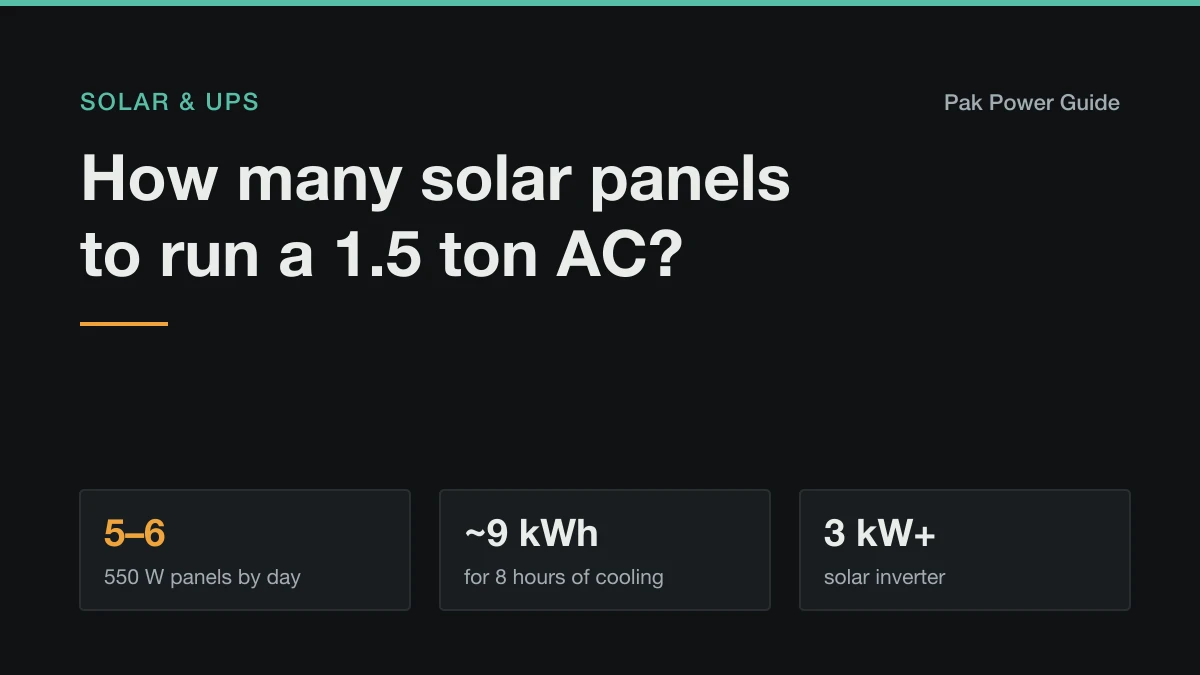
Short answer: about five or six 550 W panels (2.7–3.3 kW) run a 1.5 ton inverter AC through a sunny day, connected through a 3 kW or larger solar inverter. A fixed-speed (non-inverter) AC needs about seven. Running it at night is a battery question, and a much bigger one.
The same method works for any air conditioner, split or window, wherever you live. One ton of cooling is 12,000 BTU/h, so a 1.5 ton unit is an 18,000 BTU mini split.
The quick answer by AC size
For about eight hours of daytime cooling with 5 peak sun hours, typical of Pakistan, the Middle East and the sunny southern US:
| AC | Draws while cooling | Energy for 8 hours | Solar needed | 550 W panels | Inverter |
|---|---|---|---|---|---|
| 1 ton inverter AC | up to about 0.9 kW | about 6 kWh | 1.7–2.2 kW | 3–4 | 2 kW or more |
| 1.5 ton inverter AC | up to about 1.5 kW | about 9 kWh | 2.7–3.3 kW | 5–6 | 3 kW or more |
| 2 ton inverter AC | up to about 2 kW | about 12 kWh | 3.5–4.4 kW | 6–8 | 4 kW or more |
| 1.5 ton fixed-speed AC | about 1.8 kW | 12–14 kWh | 3.5–4 kW | 7 | 4 kW or more |
These cover the AC only. If the same panels also run the fridge, fans and lights, add those too.
How to work it out for your AC
- Find the running watts. On the rating label, or in the specs as "cooling power input". An inverter AC draws its most while pulling a hot room down, then often settles at 0.8–1.2 kW for a 1.5 ton unit.
- Work out the daily energy. Average watts × hours. A 1.5 ton inverter AC averaging about 1.1 kW for 8 hours uses about 9 kWh.
- Divide by your peak sun hours × 0.75. The 0.75 covers heat, dust, wiring and inverter losses. At 5 peak sun hours: 9 kWh ÷ (5 × 0.75) = 2.4 kW of panels at minimum.
- Add margin and round up to whole panels. Panels lose output in heat and haze, and the AC works hardest on the hottest afternoons. Around 25% extra gives 3 kW, which is five or six 550 W panels.
- Check the midday power too. The array's real output at noon, about 75% of its rating, should exceed what the AC draws at full effort. 3 kW of panels gives about 2.2 kW, comfortably above 1.5 kW.
Peak sun hours for your city are in the solar payback calculator's table: about 5–5.5 across Pakistan and much of India, around 6 in the Gulf, about 4 in New York and 2.5–3 in the UK.
The inverter matters as much as the panels
The solar inverter must carry the AC plus everything else that runs with it, and handle the compressor starting. For a 1.5 ton inverter AC, a 3 kW inverter is the minimum and 4–6 kW is more comfortable if the house shares it. Fixed-speed ACs draw a large start-up surge, so give them more headroom. The inverter size calculator includes an inverter AC in its list.
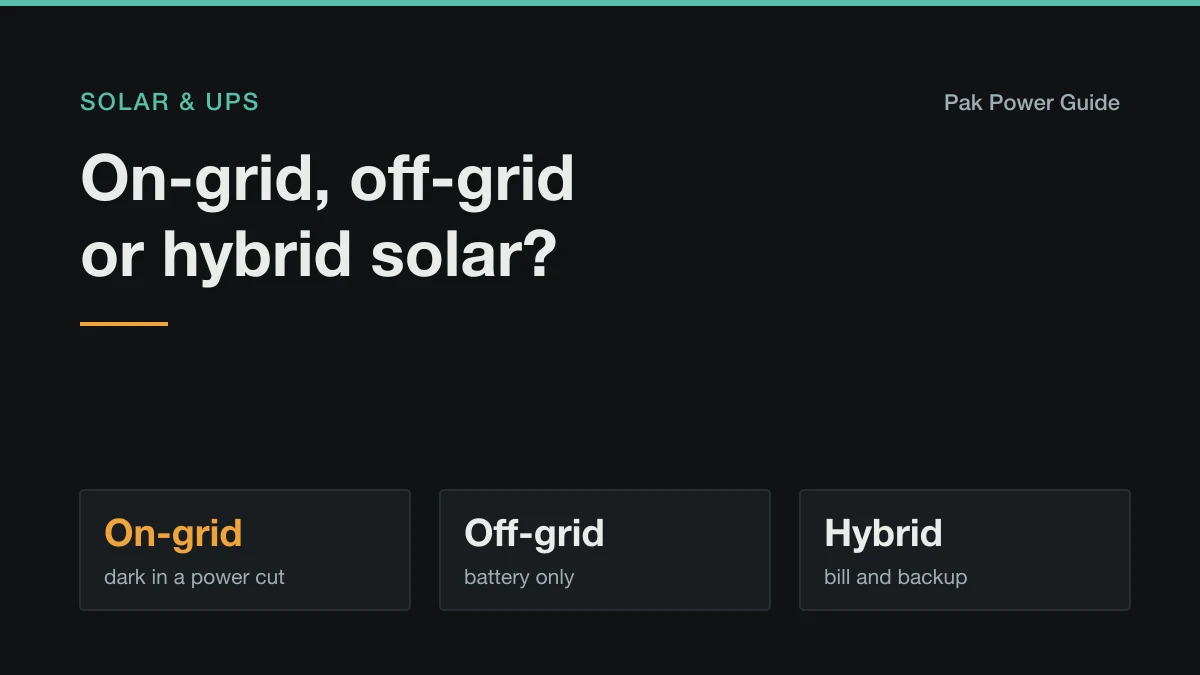
Which kind of system? An on-grid system runs the AC by day and lets the grid fill the gaps, but switches off in a power cut. A hybrid system keeps working in a cut, from the panels by day and the battery after. On-grid vs off-grid vs hybrid solar explains the choice.
Running the AC at night
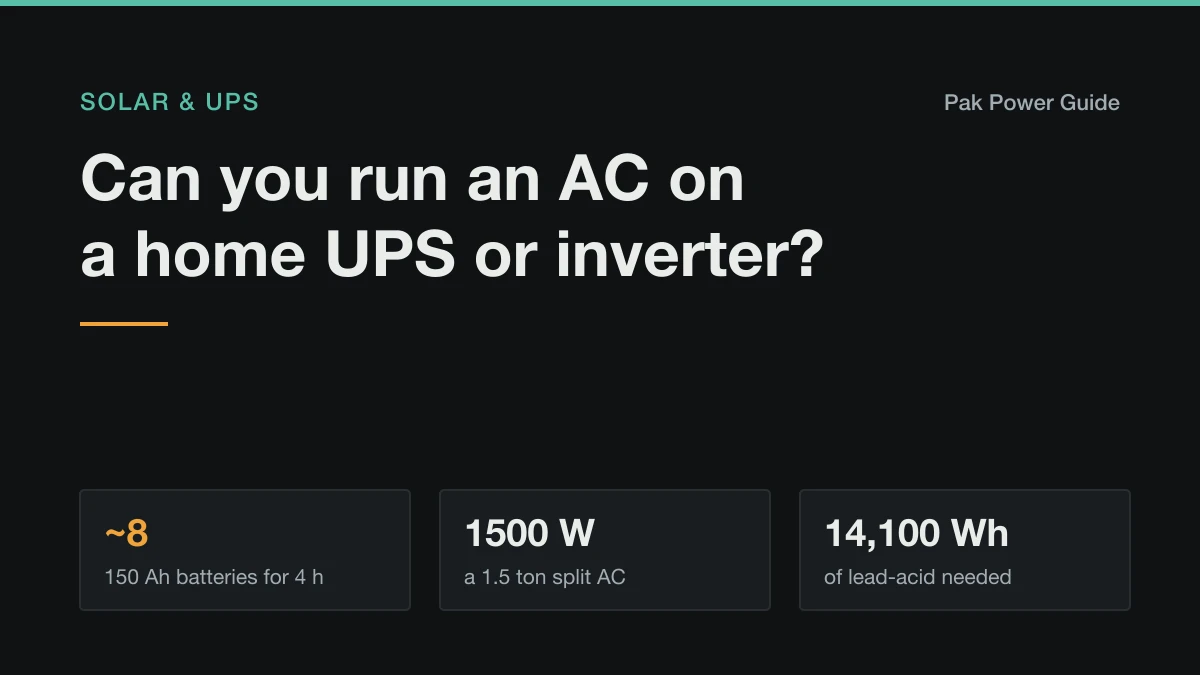
At night everything comes from the battery, and air conditioning is by far the biggest load a home battery can meet. Four hours of a 1.5 ton AC needs about 6 kWh delivered: roughly eight 12 V 150 Ah lead-acid batteries, or about 8 kWh of lithium. Can I run an AC on my home UPS works through the arithmetic and the alternatives.
Most solar homes run the AC from the panels by day, pre-cool the house in the afternoon, and use the grid or fans at night.
Getting more from the same panels
- Choose an inverter AC. It often uses a third to half less than a fixed-speed unit, and starts without a big surge.
- Set it to 26 °C, not 18. Each degree lower costs several percent more energy.
- Run it hardest when the sun is strongest, from late morning to mid-afternoon, and let the house coast in the evening.
- Angle the panels correctly and keep them clean. The tilt angle calculator gives the best angle for your city, and dust can cost more than a bad angle.
- Expect less in winter, when you need less cooling anyway: winter solar output.
Work it out for your own setup
Common questions
How many solar panels do I need for a 1.5 ton inverter AC?
About five or six 550 W panels, 2.7–3.3 kW, to run it through a sunny day with some margin, on a hybrid or on-grid inverter of 3 kW or more. That covers roughly 9 kWh of cooling over eight daytime hours where the sun gives about 5 peak sun hours.
Can a 1.5 ton AC run directly on solar panels without batteries?
By day, yes, through a solar inverter, as long as the panels produce more than the AC draws. When a cloud passes, the grid (on an on-grid or hybrid system) makes up the difference. Without the grid or a battery, the AC stops whenever solar falls short, and it cannot run at night.
How many solar panels do I need for a 1 ton AC?
About three or four 550 W panels, 1.7–2.2 kW, for a 1 ton inverter AC through the day, which uses roughly 6 kWh over eight hours of cooling. A 2 ton inverter AC needs about six to eight.
Can I run an AC on solar at night?
Only from a battery charged during the day, and it takes a lot of battery: four hours of a 1.5 ton AC needs about 6 kWh delivered, around eight 150 Ah lead-acid batteries or roughly 8 kWh of lithium. Most people run the AC on solar by day and on the grid at night.
Is an inverter AC better for solar?
Yes. An inverter AC starts gently instead of with a large surge, and slows its compressor once the room is cool, so it often uses a third to half less energy than a fixed-speed unit. That means fewer panels, a smaller inverter and far more hours from any battery.