Can I Run an Air Conditioner on My Home UPS or Inverter?
Four hours of a 1.5 ton AC needs about eight batteries. The arithmetic behind that, what a workable setup looks like, and what to do instead.
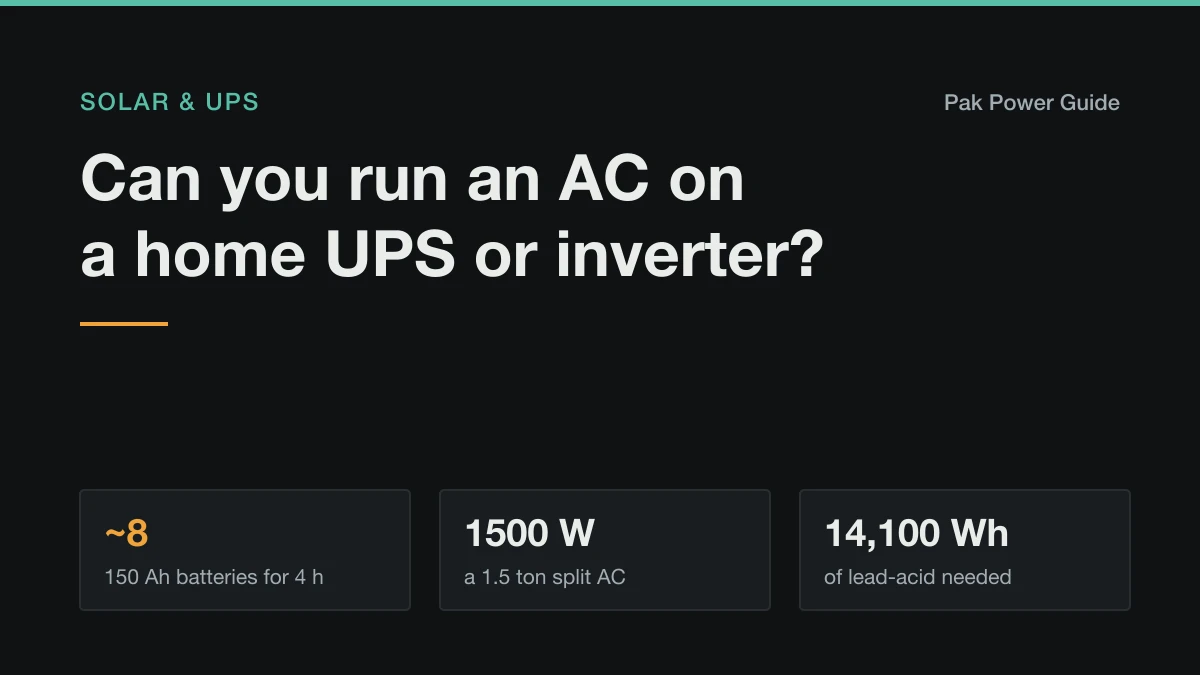
Not on a normal home UPS. The arithmetic is not close, and it is worth seeing rather than being told.
An air conditioner is not simply a large appliance — it is roughly ten times the load of everything else on your backup circuit combined, and it runs for hours rather than minutes.
The number that answers the question
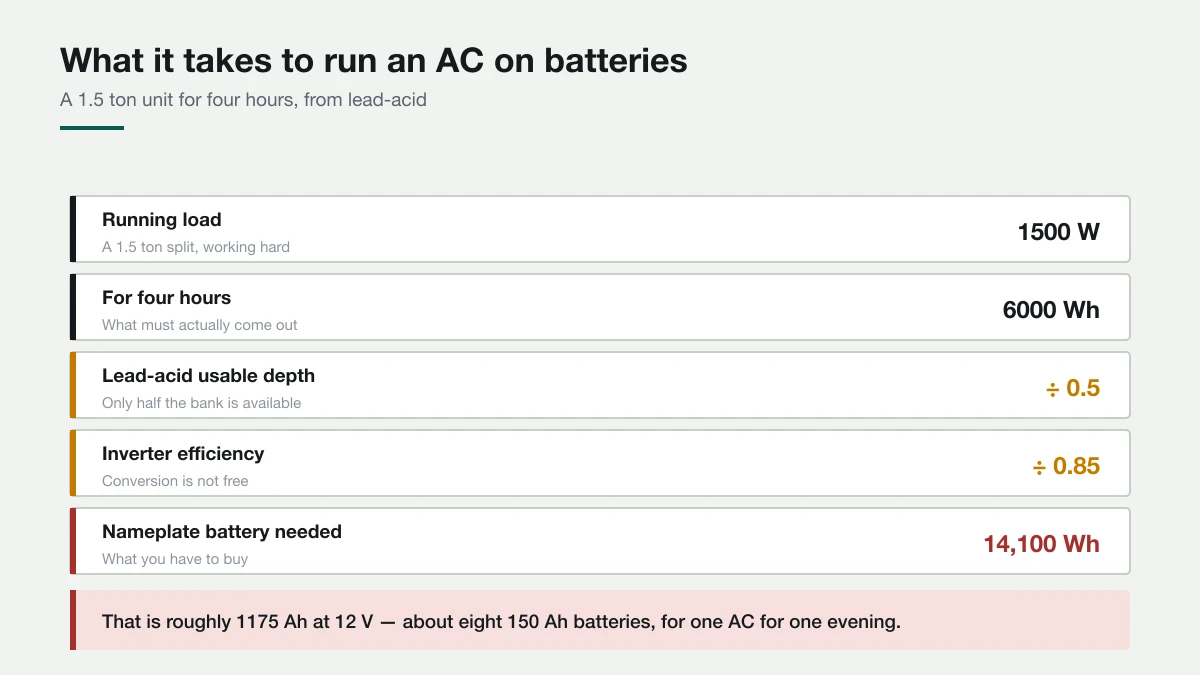
A 1.5 ton split running for four hours:
| Running load | 1500 W |
| For four hours | 6000 Wh |
| Lead-acid usable depth | ÷ 0.5 |
| Inverter efficiency | ÷ 0.85 |
| Nameplate battery needed | 14,100 Wh |
That is about 1175 Ah at 12 V — roughly eight 150 Ah batteries, for one air conditioner for one evening. Plus an inverter rated to carry 1500 W continuously and survive the compressor's start-up surge.
For comparison, a typical home setup is one or two batteries and a 1–1.5 kVA inverter. It is not marginally short. It is short by an order of magnitude.
Why the running watts are only half the problem
Running power. A conventional split draws roughly 1000–1800 W (1 ton), 1500–2500 W (1.5 ton), or 2000–3500 W (2 ton). A 1 kVA inverter delivers around 700–800 W of real power; a 1.5 kVA around 1000–1200 W. The running load alone exceeds it.
Start-up surge. A conventional compressor demands three to five times its running power for a fraction of a second. On a 1.5 ton unit that is a momentary spike well beyond 5000 W. Inverters that can carry the running load still trip on this.
Waveform. Modified sine wave is poor for compressors — humming without starting, higher current draw, extra heat, and shortened life for both the AC and the inverter. Anything with a chance of working here needs pure sine wave.
Inverter ACs change the maths, but not enough alone
A DC inverter air conditioner varies its compressor speed instead of cycling on and off. That gives two real advantages: a soft start with far less surge, and a much lower running draw once the room reaches temperature — sometimes 600–1200 W in mild conditions.
Two cautions before getting hopeful:
- In genuine summer heat it runs near full power, which is the exact situation you wanted backup for.
- The indoor and outdoor fans consume power continuously, even when the compressor eases off.
An inverter AC makes a large system viable. It does not make a small one viable.
What a workable setup actually looks like
If cooling on backup is a firm requirement:
- A DC inverter air conditioner, not a conventional one — for the soft start and the lower steady draw
- A hybrid solar inverter of 3–5 kW or more, pure sine wave, with surge headroom
- Solar panels sized to carry the AC in daylight, so the batteries are supporting rather than supplying — and sized for winter, when panels deliver roughly half their summer output
- A substantial battery bank, and realistically lithium — the depth of discharge and cycle life make an eight-battery lead-acid bank impractical to own. See lithium vs lead-acid
- Dedicated wiring from the inverter to the AC, sized for the current
This is a solar installation with air conditioning as its design goal, not a UPS with an AC plugged into it. Priced accordingly, and the honest comparison is against a generator — UPS vs generator vs solar sets that out.
Daytime outages are where this genuinely shines. With enough panels, an inverter AC can run largely on solar while the sun is up, with the batteries only smoothing the gaps. Overnight is a different and much more expensive problem.
What to do instead
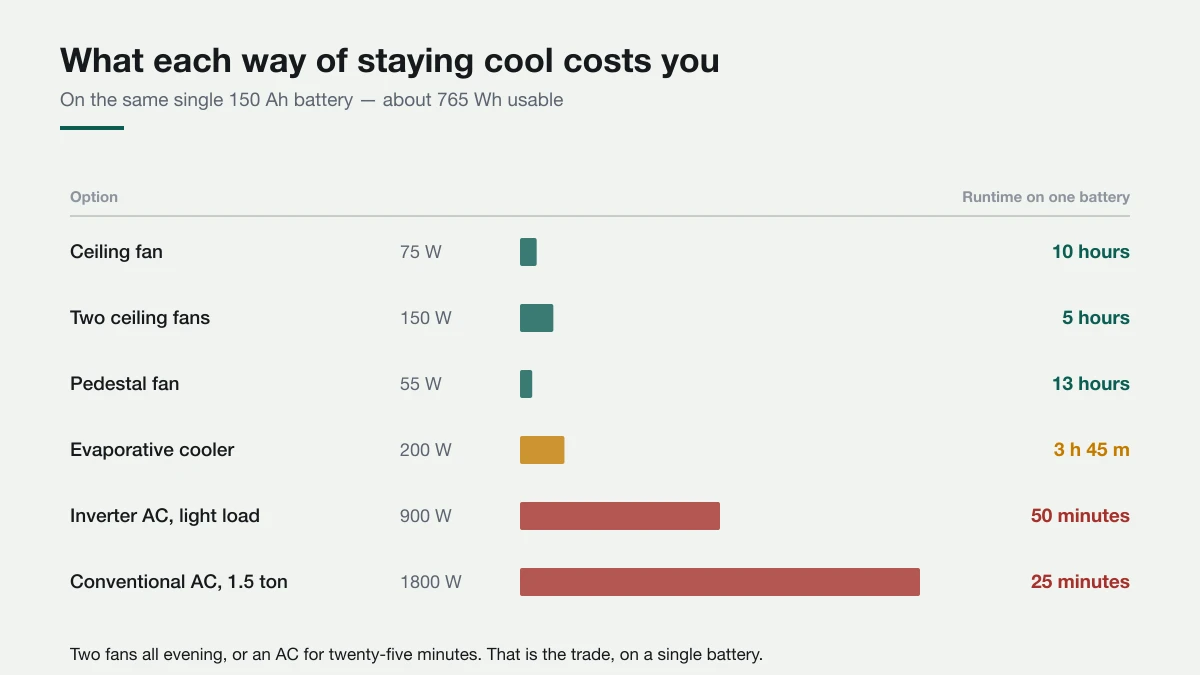
| Option | Draw | Runtime on one battery |
|---|---|---|
| Pedestal fan | 55 W | 13 hours |
| Ceiling fan | 75 W | 10 hours |
| Two ceiling fans | 150 W | 5 hours |
| Evaporative cooler | 200 W | 3 h 45 m |
| Inverter AC, light load | 900 W | 50 minutes |
| Conventional AC, 1.5 ton | 1800 W | 25 minutes |
That is the trade in one line: two fans all evening, or an air conditioner for twenty-five minutes.
Practical things that help more than they sound:
- Run the AC while the grid is on and close the room up. A well-sealed room holds temperature for a surprisingly long time after the compressor stops.
- Fans on backup, AC on grid. Moving air makes a room feel several degrees cooler for a twentieth of the power.
- An evaporative cooler where the climate is dry — far less power than an AC, though it does little in humid conditions.
- Shade and ventilation during the day. Keeping heat out is cheaper than removing it later.
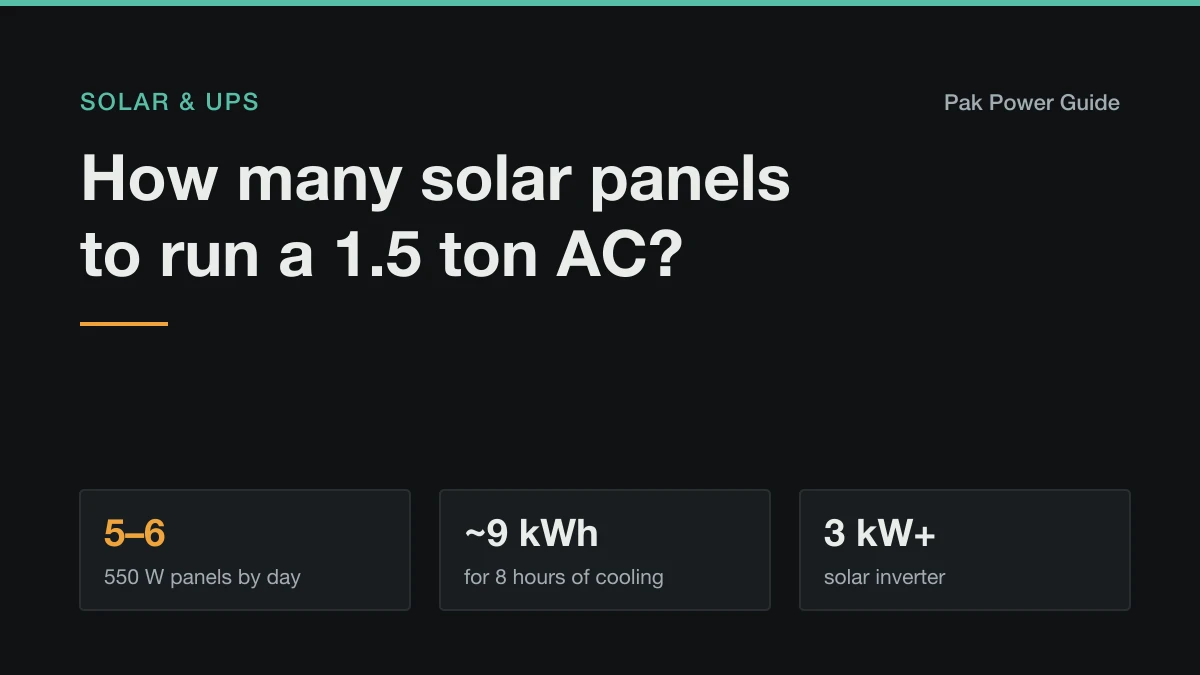
Running the AC from solar panels by day is the practical middle ground: how many solar panels run a 1.5 ton AC.
If you try it anyway
Two things not to do, because they cause real damage:
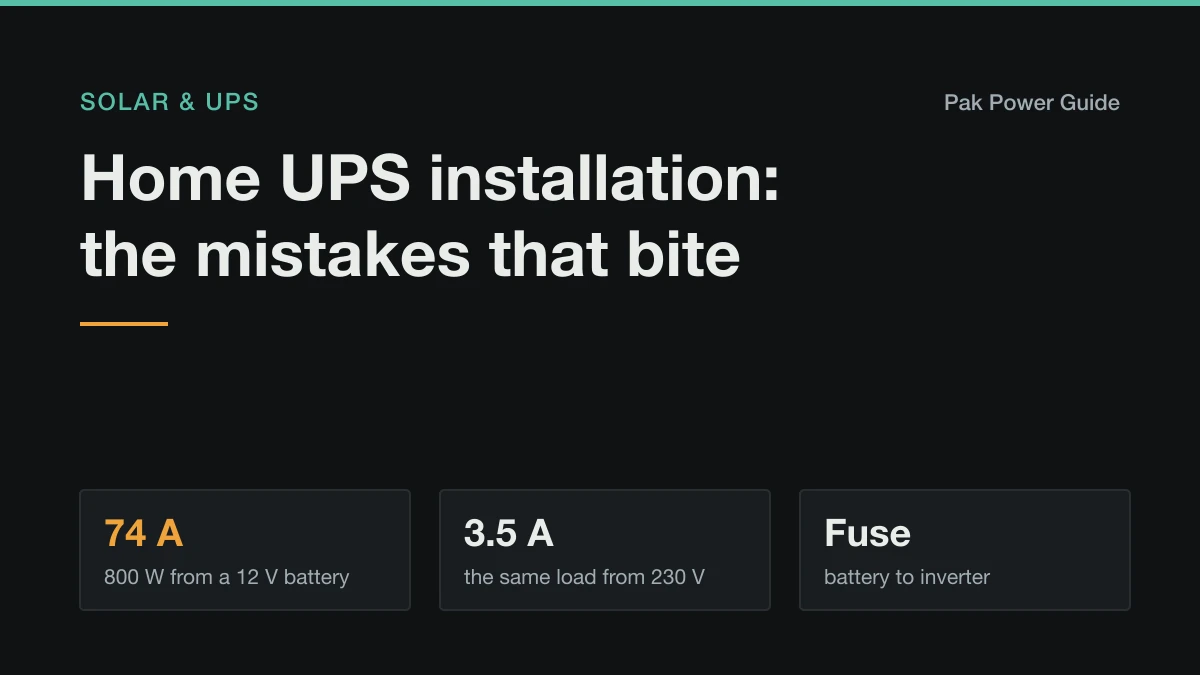
Do not let it retry repeatedly. If the inverter trips when the compressor starts, switch the AC off. Repeated stalled starts overheat compressor windings, and that is how an AC gets destroyed by a backup system.
Do not run a conventional AC on modified sine wave. The compressor draws more current, runs hotter, and fails earlier — and so does the inverter.
If the inverter beeps, gets hot, or the AC hums without starting, you have your answer. Related reading: what to avoid running on a UPS or inverter and understanding inverter load.
Work it out for your own setup
Common questions
How many batteries do I need to run a 1.5 ton AC?
For four hours at 1500 W you need about 6000 Wh at the socket, which is roughly 14,100 Wh of lead-acid battery once depth of discharge and inverter loss are allowed for. At 12 V that is about eight 150 Ah batteries, plus an inverter that can start the compressor.
Can a 1.5 kVA inverter run an air conditioner?
No. A 1.5 kVA inverter delivers roughly 1000–1200 W of real power, while a 1.5 ton conventional split draws 1500–2500 W running and several times that for a moment at start-up.
Can solar panels run an inverter AC during a power cut?
In daylight, with enough panels, a hybrid inverter of 3–5 kW or more and a DC inverter AC, yes. The panels carry most of the load and the batteries smooth the gaps. Overnight cooling on batteries alone needs a very large, usually lithium, battery bank.
What is the best way to stay cool on backup power?
Fans. One battery runs two ceiling fans for about five hours, or a conventional 1.5 ton AC for about 25 minutes. Cool and seal the room while the grid is on, then keep fans on backup.