UPS/Inverter Overheating in Hot Weather – Prevention Tips
An inverter turns about a tenth of what it delivers into heat. Where that heat goes decides whether it shuts down — and how fast your batteries age.
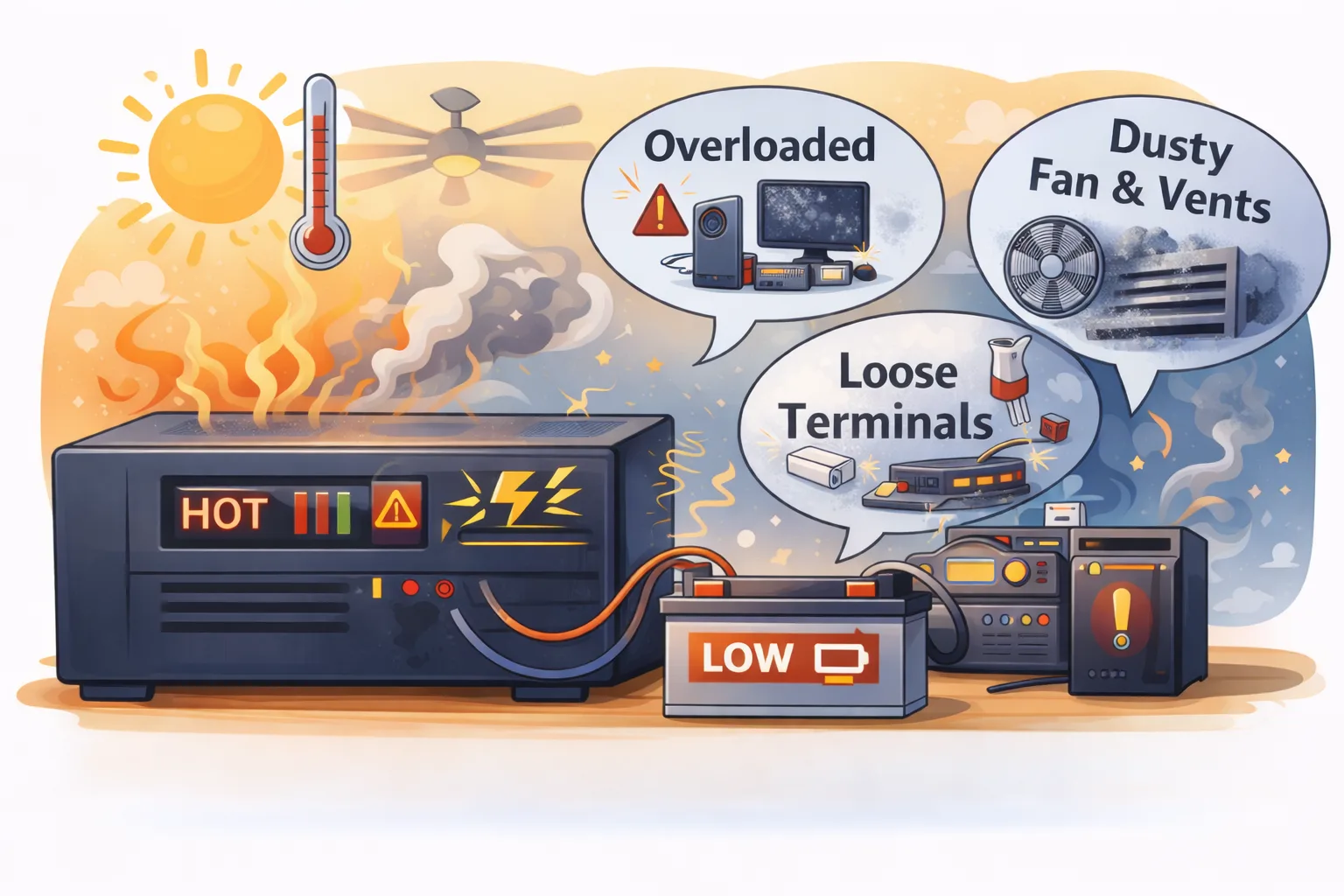
An inverter is a power converter, and no converter is perfect. The losses come out as heat — continuously, for as long as the outage lasts. In an open room that heat disperses. In a closed cabinet it accumulates until the unit protects itself by shutting down.
Warm is normal. Too hot to keep your hand on is not.
Where the heat comes from
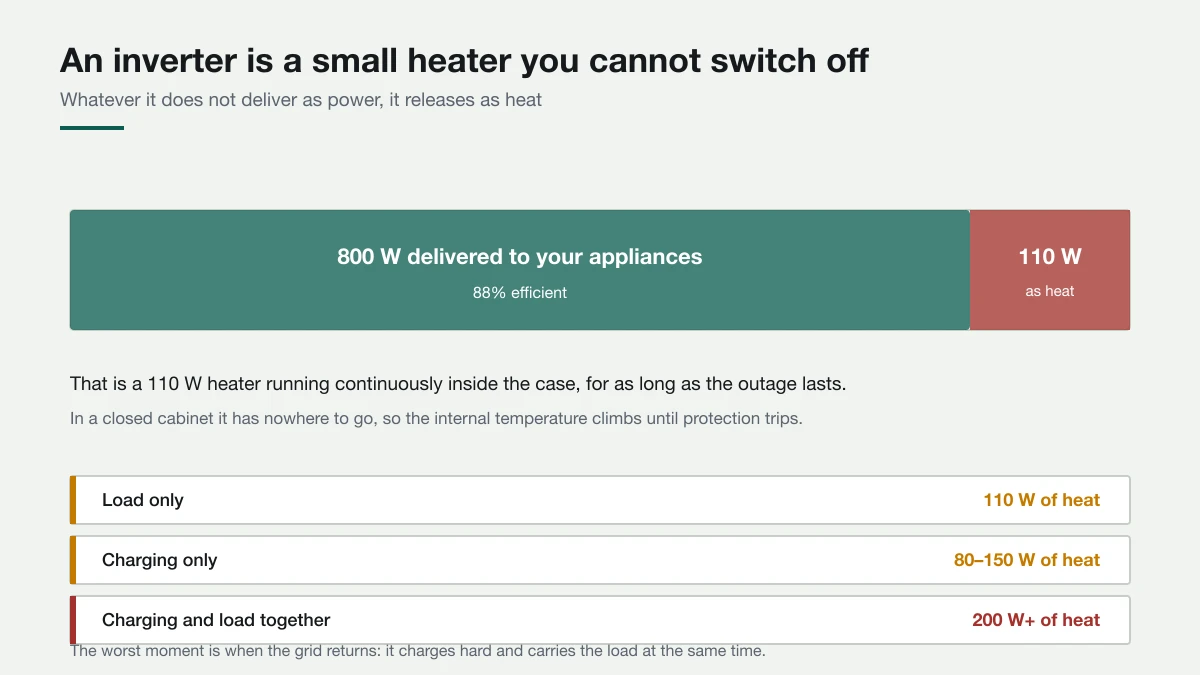
A typical home inverter runs at around 85–90% efficiency. Delivering 800 W to your fans and lights means roughly 110 W being released as heat inside the case — a small heater running continuously in whatever space you put it in.
Three situations, increasing in severity:
| Situation | Heat produced |
|---|---|
| Supplying load only | ~110 W |
| Charging batteries only | 80–150 W |
| Charging and supplying load together | 200 W+ |
That last row is why overheating so often happens just after the grid returns, not during the outage. The inverter is charging depleted batteries hard while still carrying the house, and both jobs make heat at once.
What overheating looks like
- The body is too hot to rest your hand on
- Hot plastic or burnt-wiring smell
- The cooling fan is loud, or is not running at all
- It shuts down on its own and restarts once cool — thermal protection working
- Battery cables or terminals are hot
- More beeping, or overload warnings at loads it used to handle
If you see melted insulation, sparking or smoke, switch it off at once and have it inspected before using it again.
Cause 1: it has nowhere to breathe
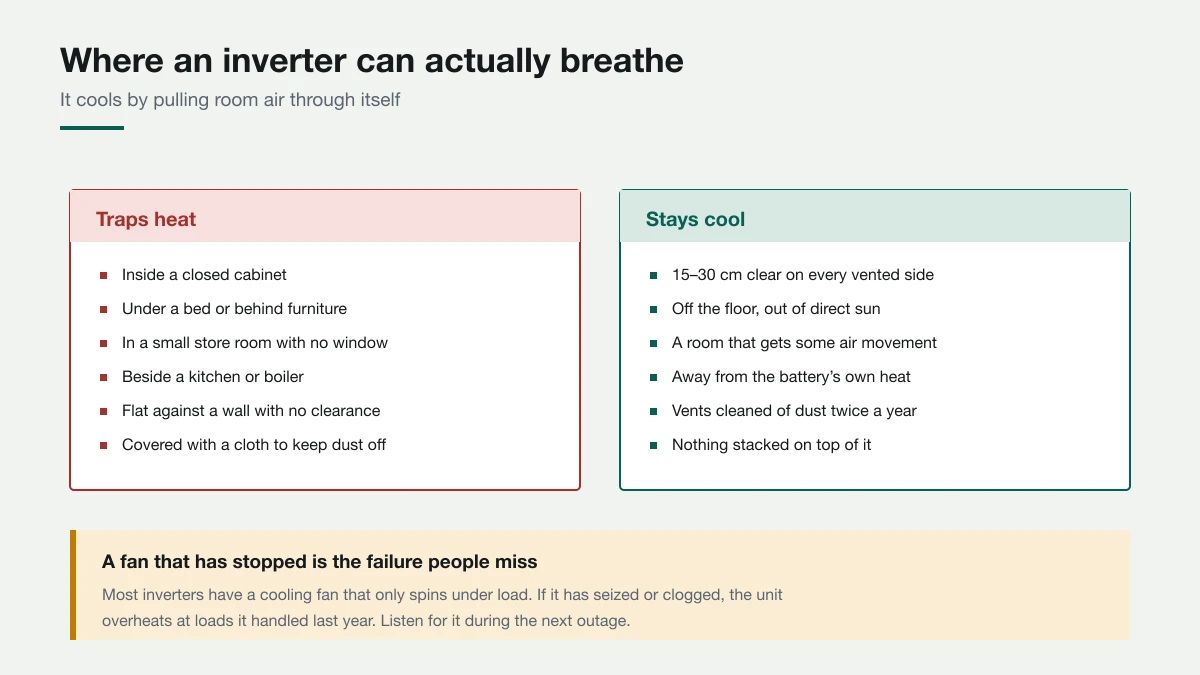
The most common cause by far. Inverters cool by drawing room air across their heatsinks, so anything obstructing that path raises the internal temperature directly.
Give it 15–30 cm of clear space on every vented side. Off the floor, out of direct sun, not against a wall, nothing stacked on top, and not covered with cloth to keep dust off — that cover is worse than the dust.
A living-room corner is usually better than a store room, even though the store room feels tidier. Airflow matters more than ambient temperature.
Cause 2: dust in the vents and a fan that has stopped
Dust builds into a felt-like layer over vents and heatsink fins and acts as insulation. Meanwhile most inverters have a fan that only spins under load — so a seized or clogged fan goes unnoticed until the unit starts overheating at loads it managed last year.
Twice a year: switch it off, look into the vents with a torch, and clear dust with a soft brush or blower. Never water. During the next outage, listen for the fan. Silence when it is working hard is a problem worth fixing.
Cause 3: it is running closer to its limit than you think
Heat rises with load, and load creeps. An extra fan here, a second TV there, and a backup circuit that quietly includes a socket nobody remembers connecting.
Worth doing the socket audit — walk the house during an outage and find out what is really on the backup line. A fridge or pump discovered there explains a lot of heat.
If the load is genuinely high for the unit, understanding inverter load covers sizing.
Cause 4: charging current set too high
A high charge-current setting makes the inverter work harder for longer every time power returns, producing more heat at exactly the moment it is already carrying the house.
For a flooded tubular battery, roughly a tenth of its capacity is the sensible rate — 15 A for a 150 Ah battery. Setting it high to refill faster costs heat and battery water, which is covered in why battery water runs out so fast.
The part that costs the most money: your batteries
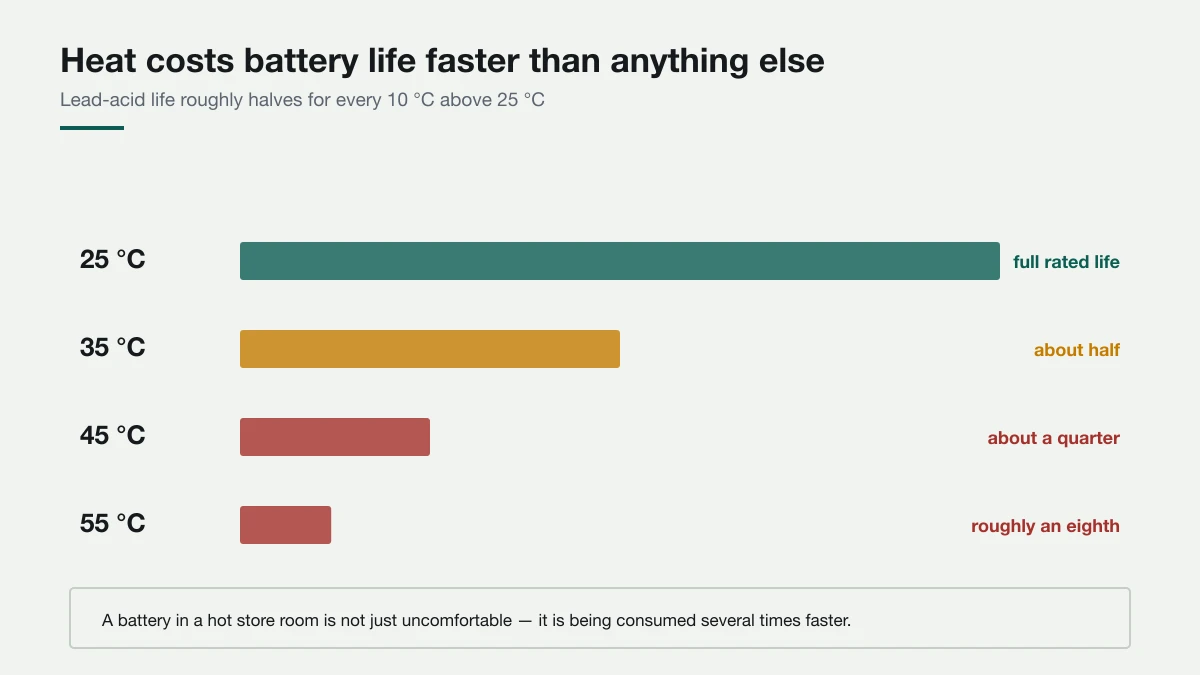
Heat is harder on the batteries than on the inverter, and the relationship is steeper than most people expect: lead-acid battery life roughly halves for every 10 °C above 25 °C.
| Battery temperature | Life expectancy |
|---|---|
| 25 °C | full rated life |
| 35 °C | about half |
| 45 °C | about a quarter |
| 55 °C | roughly an eighth |
A battery bank in a hot, unventilated store room is not merely uncomfortable — it is being consumed several times faster than the same bank in an airy room. That is often the real reason batteries "only last a year".
Heat compounds a second way: the correct charge voltage falls as temperature rises, so a charger with no temperature compensation overcharges all summer, gassing away water and accelerating wear.
Practical steps that work
Move it. The single most effective change, and free. Out of the cabinet, off the floor, away from the kitchen, with space around it.
Separate inverter and batteries. Both produce heat; sitting them together means each warms the other.
Clean the vents. Twice a year, more in a dusty area.
Shed load during the hottest hours. Fewer watts means less heat, immediately.
Drop the charge current if it is set high.
Add air movement, not cooling. A small pedestal fan pointed at the inverter during long summer outages does more than any enclosure change. Never enclose it to make it look tidier.
Do not run it in a sealed cupboard "for safety". Flooded batteries vent hydrogen, which needs ventilation of its own, and a sealed space concentrates it.
When to stop and call someone
- It shuts down repeatedly even after you have improved airflow and cut load
- The fan does not run at all under load
- Any burnt smell, discolouration or melted insulation
- Battery terminals hot enough that you cannot hold a finger on them
- Cables warm along their length rather than just at the ends — usually undersized cable
Ask them to check cable sizing against your actual load, terminal tightness and corrosion, the cooling fan, and whether the charge settings suit your battery type and the temperature it lives at.
Work it out for your own setup
Common questions
How hot is too hot for an inverter?
Warm is normal. If the case is too hot to keep your hand on, the fan is loud or silent under load, or it shuts itself down and restarts once cool, it is overheating. Melted insulation, sparks or smoke mean switch it off at once.
Why does my inverter overheat when the power comes back?
Because it is charging the drained batteries and supplying the house at the same time. Together that can release 200 W or more of heat inside the case, roughly twice as much as during the outage itself.
How much space does an inverter need around it?
About 15–30 cm of clear space on every vented side, off the floor, out of direct sun and never in a closed cabinet or under a cloth cover.
Does heat shorten inverter battery life?
Sharply. Lead-acid battery life roughly halves for every 10 °C above 25 °C, so a battery kept at 35 °C lasts about half as long and one at 45 °C about a quarter.