Why Does My Inverter Battery Drain So Fast Overnight?
Usually it is not the battery. Standby draw, always-on devices and a bank that never fully charged cause most of it — with the numbers to check each.
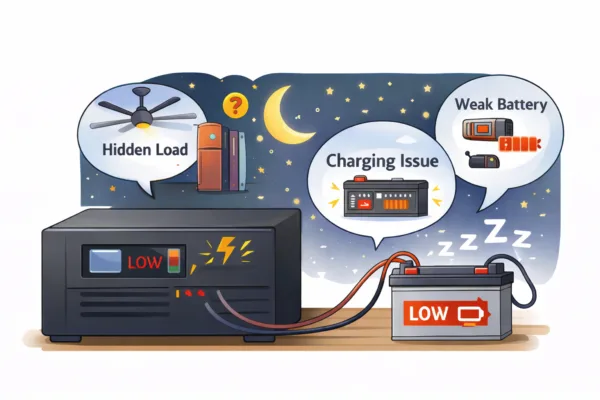
The instinct is to blame the battery, and sometimes that is right. More often the battery is fine and is being asked for more than you think — by things that draw very little but draw it for ten hours straight.
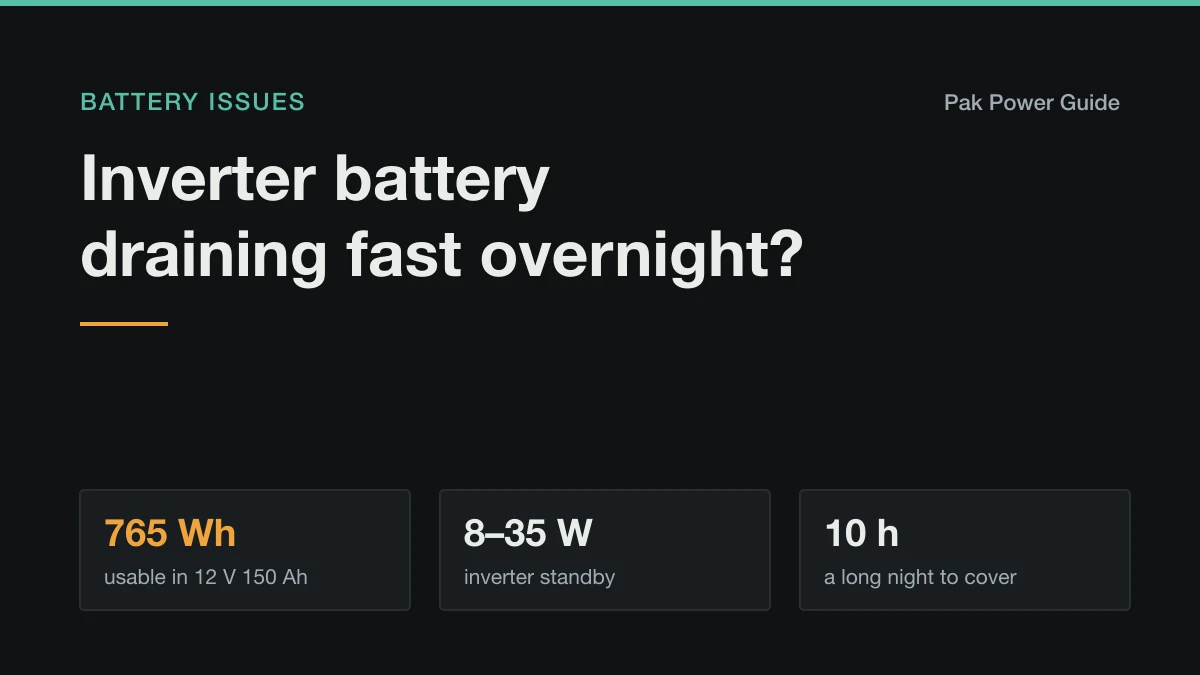
Start with the number that frames everything: one 12 V 150 Ah battery holds about 765 Wh of usable energy. Ten hours is a long time to spend it.
The load nobody counts: the inverter itself
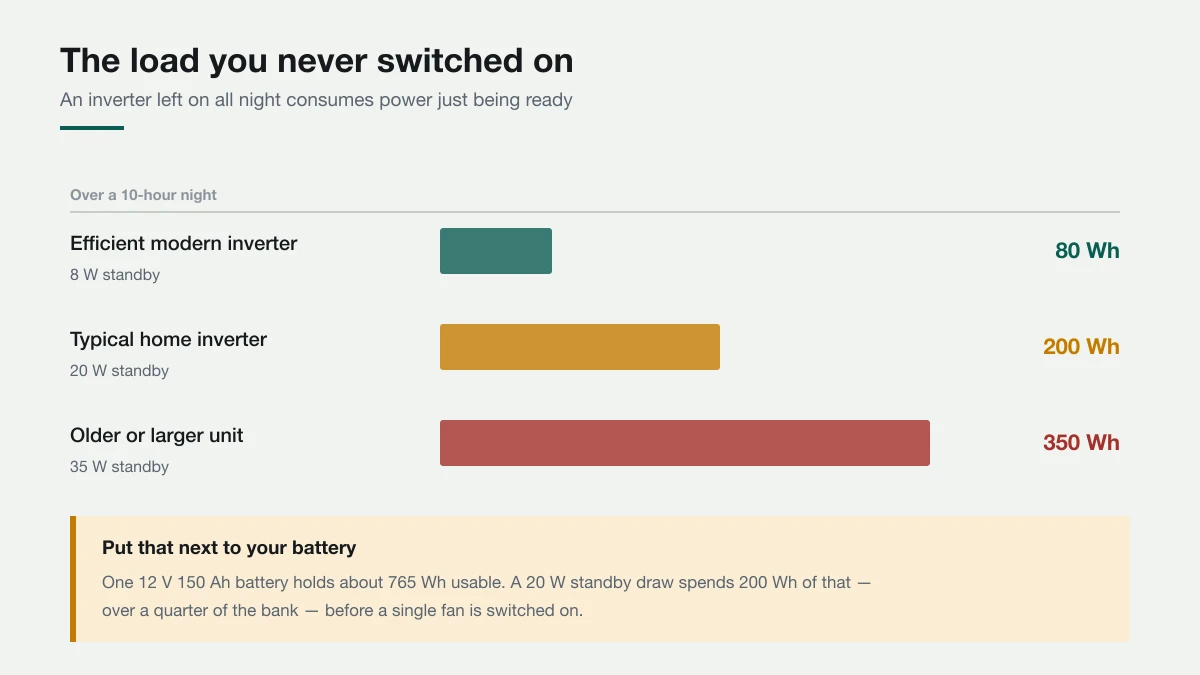
An inverter left on all night draws power just being ready. Not much at any instant — 8 to 35 W depending on age and size — but continuously.
| Inverter | Standby draw | Over a 10-hour night |
|---|---|---|
| Efficient modern unit | 8 W | 80 Wh |
| Typical home inverter | 20 W | 200 Wh |
| Older or larger unit | 35 W | 350 Wh |
A 20 W standby draw spends 200 Wh overnight — more than a quarter of that 765 Wh bank — before you switch anything on. This is the single most commonly missed cause of "it drains with nothing running", and no amount of battery replacement will fix it.
Where the rest of it goes
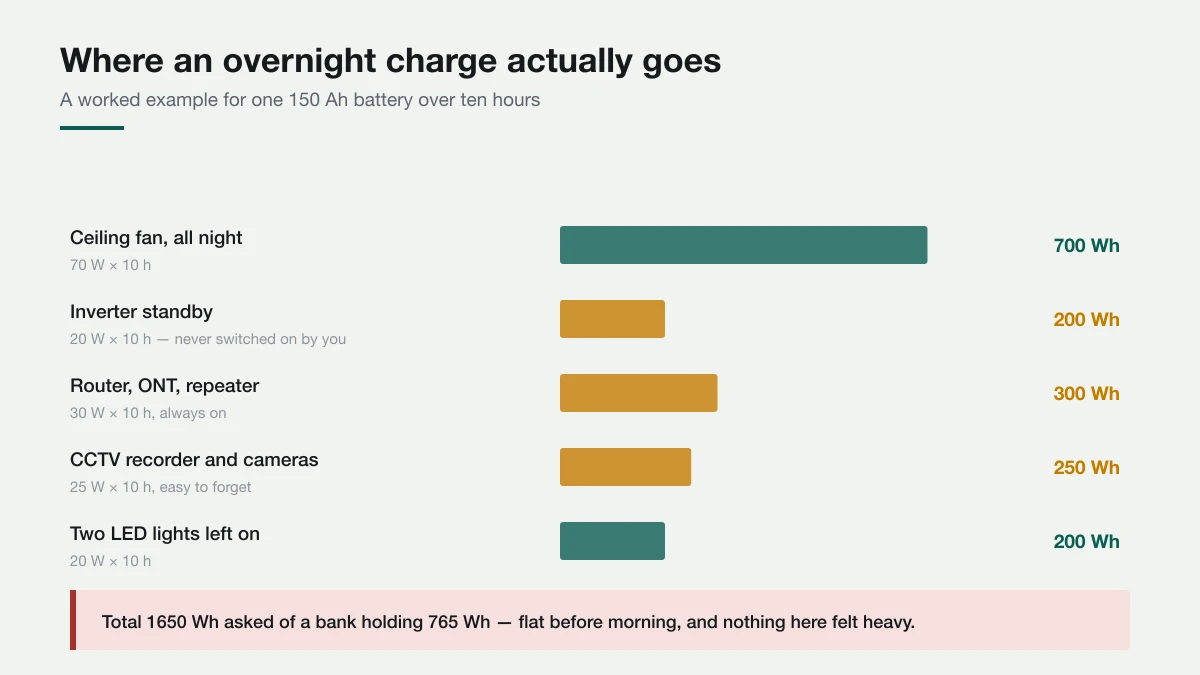
A realistic night on a single battery:
| Load | Over 10 hours |
|---|---|
| Ceiling fan (70 W) | 700 Wh |
| Router, ONT, repeater (30 W) | 300 Wh |
| CCTV recorder and cameras (25 W) | 250 Wh |
| Inverter standby (20 W) | 200 Wh |
| Two LED lights left on (20 W) | 200 Wh |
| Total | 1650 Wh |
Against a bank holding 765 Wh. It is flat well before morning, and nothing on that list felt like a heavy load.
Always-on devices are the quiet problem. A router and ONT draw perhaps 30 W, which is trivial for an hour and substantial across a night. CCTV is worse because people genuinely forget it is on the backup circuit.
The hidden-load test
One night, no tools:
- Switch off everything you can reach — every light, TV, charger, and anything on an extension board.
- Leave one fan and the Wi-Fi on backup.
- Photograph the inverter display (voltage or battery bars).
- Check again in the morning.
If backup is suddenly normal, the problem is extra load, not the battery. If it still drains, continue below.
For a more complete picture, do the socket audit — walk the house during an outage and find out what is genuinely on the backup line. A fridge or a pump controller quietly connected explains everything at once.
The night never started full
This is the second big one. If the battery began the evening at 70% because charging never finished, you lost 30% of your backup before the sun went down.
Lead-acid charging slows dramatically above 80%, so a grid window of three or four hours may leave the battery short — and many inverter displays report "full" once absorption begins, which is not the same thing. The details are in how long it takes to fully charge an inverter battery.
Two things to check:
- Charging current. A 150 Ah battery wants around 15 A. If your unit only manages 5–8 A, it will not finish between outages.
- Grid voltage when power returns. Many inverters reduce or stop charging on low incoming voltage, so charging time quietly doubles.
Terminals, cables and corrosion
Poor connections waste energy as heat and hinder charging in both directions.
With the inverter off, check that terminals are tight and free of the white or green powder that builds on lead-acid posts. Clean corrosion properly and re-tighten. During an outage, feel the battery cables near the terminals: warm is acceptable, hot means a loose terminal or undersized cable, and that is both a waste and a fire risk.
The battery genuinely is worn
Once the above are ruled out, age is the answer. A battery can show a healthy resting voltage and still have lost much of its capacity.
Signs it is the battery:
- Backup has shortened gradually over months rather than suddenly
- Voltage falls quickly from full under a modest load
- The low-voltage alarm arrives early
- It runs warm while charging
- Water needs topping up often — see why battery water runs out so fast
A quick capacity check: charge fully, run one fan and two LED bulbs, and watch the voltage over ten minutes. A healthy 12 V bank holds up well; a worn one sags visibly almost immediately.
Two things age batteries fastest: deep discharge and heat. Lead-acid life roughly halves for every 10 °C above 25 °C, so a battery in a hot store room is being consumed several times faster than one in an airy room.
How long a UPS battery lasts gives typical lifespans for each type and the signs that one is finished.
The wrong battery for the job
Car batteries are built to deliver a large current for a few seconds, then be immediately recharged. They are not built to be discharged deeply, night after night.
Used on an inverter, a car battery loses capacity within months. If yours is a starter-type battery, overnight drain is not a fault — it is the battery doing what that design does under this treatment.
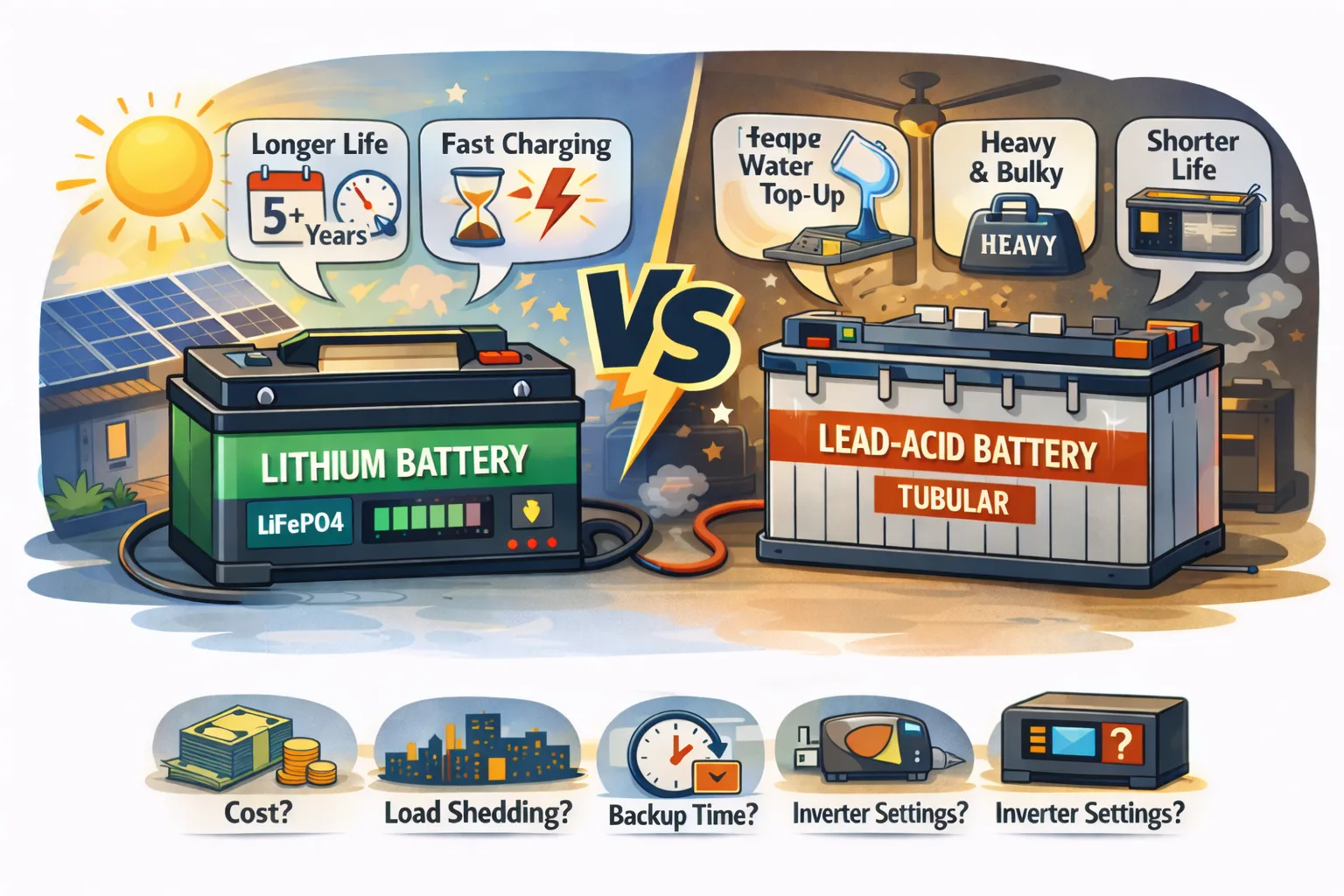
Tubular batteries are the lead-acid type intended for this duty. If you deep-cycle every night, lithium is worth the comparison — it tolerates 80% depth where lead-acid wants 50%.
Once the cause is fixed, how to increase UPS backup time shows which changes add the most hours for the money.
Working through it in order
- Do the hidden-load test. One night, one fan, Wi-Fi only.
- Add up the always-on devices — router, ONT, CCTV, standby. Multiply by ten hours.
- Switch the inverter off overnight when outages are unlikely, and see what changes. That isolates standby draw, though it is a trade-off — should you turn the inverter off covers when that is sensible.
- Confirm it reaches full before the evening.
- Check terminals and cables for tightness and heat.
- Only then suspect the battery.
Most people find their answer in the first three steps, and none of them cost anything.
Work it out for your own setup
Common questions
Why does my inverter battery drain overnight with nothing on?
The inverter itself draws 8–35 W in standby, and always-on devices such as the router, ONT and CCTV add more. A 20 W standby alone uses about 200 Wh over ten hours, over a quarter of a 150 Ah lead-acid battery's usable energy.
How long should a 150 Ah inverter battery last overnight?
It holds about 765 Wh usable. That covers roughly ten hours at about 75 W in total, including standby, so one fan, the router and the inverter's own draw can already use most of it. Add CCTV and a couple of lights and it will be flat before morning.
How do I know if my inverter battery is weak?
Rule out extra load first with a one-fan-and-Wi-Fi night. If backup is still short, a worn battery shows gradually shrinking backup over months, voltage falling quickly under a modest load, an early low-battery alarm, and frequent water top-ups.
Can a car battery be used with an inverter overnight?
Not for long. Car batteries are built for short bursts and quick recharging, and lose capacity within months when discharged deeply every night. Use a tubular deep-cycle or lithium battery for backup.