Which Battery Is Best for a Home UPS? Tubular, Dry (AGM/Gel) or Lithium
Tubular lead-acid is the value pick for occasional outages, lithium wins for daily ones, and sealed dry batteries suit rooms you cannot ventilate.
There is no single best battery, but there is a best battery for how your outages behave. The deciding question is how often you drain it.
- Occasional outages, a few times a week or less: a tubular lead-acid battery is the best value.
- Daily outages that drain it most nights: LiFePO4 lithium usually costs less over its life, despite the price on the day.
- Nowhere to vent it, or no one to top up water: a sealed AGM or gel ("dry") battery.
The four types compared
| Tubular flooded | Flat-plate flooded | Sealed AGM / gel ("dry") | LiFePO4 lithium | |
|---|---|---|---|---|
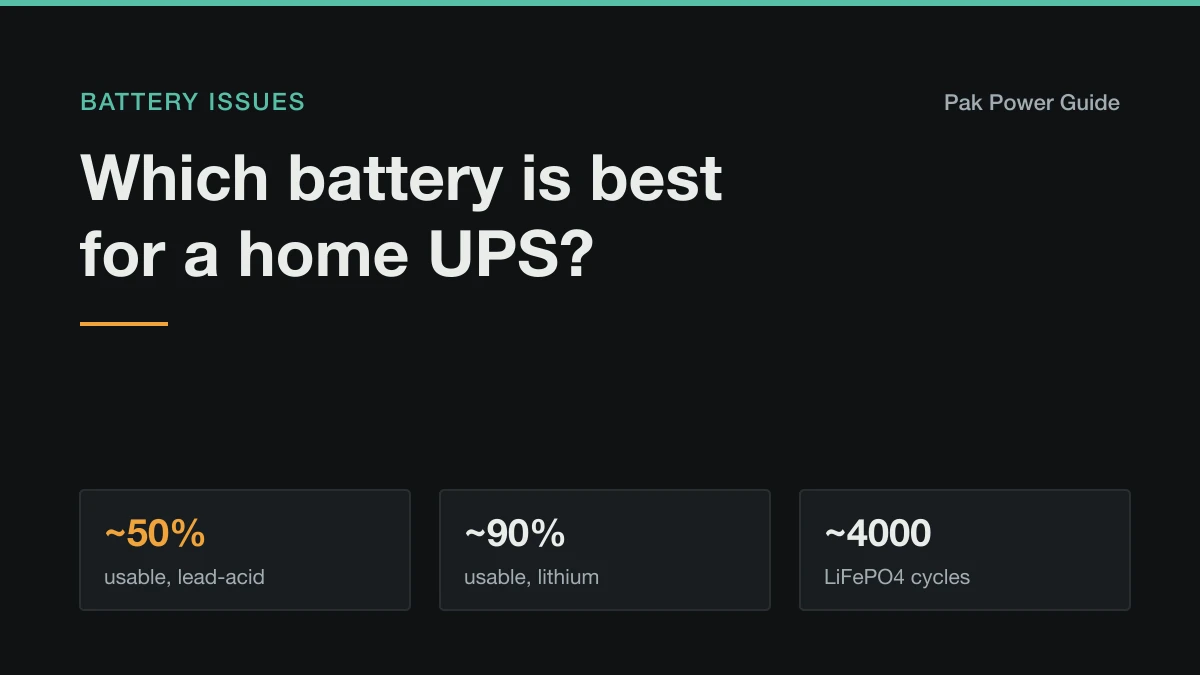
| Usable per cycle | about 50% | about 50% | about 50% | about 90% |
| Cycle life | about 700 deep, 1500 gentle | a few hundred | 300–700 | about 4000 at 80% depth |
| Typical life | 2–6 years | 2–4 years | 2–5 years | 10 years or more |
| Recharge time | 8–10 hours | 8–10 hours | 8–10 hours | 2–3 hours |
| Maintenance | Distilled water every few months | Water more often | None | None |
| Ventilation | Needed: gives off hydrogen | Needed | Little | None |
| Handles heat | Fairly well | Poorly | Poorly | Well |
| Price up front | Low | Lowest | Medium | Highest |
Tubular lead-acid: the value choice
Tall, heavy and needing water, tubular batteries are the standard for home inverters in Pakistan and across South Asia for a reason. Their thick tubular plates survive repeated deep discharges far better than flat plates, and they are cheap for the capacity.
They last years if you:
- Only use about half of their capacity in a normal outage.
- Let them charge fully between outages.
- Keep the water 10–15 mm above the plates, with distilled water only.
- Keep them cool. Lead-acid life roughly halves for every 10 °C above 25 °C.
If you are topping up far more often than every couple of months, the charging voltage is probably wrong: why the battery needs water so often.
Flat-plate flooded: cheapest, shortest-lived
Flat-plate batteries look like car batteries and are built more like them. They cost less but tolerate deep discharges poorly. They only make sense for rare, short outages on a tight budget.
Dry batteries: sealed AGM and gel
"Dry" batteries are not dry inside. They are sealed lead-acid (AGM or gel) that recombine their gases, so they need no water and give off very little gas. That makes them the choice for a flat, a cupboard or anywhere a flooded battery would be a nuisance.
The price is sensitivity. They cannot be topped up, so any overcharging or heat that dries them out shortens their life for good. In a hot room they often outlast a tubular battery by no margin at all. Set the inverter's battery type to AGM or gel, not flooded, or it will overcharge them.
LiFePO4 lithium: the long game
A LiFePO4 battery lets you use about 90% of its capacity against about half of lead-acid, recharges in two to three hours, needs no maintenance, and lasts around 4000 cycles: about eleven years with an outage every day.
It costs roughly four times as much as tubular up front. If you are replacing lead-acid every two years because of daily deep outages, lithium has usually paid for itself by about year five or six and keeps going. For occasional outages, the payback stretches too far to justify it. The full comparison is in lithium vs lead-acid for UPS.
Check compatibility before you buy. The inverter must be able to charge lithium to the voltages the battery maker specifies. On a lead-acid profile it may never charge fully, or the battery's BMS may cut it off.
Choosing the size
Chemistry is half the choice. The other half is capacity. Work out what your load uses through a typical outage and divide by the usable share: 0.5 for lead-acid, 0.9 for lithium, then by 0.85 for inverter losses.
| Load through a 4-hour outage | Lead-acid to buy | LiFePO4 to buy |
|---|---|---|
| 200 W (2 fans, lights, router) | about 1900 Wh: one 12 V 150–200 Ah | about 1050 Wh: one 12 V 100 Ah |
| 430 W (3 fans, lights, TV, router) | about 4000 Wh: two 12 V 200 Ah | about 2250 Wh: one 24 V 100 Ah |
| 610 W (the above plus a fridge) | about 4700 Wh: two 12 V 200 Ah | about 2600 Wh: one 12 V 220 Ah |
The inverter and battery size calculator works it out for your own appliances, and the backup time calculator shows what a given battery will run.
Whatever you choose
- Never mix old and new batteries, or different types, in one bank.
- Set the inverter's battery type to match the battery.
- Buy from a seller who will honour the warranty, and read whether it is full replacement or pro-rated.
- Keep the receipt and the installation date. Battery warranties are usually shorter than their real life.
How long each kind really lasts, and the signs it is finished, are in how long a UPS battery lasts.
Work it out for your own setup
Common questions
Which battery is best for a home UPS?
For occasional short outages, a tubular lead-acid battery is the best value and lasts years if kept charged, topped up and cool. For daily outages that drain the battery most nights, LiFePO4 lithium costs more up front but usually works out cheaper within about five to six years. Sealed AGM or gel suits places where a flooded battery cannot be ventilated or watered.
Is a dry battery or a wet battery better for a UPS?
A wet (flooded tubular) battery usually lasts longer and costs less per year for a home inverter, but needs distilled water every few months and ventilation. A dry (sealed AGM or gel) battery needs no water and can sit indoors, but it is more sensitive to heat and overcharging, so it tends to wear out sooner in hot climates.
Can I use a lithium battery with my existing UPS?
Only if the inverter can charge it to the voltages the battery maker specifies, through a lithium or user-defined battery setting. On a lead-acid charging profile a lithium battery may never charge fully or may be cut off by its own BMS. Many newer home inverters support lithium; older ones often do not.
What size battery do I need for my UPS?
Work out the watt-hours your load uses through a typical outage, then divide by the usable share: about 0.5 for lead-acid and 0.9 for lithium, and by 0.85 for the inverter's losses. The inverter and battery size calculator does it from your appliance list.