How Long Does a UPS or Inverter Battery Last?
About 3–5 years for a sealed computer UPS battery, 2–6 for tubular lead-acid and 10+ for LiFePO4. Heat and daily deep discharge shorten them all.

It depends far more on how the battery is used than on its brand. Two identical tubular batteries can last two years in one house and six in the next. The difference is how deeply they are drained, how often, and how hot they sit.
Typical lifespans
| Battery | Where you find it | Typical life |
|---|---|---|
| Sealed lead-acid (VRLA / AGM) | Inside computer UPS units | 3–5 years, less in a hot room |
| Sealed lead-acid (AGM / gel, "dry") | Home inverters | 2–5 years |
| Flat-plate flooded | Budget home inverters | 2–4 years |
| Tubular flooded | Home inverters | about 2 years cycled deeply every day, 4–6 years with gentle use |
| LiFePO4 lithium | Newer home inverters and power stations | around 10 years or more, even cycled daily |
Warranty periods are usually shorter than these lives and are often pro-rated. Read the terms rather than the headline number.
Why the same battery lasts two years or six
Depth of discharge. Every discharge and recharge is a cycle, and a battery has a limited number of them. The deeper each one, the fewer you get. With one outage a day, cycles turn straight into years:
| Use | Cycles | Years at one cycle a day |
|---|---|---|
| Tubular, gentle use (30% depth) | about 1500 | about 4 |
| Tubular, daily deep use (50% depth) | about 700 | about 2 |
| LiFePO4, daily deep use (80% depth) | about 4000 | about 11 |
The lithium vs lead-acid guide works through when that longer life pays for lithium's higher price.
Heat. Lead-acid life roughly halves for every 10 °C above 25 °C. A battery at 35 °C lasts about half as long as one at 25 °C; at 45 °C, about a quarter. Where the batteries sit matters more than which brand you bought. See overheating in hot weather.
Never finishing a charge. A lead-acid battery that spends its life part-charged sulphates and loses capacity for good. With short grid windows between outages, it may never reach full. How long a full charge takes has the figures.
Water and charging voltage. A flooded battery run with the plates exposed, or charged at too high a voltage, dies early. Topping up far more often than every couple of months is a sign the charging voltage is wrong: why a battery needs water so often.
Signs it is near the end
- Backup has halved compared with when it was new, at the same load.
- Voltage collapses under load. A healthy 12 V battery barely moves when the fans come on. A worn one drops several tenths of a volt at once.
- It reaches "full" quickly but empties just as fast.
- A replace-battery alarm returns after a full charge. On computer UPS units, this is the usual end-of-life signal.
- The case is swollen, cracked or leaking, or smells of rotten eggs. Stop using it.
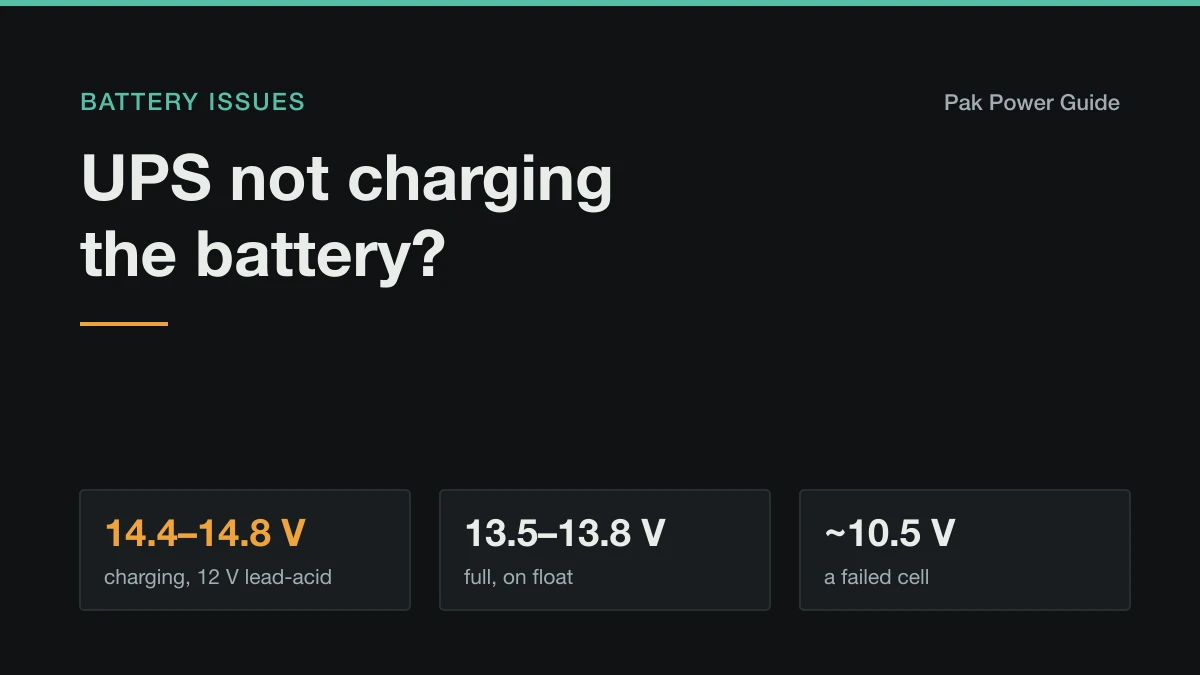
- A 12 V battery rests around 10.5 V after charging. One cell has failed.
Before you replace anything, rule out the charger and the load. A healthy battery that never finishes charging, or a load that has quietly grown, looks exactly like a worn battery. Why an inverter battery drains fast covers both.
How to make it last
- Size the battery so a normal outage uses half or less of a lead-acid battery's capacity. The backup time calculator shows the depth your load takes.
- Keep it cool, ventilated and out of direct sun.
- Let it finish charging, and set the charge current to about a tenth of the amp-hours.
- Match the battery-type setting on the inverter to the battery you have.
- Top up flooded batteries with distilled water only, after a full charge.
- Replace a bank all at once. A new battery wired beside old ones is dragged down to their level.
When to replace
Replace a lead-acid battery when backup has fallen to about half of what you need and a full, correct charge does not restore it. Replace it at once if it is swollen, leaking or hot. If you are replacing lead-acid every two years because of daily deep outages, look hard at lithium before buying the same again, and see which battery is best for a UPS.
Work it out for your own setup
Common questions
How long does a UPS battery last?
A sealed lead-acid battery in a computer UPS typically lasts 3–5 years, less in a hot room. A tubular inverter battery lasts about 2 years cycled deeply every day and 4–6 years with gentler use. A LiFePO4 battery rated for about 4000 cycles lasts around 11 years even with a deep cycle every day.
How do I know when my UPS battery needs replacing?
Backup has fallen to about half of what it was when new, the voltage collapses as soon as load is applied, the UPS shows a replace-battery alarm after a full charge, or the case is swollen, cracked or leaking. A flooded battery needing water much more often than it used to is another late sign.
How long does a UPS battery last on a single charge?
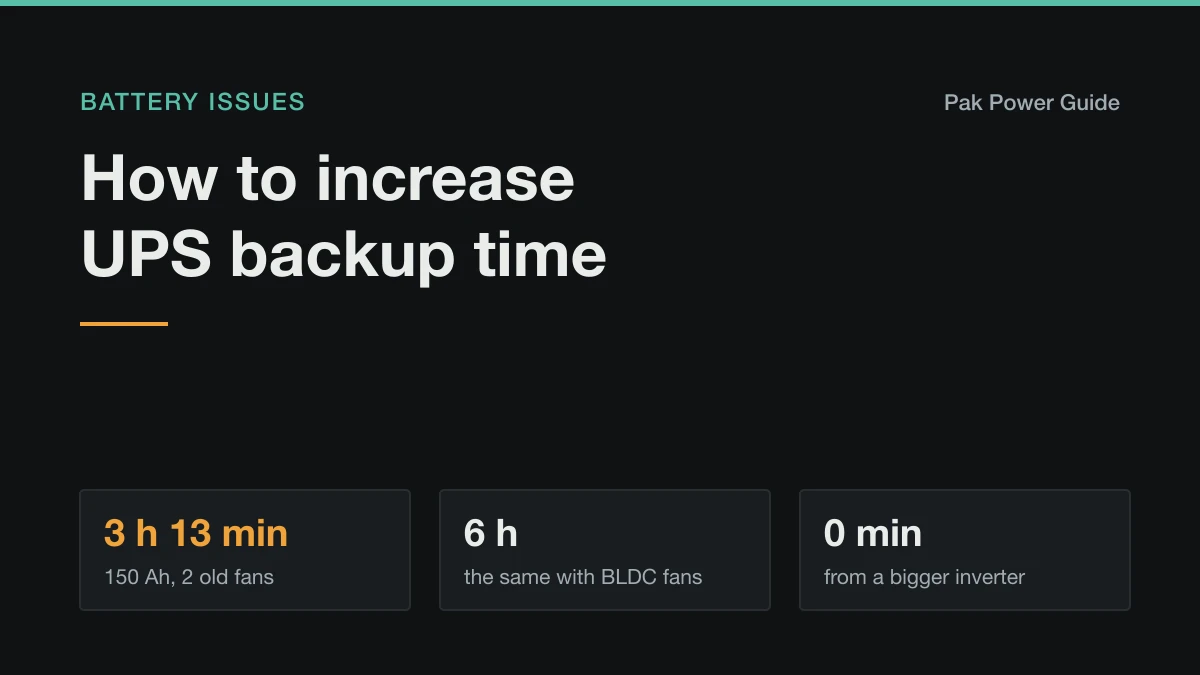
That is backup time rather than lifespan. A computer UPS runs a PC for about 5–30 minutes. A home inverter on one 12 V 150 Ah lead-acid battery runs two fans, a few lights and a router for a little over three hours. The backup time calculator works it out for your load.
Does heat reduce UPS battery life?
Sharply. Lead-acid battery life roughly halves for every 10 °C above 25 °C, so a battery kept at 35 °C lasts about half as long and one at 45 °C about a quarter. Keeping batteries out of a hot cupboard, loft or sunlit wall is the cheapest way to make them last.
Can a dead UPS battery be revived?
Rarely for long. A flooded battery that was only undercharged can sometimes recover capacity with a long, full charge and, where the maker allows, an equalising charge. A sealed battery that has dried out, or any battery with a shorted cell (a 12 V battery resting near 10.5 V), cannot be brought back.