UPS or Inverter Not Charging the Battery? Causes and Fixes
Low mains voltage, a wrong battery setting, a loose terminal or a worn battery cause most of it. How to tell which with one multimeter reading.
A battery that is not charging usually means one of five things, and a single reading on a multimeter narrows it down to one or two. You do not need to open the inverter.
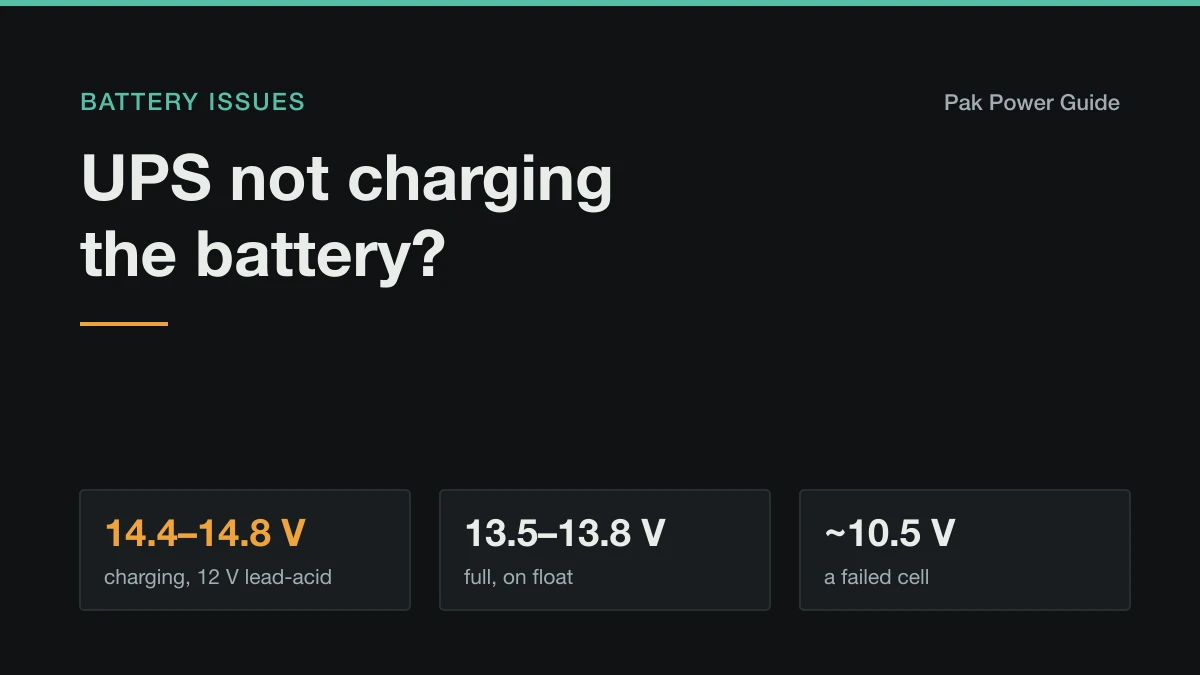
The reading that answers it: measure the voltage across the battery terminals while mains is on. On a 12 V lead-acid battery, a charging battery climbs to 14.4–14.8 V during the main charge and settles at 13.5–13.8 V once full. Double those figures for a 24 V bank. If the voltage just sits at its resting level of about 12.2–12.7 V, no charge is going in.
What the reading tells you
| Battery voltage with mains on (12 V) | What it means |
|---|---|
| 14.4–14.8 V, and backup is still short | It is charging. The battery is worn, or it is not given long enough. |
| 13.5–13.8 V all the time | It is on float, holding a full battery. Check it ever reached absorption. |
| Stuck at 12.2–12.7 V | No charge going in: mains, setting, connection, fuse or charger. |
| Around 10.5 V and will not rise | A failed cell, or a battery drained so deep the charger will not start. |
| Above 15.5 V for hours | Overcharging. Boils off water and shortens life. Check the settings. |
For a 24 V bank, double every figure. Take the reading at the battery posts themselves, not at the end of a long cable.
Cause 1: the mains voltage is too low
When the incoming voltage drops below the inverter's accepted range, it does not charge at all: it switches to battery and starts discharging. Near the bottom of the range many units charge weakly.
This is common where supply voltage sags in the evening peak, exactly when the battery should be topping up before night. Signs are dim lights on unprotected circuits and the inverter flicking to battery while the grid is technically on.
Many home inverters have two input modes: a narrow UPS mode for computers and a wider appliance mode. Appliance mode keeps charging from a lower voltage, which helps. Where voltage is chronically low, a stabiliser in front of the inverter is the usual fix. UPS vs inverter explains the two modes.
Cause 2: the battery type or charge current is set wrong
Most home inverters ask what battery they are charging. The setting decides the charging voltages and when the charge ends.
- Set to AGM or gel with a tubular (flooded) battery: it stops short and never quite fills the battery.
- Set to flooded with a sealed battery: it charges too hard and dries the battery out.
- A lead-acid setting with a lithium battery: it may stop short of full, or the battery's BMS may refuse the float voltage.
- Charge current set too low: it does charge, just too slowly to finish before the next outage. About a tenth of the amp-hour rating is right for lead-acid: 15 A for a 150 Ah battery.
Check the battery label, set the matching type, and read the charging time guide for how long a full charge really takes at your current.
Cause 3: a loose connection or a blown fuse
A loose, corroded or undersized connection lets through too little current to charge, and a blown DC fuse lets through none. Often the backup fails at the same time, because the same path carries both.
With the inverter and mains switched off:
- Check every lug is tight enough that it will not turn by hand.
- Look for white or green corrosion on the posts. Clean it off, then refit.
- Check the DC fuse or breaker between the battery and inverter.
- Look for melted insulation or scorching, which means that connection has been running hot.
Warm terminals after a charge are the warning sign of a poor joint. The battery cable size calculator shows what the cable and fuse should be.
Cause 4: the battery is worn out
A battery near the end of its life can look as if it will not charge. There are two tell-tale patterns:
- It charges suspiciously fast to full voltage, then collapses the moment load is applied. The plates are sulphated and hold little real capacity.
- A 12 V battery rests at about 10.5 V however long it charges. One of its six cells has shorted, and it cannot be recovered.
A battery drained completely and left flat for days can also fall below the voltage at which some chargers will start. If it does recover, expect it to have lost capacity for good. How long batteries normally last, and the signs that one is finished, are in how long a UPS or inverter battery lasts.
Cause 5: a lithium battery's BMS is protecting it
Lithium (LiFePO4) batteries have a battery management system that switches the battery off to protect it. It will refuse to charge:
- Below about 0 °C. Charging lithium in freezing conditions plates the cells, so the BMS blocks it.
- After a very deep discharge, until it is woken. Some need a short charge from a compatible charger first.
- At a voltage outside its range, for example on a lead-acid charging profile.
The battery maker's manual lists the charge voltages it needs. If your inverter cannot be set to them, the pairing is not compatible, however well the battery is made. The lithium vs lead-acid guide covers the compatibility checks.
Cause 6: a charger fault
If mains is good, the settings are right, the connections are sound, and the voltage still never rises, the charging circuit in the inverter has failed. That is a repair for the service centre, not a DIY job: the inside of an inverter holds dangerous voltages even when unplugged.
Check in this order
- Measure the battery voltage with mains on, and compare with the table.
- Check the mains voltage on the inverter's display. Is it inside the accepted range?
- Check the battery type and charge current settings against the battery label.
- Switch everything off and check terminals, cables and the DC fuse.
- Test the battery under load. A voltage that collapses means a worn battery.
- If all of that is fine, the charger has failed. Get the inverter serviced.
When to stop
Switch off and get help if the battery is swollen, leaking, hot to the touch, or smells of rotten eggs. That smell is hydrogen sulphide from a battery being overcharged, and it means the charger is doing the opposite of what you feared.
Work it out for your own setup
Common questions
How do I know if my UPS is charging the battery?
Measure the battery voltage with a multimeter at the terminals while mains is on. On a 12 V lead-acid battery it should climb to about 14.4–14.8 V during the main charge and settle at 13.5–13.8 V when full (double for 24 V). If it sits at the resting voltage, around 12.2–12.7 V, and never rises, the battery is not being charged.
Why is my UPS battery not charging fully?
Usually because it is not given enough time or current: a 150 Ah lead-acid battery needs about ten hours from half empty on a 10 A charger, and the last fifth is the slowest. A charge current set too low, a battery-type setting that ends the charge early, and low mains voltage are the other common causes.
Can low voltage stop an inverter from charging?
Yes. When mains voltage falls below the inverter's accepted range it switches to battery instead of charging it, and near the edge of the range many units charge slowly or not at all. Chronic evening low voltage is one of the most common reasons batteries never reach full in South Asia.
Why is my new lithium battery not charging on my old UPS?
The UPS is probably charging to a lead-acid profile. It may stop short of full, hold a float voltage the lithium battery does not want, or never reach the voltage the BMS needs. Check that the inverter has a lithium or user-defined battery setting with the voltages the battery maker specifies; if not, it is not a compatible pairing.
Is a UPS battery that will not charge dead?
Not necessarily. Check the connections and fuse, the mains voltage and the battery-type setting first. If the battery reaches charging voltage quickly but collapses as soon as load is applied, or a 12 V battery reads around 10.5 V at rest, one cell has likely failed and it needs replacing.