Load Shedding: Sizing Backup Power for Daily Scheduled Cuts
With cuts every day, the battery must refill between them. How to size for recharge time as well as backup, and why lithium often pays off.
Load shedding, the scheduled rotating power cuts used in South Africa, Pakistan, Nigeria and elsewhere when supply falls short of demand, turns backup sizing into a timing problem. The question is not only how long the battery lasts. It is whether it can refill before the next cut.
Two numbers to size for
1. Backup for the longest cut. Load × hours of your longest cut, then gross it up for usable depth and inverter loss:
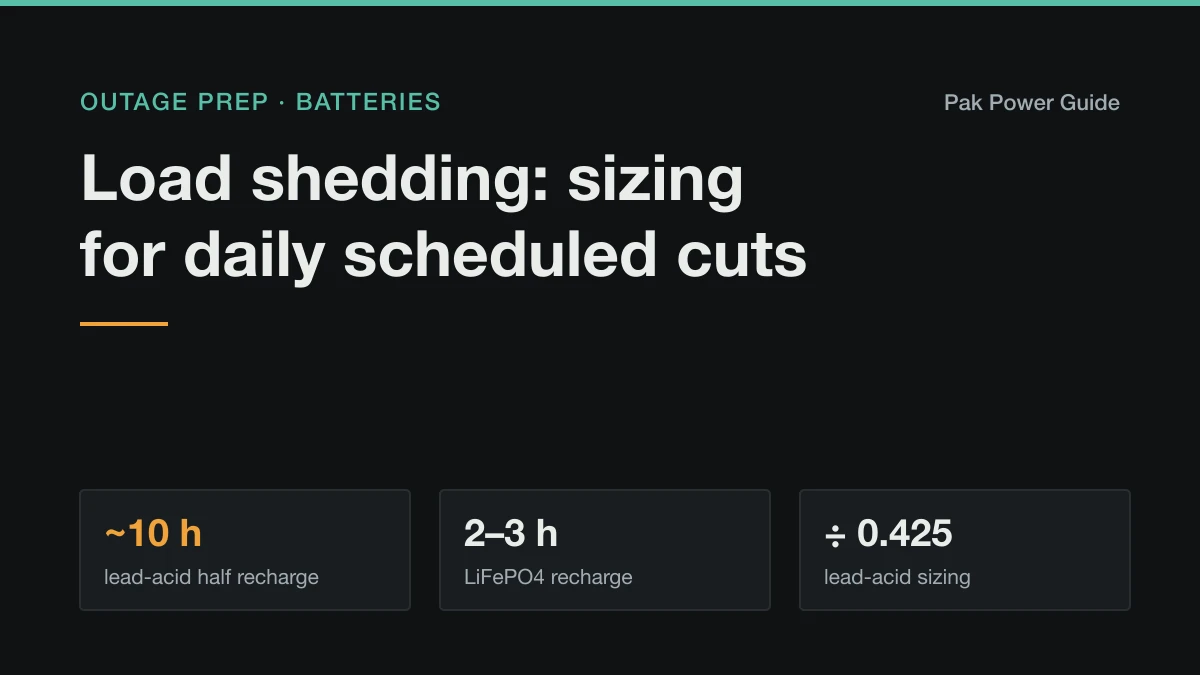
- Lead-acid: Wh needed ÷ 0.425 (half the battery × 85% inverter efficiency)
- LiFePO4: Wh needed ÷ 0.765 (90% × 85%)
A 400 W evening load through a 2.5-hour cut is 1000 Wh, so about 2350 Wh of lead-acid (200 Ah at 12 V) or 1300 Wh of LiFePO4. The backup time calculator checks any combination.
2. Recharge before the next cut. Energy to replace ÷ charging power. Roughly:
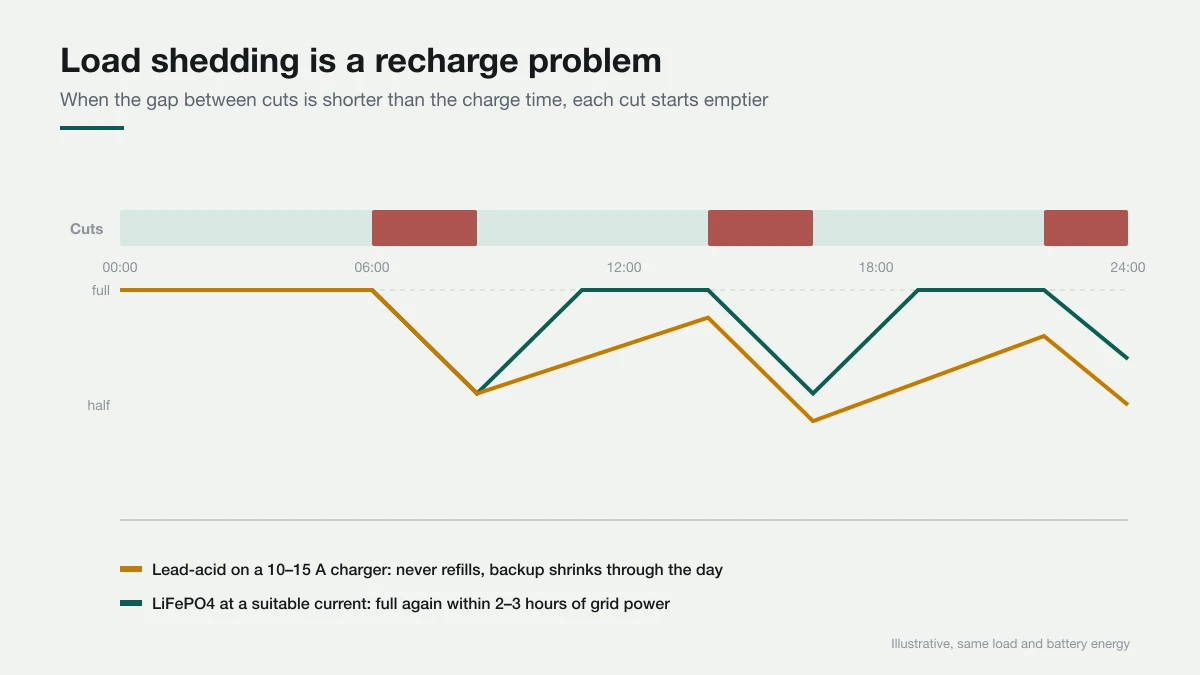
- Lead-acid accepts about a tenth of its capacity in amps (15 A for 150 Ah), and slows to a trickle for the last 20%. Refilling half a 150 Ah battery takes about ten hours. The details are in how long an inverter battery takes to charge.
- LiFePO4 can typically charge at a third to half of its capacity in amps, and takes nearly the full current until it is almost full. The same energy goes back in two to three hours, if the charger can supply it.
If the gaps between cuts are shorter than your recharge time, the bank starts each cut emptier than the last and backup shrinks through the day.
Why load shedding kills lead-acid batteries
A lead-acid battery that is regularly discharged and not fully recharged sulphates: hard crystals form on its plates and capacity is permanently lost. Daily cuts with short gaps are close to the worst case. It is common for batteries in these conditions to lose much of their backup within a year or two.
What helps, in order of cost:
- Raise the charge current to suit the battery, if your inverter allows it and the battery maker approves (typically up to about C/10 for tubular batteries).
- Cut the backup load. Every watt not used is a watt not to put back. LED bulbs and efficient BLDC fans make a large difference.
- Keep heavy loads off while charging. The charger feeds the house first.
- Give it a full charge whenever there is a long stretch of grid power, such as overnight.
- Switch to lithium when the lead-acid bank is due for replacement.
The case for lithium under load shedding
| Daily cutting | Lead-acid (tubular) | LiFePO4 |
|---|---|---|
| Usable capacity per cut | ~50% | ~80–90% |
| Recharge speed | Slow, especially last 20% | Fast almost to full |
| Partial charging | Damages it | No harm |
| Cycle life | ~800–1500 at 50% | 3000+ |
LiFePO4 costs more up front, but under daily cycling it often costs less per year of service. Check that your inverter has a lithium charging profile or adjustable voltages before switching; the lithium vs lead-acid guide covers compatibility.
Solar changes the timetable
If cuts fall during the day, a hybrid inverter with solar panels recharges the battery and runs the house at the same time, independent of when the grid returns. Evening and night cuts still need the battery, but it starts them full. For a long-term view of cost, the solar payback calculator works in any currency.
When the power comes back
The grid often returns with low or unstable voltage, and every fridge, pump and AC in the street starts at once.
- Switch heavy appliances off during the cut and back on one at a time, a minute or two apart.
- Check the inverter's input voltage range. A narrow "UPS" setting protects computers but may reject weak grid power, running the battery down while the grid is technically on. A wider "appliance" setting accepts it.
- Surge protection on the main board helps protect electronics from the spike at switch-on.
To see how a generator compares with batteries for the same timetable, use the generator vs battery cost calculator.
Work it out for your own setup
Learn it by playing

Common questions
What size inverter battery do I need for load shedding?
Size it for the longest single cut: load watts × hours, divided by 0.425 for lead-acid or 0.765 for LiFePO4, then by the system voltage for amp-hours. A 400 W load for 2.5 hours needs about 2350 Wh of lead-acid, around 200 Ah at 12 V. Then check the charger can refill it before the next cut.
Why does my inverter battery never fully charge during load shedding?
Lead-acid batteries charge slowly, especially the last 20%, and a typical 10–15 A charger needs 8–10 hours to refill a half-empty 150–200 Ah battery. With only a few hours of grid power between cuts, it never finishes, which shortens its life. A higher charge current, a smaller load, or lithium fixes it.
Is lithium worth it for load shedding?
For daily cuts, usually yes. LiFePO4 can recharge in two to three hours at a suitable current, can use 80–90% of its capacity every day, and lasts thousands of cycles. Lead-acid cycled daily and never fully charged often fails within one to two years.
Should I switch appliances off before the power comes back?
It helps. When the grid returns, voltage can dip or spike and every compressor and motor tries to start at once. Turning off heavy loads such as ACs, pumps and fridges and bringing them back one at a time protects them and the inverter.