Should I Turn Off My UPS or Inverter When Not in Use?
Usually leave it on. Switching off saves 8–35 W of standby but also stops charging, and a lead-acid battery left partly charged loses capacity permanently.
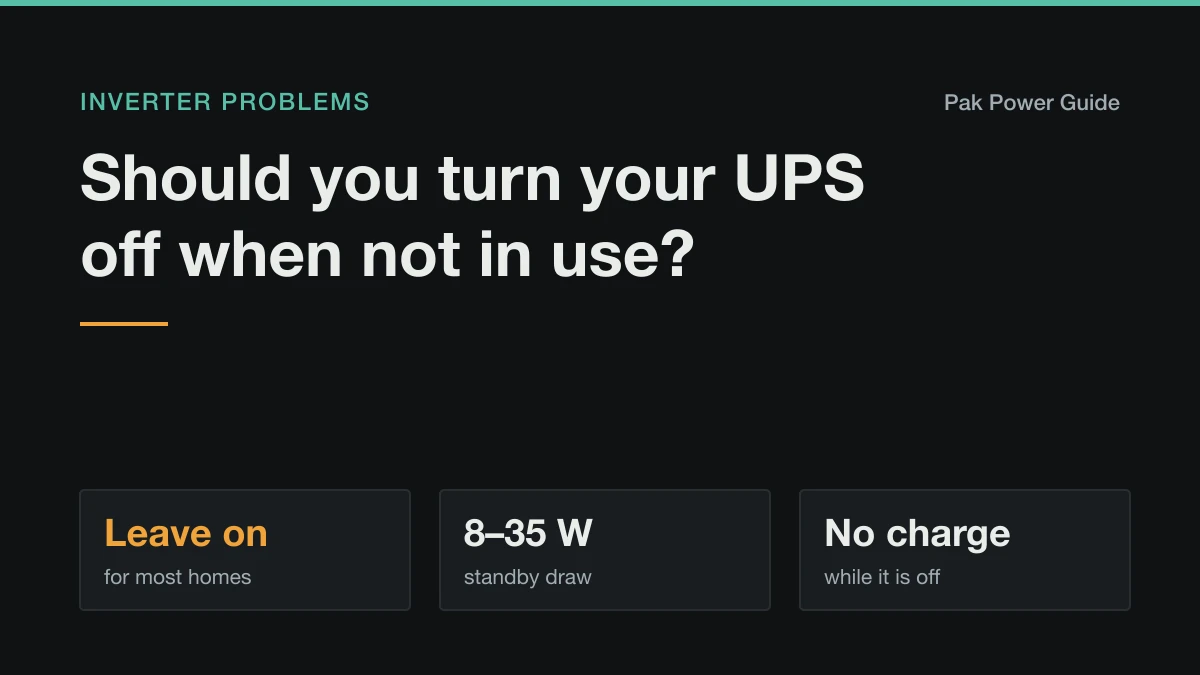
For most homes: leave it on.
The instinct to switch it off is reasonable — it does consume power sitting idle. But switching off does not only stop the standby draw. It also stops the charging, and a lead-acid battery left sitting partly charged loses capacity permanently. That costs far more than the watts you saved.
The actual trade-off
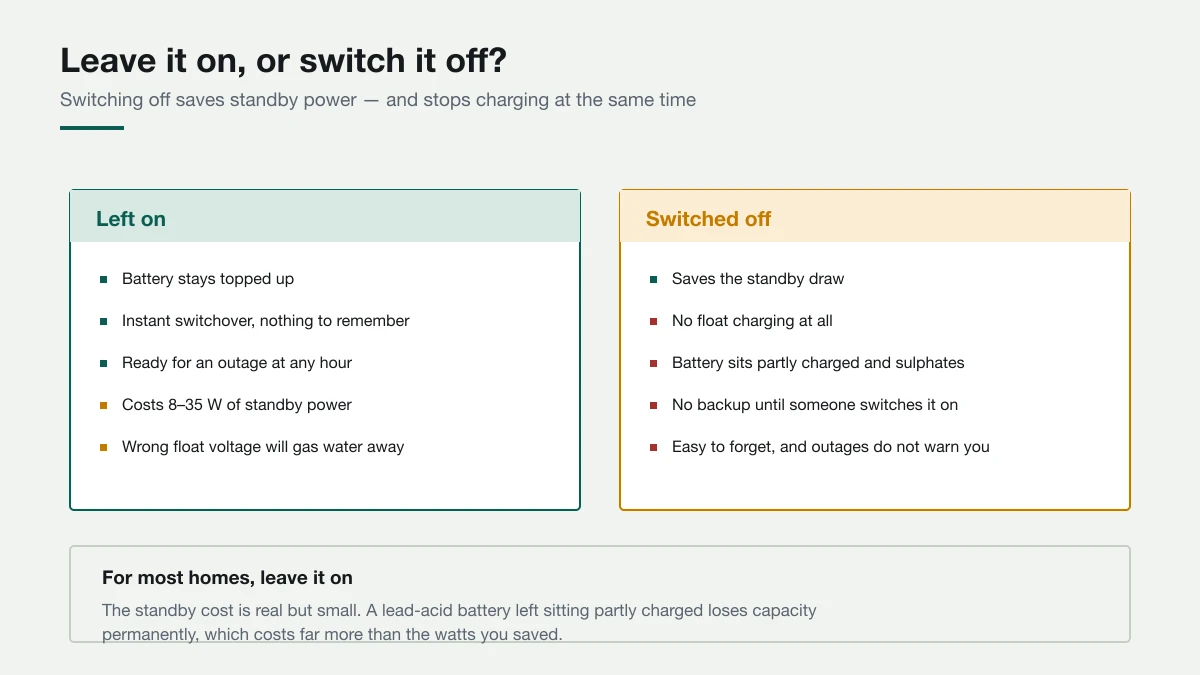
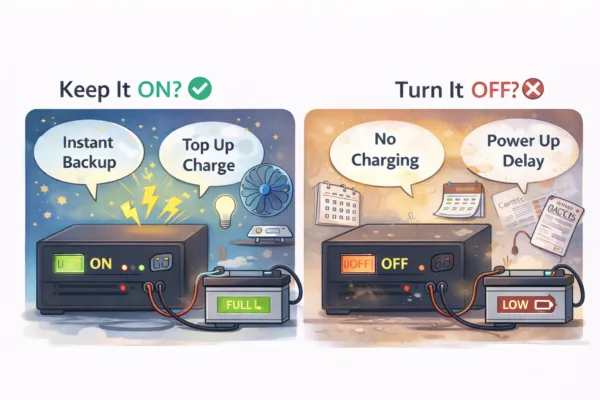
Left on: the battery stays topped up, switchover is instant, nothing has to be remembered — at a cost of 8–35 W of standby draw.
Switched off: you save that draw, but nothing charges, the battery sits partly full, and you have no backup until someone remembers to switch it on. Outages do not announce themselves.
Why a partly charged battery is the real cost
Lead-acid batteries dislike sitting below full. Lead sulphate crystals form on the plates and gradually harden, and hardened sulphate does not convert back — it is lost capacity, permanently.
Two things make it worse:
- Self-discharge. A lead-acid battery loses roughly 3–5% of its charge per month at 25 °C, and considerably faster in heat. Left disconnected through a hot summer, it drifts down on its own.
- Never finishing a charge. Turning the inverter off during grid windows removes exactly the time the battery had to complete its slow absorption stage — see how long a full charge takes.
A battery kept properly topped up lasts years. One repeatedly left at 60–70% will not.
What the standby draw really costs
It is worth knowing the number rather than guessing.
At 20 W standby, running continuously, that is roughly 0.5 kWh per day. Whether that matters depends on your electricity price, but it is a genuine cost and not nothing.
The comparison that settles it: that same 20 W over a ten-hour outage spends 200 Wh of a 765 Wh battery — over a quarter of it. So standby draw matters a great deal during an outage, and comparatively little while the grid is carrying it.
That distinction is the key: switching off during an outage to save the battery is sensible. Switching off while the grid is on mostly costs you charging.
When to leave it on
- Outages are frequent or unpredictable
- You use backup daily
- The battery is a proper deep-cycle or tubular type
- The inverter has good ventilation and does not overheat
- Charge settings are correct for the battery fitted
This covers most households.
When switching off makes sense
During a long outage where you do not need backup. If the power is out and everyone is asleep or away, switching the inverter off stops the standby draw eating the battery. This is the strongest case for turning it off, and it is the opposite of what most people do.
When you are away for more than a few days. See below.
If the inverter overheats or misbehaves while idle — that is a fault to fix, but switching off is a reasonable interim step. See overheating.
If float voltage is set wrong. An inverter holding too high a float voltage gasses water out of flooded batteries continuously. The fix is the setting, not the switch — why battery water runs out so fast has the correct figures. Until it is fixed, switching off during long grid periods limits the damage.
Leaving home for a while
This is where the answer genuinely changes.
A few days to two weeks: leave it on, provided float voltage is correct. The battery stays full and everything is ready when you return.
Several weeks or months:
- Charge it fully first. Storing a lead-acid battery at less than full is what damages it.
- Then either leave the inverter on if you trust the float voltage, or disconnect the battery and plan to recharge it every month or two — self-discharge alone will run it down.
- Store it somewhere cool. Heat accelerates both self-discharge and ageing.
Never leave a lead-acid battery flat and disconnected for a long period. That is the single most reliable way to destroy one.
Two checks worth doing either way
Does it actually reach full? After a long grid period, check the battery voltage — around 12.7 V resting for a 12 V system, 25.4 V for 24 V. If it never gets there, leaving it on is not achieving what you assume.
Is the float voltage correct? With the battery full and the grid on, measure at the terminals: 13.5–13.8 V for a 12 V flooded battery, double for 24 V. Meaningfully higher means it is gassing away water all day, and that is the one scenario where leaving it on is genuinely harmful.
The short version
Leave it on while the grid is on — the charging is worth more than the standby draw costs.
Switch it off during an outage when you do not need backup — that is when standby actually eats your battery.
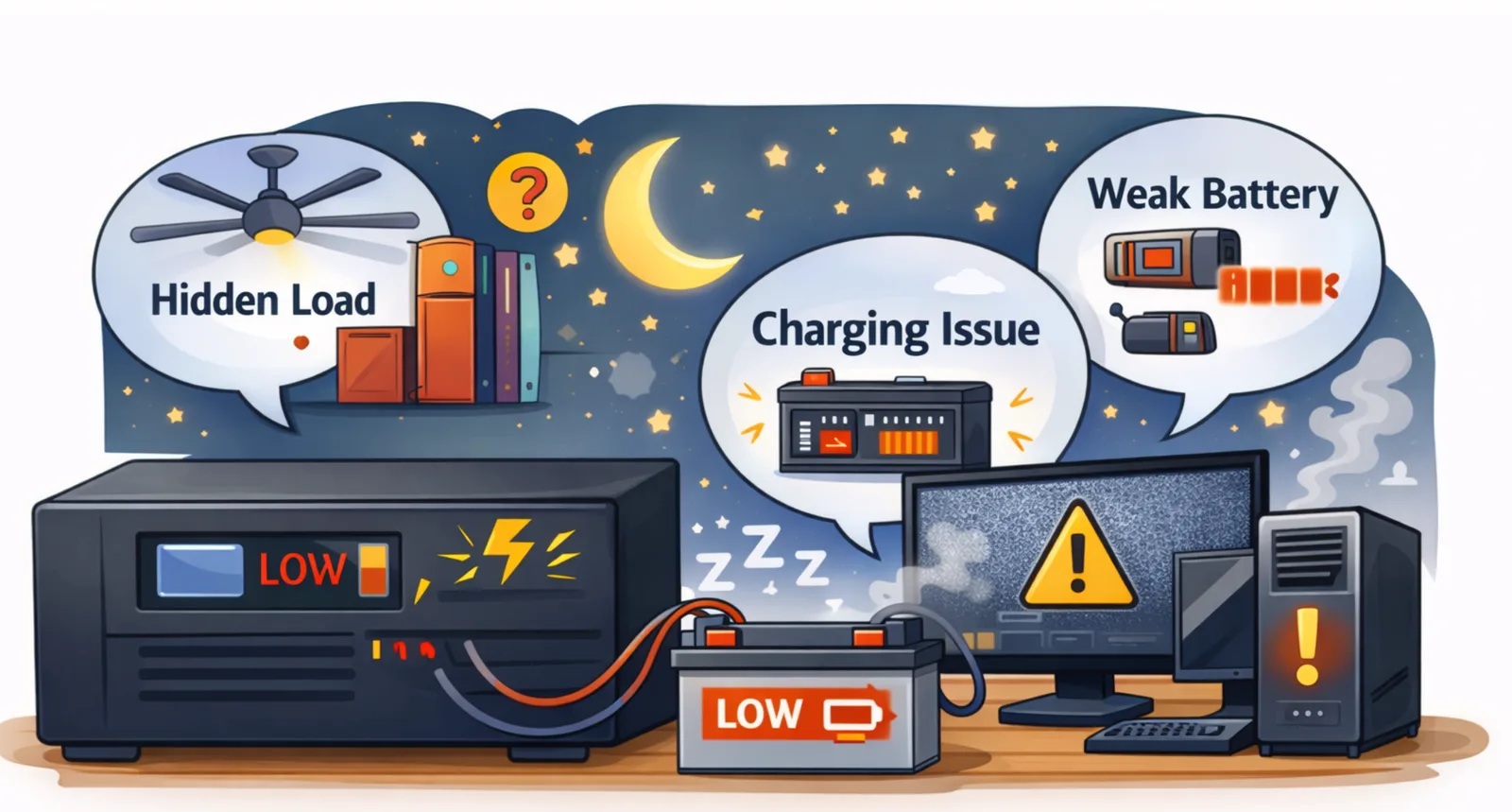
Going away for a long time? Charge it fully first, and either trust the float or disconnect and recharge periodically. If you find the standby draw significant during outages, why an inverter battery drains fast overnight covers what else is quietly consuming it.
Work it out for your own setup
Common questions
Does leaving an inverter on waste electricity?
A little. Standby draw is typically 8–35 W; at 20 W that is about 0.5 kWh a day. While the grid is on, that is usually worth paying, because it keeps the battery fully charged.
Should I switch the inverter off during a power cut?
If nobody needs backup, for example overnight with the fans off, yes. The standby draw comes out of the battery during an outage: 20 W over ten hours uses about 200 Wh, over a quarter of one 150 Ah lead-acid battery's usable energy.
What should I do with my inverter battery when going away for months?
Charge it fully first. Then either leave the inverter on if its float voltage is correct, or disconnect the battery, store it somewhere cool, and recharge it every month or two. Never leave a lead-acid battery flat and disconnected.
What float voltage should a 12 V inverter battery be held at?
About 13.5–13.8 V for a flooded lead-acid battery, measured at the terminals with the battery full and the grid on, and double that for a 24 V bank. Much higher means it is gassing water away all day.