Hurricane and Storm Season: Keeping the Power On at Home
Storm outages last days, not hours. What to power, how to size batteries or a generator, safe generator use, and what to do before, during and after.
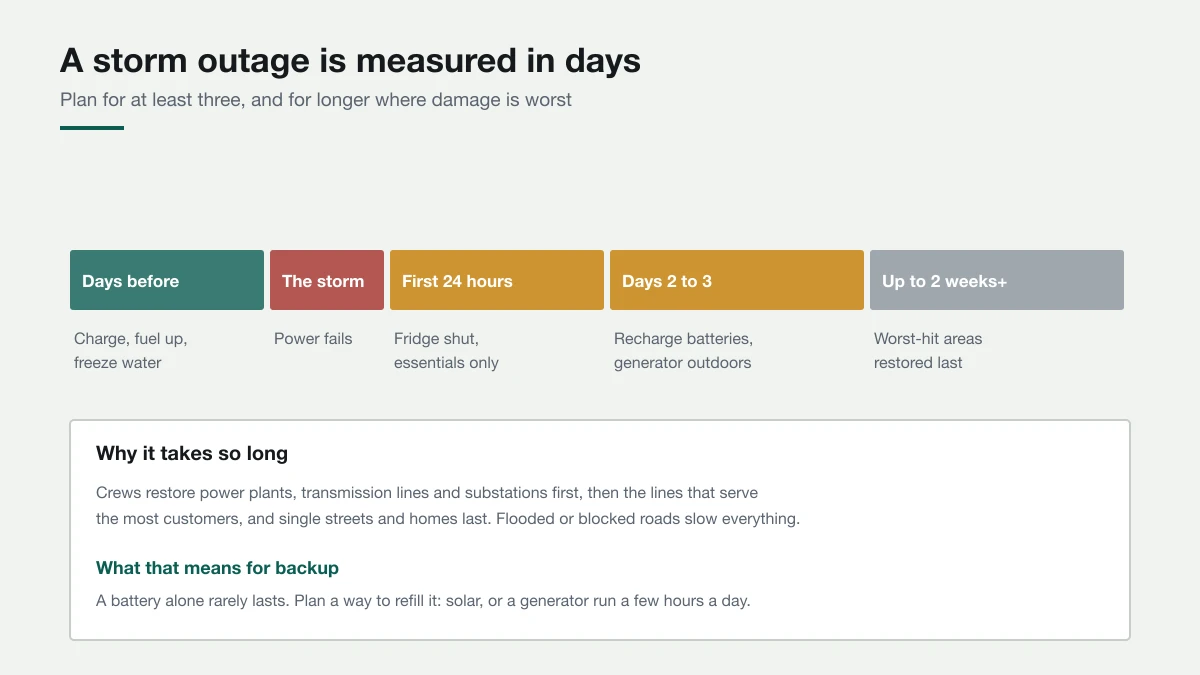
Storm outages are a different problem from everyday power cuts. They last days, they arrive when fuel and supplies run short, and the grid may be down across a whole region. The Atlantic hurricane season runs from June to November, and typhoons, cyclones and winter storms bring the same problem elsewhere.
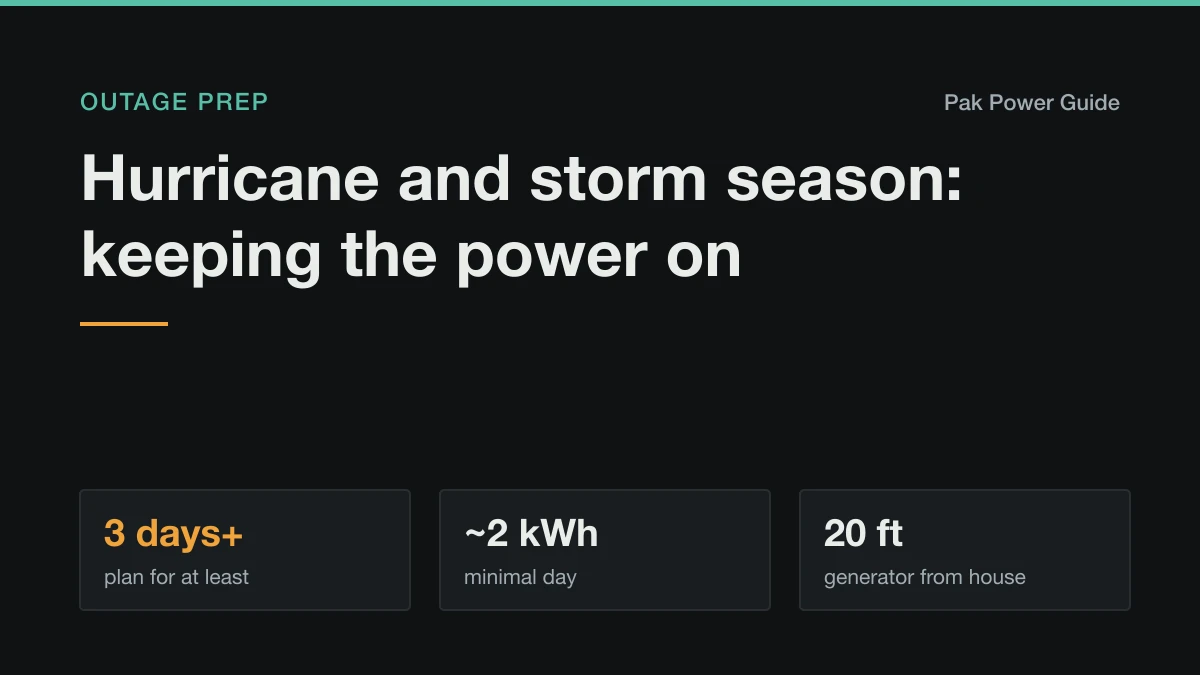
The goal is not to run a normal house. It is to keep a small number of things going safely for three days or more.
Decide what actually needs power
In order of importance for most households:
- Medical devices: CPAP, oxygen concentrators, refrigerated medicines. See keeping a CPAP running.
- Communication: phones, a radio, a Wi-Fi router while the internet lasts.
- Water: a sump pump in flood-prone basements, a well pump if you have one.
- Food: the fridge and freezer, but only a few hours a day are really needed.
- Light, and a fan when the heat and humidity arrive after the storm.
Air conditioning, electric water heaters, dryers and cookers are the loads that make backup expensive. Most people leave them off.
Sizing the backup
| Load | Running watts | Energy per day |
|---|---|---|
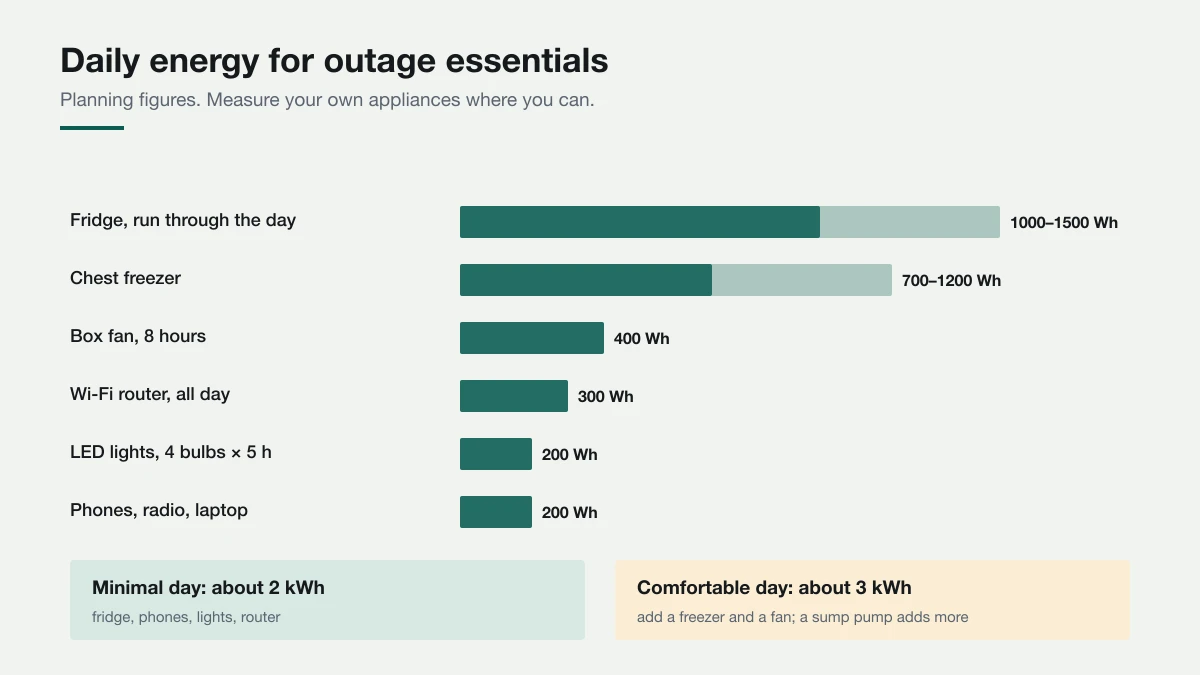
| Fridge (run through the day) | 150–250 | 1.0–1.5 kWh |
| Chest freezer | 100–200 | 0.7–1.2 kWh |
| Phones, radio, laptop | 20–60 | 0.2 kWh |
| LED lights, 4 bulbs × 5 h | 40 | 0.2 kWh |
| Wi-Fi router | 12 | 0.3 kWh |
| Box fan, 8 h | 50 | 0.4 kWh |
| Sump pump (½ hp, varies hugely) | 800–1000, surge ×3 | 0.5–3 kWh |
A minimal day of fridge, phones, lights and router is about 2 kWh. Add a freezer and fan and it is about 3 kWh. Three days of that is beyond most single power stations without recharging, which is why storm backup is usually a battery plus a way to refill it: solar panels, or a generator run for a few hours.
The inverter and battery size calculator turns your own list into watts and watt-hours, and the generator vs battery cost calculator compares fuel against recharging.
Generators: the safety rules that save lives
Carbon monoxide from generators kills people after almost every major storm. It has no smell, and open doors do not clear it.
- Outdoors only, at least 20 feet (6 m) from the house, exhaust pointing away from doors, windows and vents. Never in a garage, carport, basement or porch.
- Battery-powered CO alarms inside, tested before the season.
- No backfeeding. Never plug a generator into a wall socket with a double-ended cord. It can electrocute line workers and start fires when the grid returns. Use heavy extension cords to appliances, or an electrician-fitted transfer switch or interlock.
- Let it cool before refuelling. Petrol on a hot exhaust ignites.
- Keep it dry under an open canopy designed for generators, not inside a shed.
- Fuel: store it in approved cans, away from the house, with a fuel stabiliser. Stations close or run dry after storms.
Before the storm
- Charge everything: power stations, power banks, phones, laptops, spare batteries.
- Turn the fridge and freezer to their coldest setting a day ahead, and fill empty freezer space with bottles of water.
- Test the generator and run it for a few minutes; fill it and the cans.
- Fill containers with water, and a bathtub for flushing if you rely on a well pump.
- Write down your utility's outage number and your medical supplier's contact on paper.
- Work through the printable power outage preparation checklist.
During and after
- Keep fridge and freezer doors shut. A closed fridge keeps food safe for about 4 hours, a full freezer about 48. Run them from backup in blocks rather than all day if the battery is small, checking with a thermometer.
- Switch off major appliances and electronics so they are not hit by surges when power returns. Leave one light switched on so you know when it is back.
- Stay away from downed lines, and anything they touch, including water. Report them.
- Flooding: if water has reached outlets, appliances or the panel, do not switch anything on. Have an electrician check it first. Do not use a power station, inverter or generator that has been submerged.
- When power returns, turn loads back on gradually rather than all at once.
Work it out for your own setup
Common questions
How long do power outages last after a hurricane?
Anything from hours to weeks. After a major storm, restoring the worst-hit areas commonly takes several days to two weeks or more, because damaged lines, poles and substations are repaired in order of how many customers each serves. Plan for at least three days.
How far from the house should a generator be?
US public health guidance is at least 20 feet (6 metres) from the house, with the exhaust pointing away from doors, windows and vents. Never run one indoors, in a garage, carport or basement, even with doors open, and fit battery-powered carbon monoxide alarms.
Can I plug my generator into a wall socket?
No. A double-ended plug sends power back into the grid, where it can electrocute utility workers and neighbours, and it can start a fire when the power returns. Use extension cords straight to appliances, or have an electrician fit a transfer switch or interlock with an inlet.
Is a power station or a generator better for a hurricane?
A power station is silent, safe indoors and needs no fuel, but a large one covers essentials for about a day unless you can recharge it with solar. A generator runs as long as you have fuel. Many prepared homes use both: batteries for the night, the generator for a few hours a day to recharge and cool the fridge.