Portable Power Station vs Home UPS/Inverter: Which Do You Need?
A power station is a UPS, charger and lithium battery in one box. When that convenience is worth paying for, and when a fixed inverter is the better buy.
Both do the same job: store energy in a battery and turn it back into mains-style AC when the grid goes. The difference is how the parts are packaged, and that decides cost, capacity and convenience more than anything on the spec sheet.
Short answer: a power station suits small loads, renters, occasional outages and anything you want to carry. A fixed UPS or inverter suits daily outages, whole-circuit backup, and anyone who wants the most hours of backup for their money.
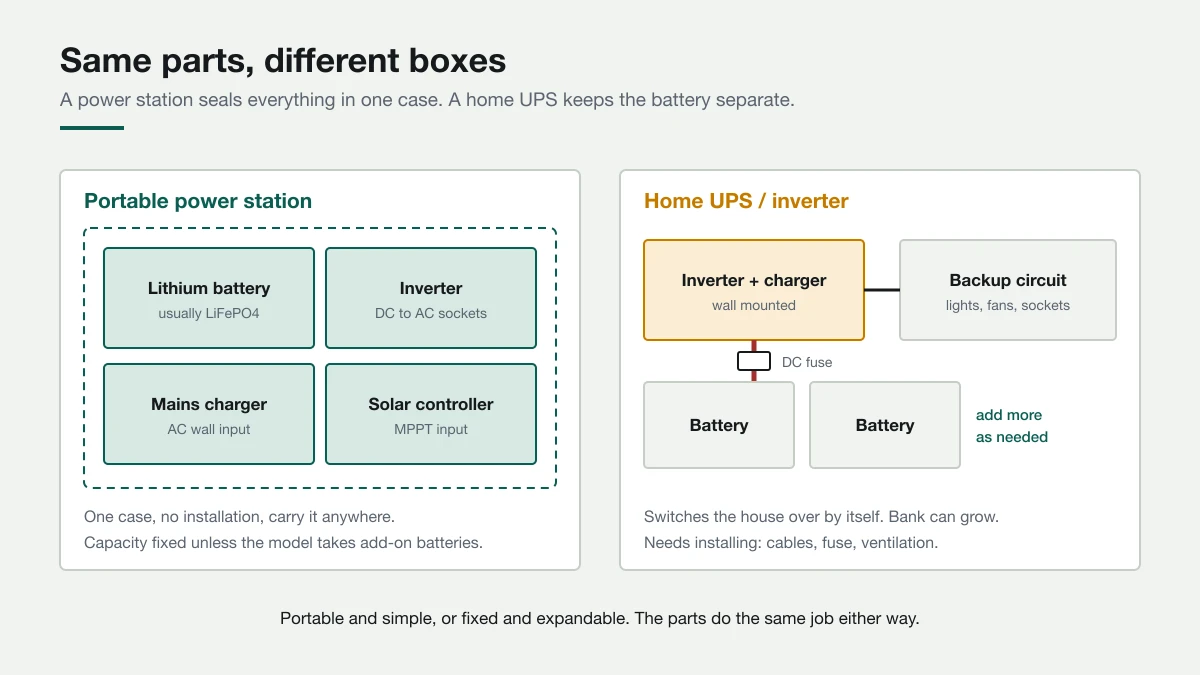
What is actually inside each
A portable power station puts four things in one case: a lithium battery (now mostly LiFePO4), an inverter, a mains charger and a solar charge controller. You plug appliances into its sockets and plug it into the wall or a solar panel to recharge.
A home UPS or inverter combines the inverter and charger, and connects by cable to a separate battery bank, often one or two large lead-acid batteries, increasingly lithium. It is wired into the house so that selected lights, fans and sockets switch to battery automatically when the grid fails.
Where each one wins
| Power station | Home UPS / inverter | |
|---|---|---|
| Cost per hour of backup | Higher | Lower, especially with lead-acid |
| Switches over by itself | Only for what is plugged into it | Yes, for the whole backup circuit |
| Capacity | Fixed, some take add-on batteries | Grows by adding batteries |
| Installation | None | Electrician, cables, fuse, ventilation |
| Fumes, noise, maintenance | None | None for lithium; lead-acid needs water and venting |
| Solar charging | Built in, limited input | Needs a hybrid inverter or separate controller |
| Portability | Yes | No |
Choose a power station when
- You rent, or cannot run new wiring.
- Outages are occasional and you want to keep a fridge, router, CPAP or phones going rather than the whole house.
- You want one thing for home and travel: camping, a van, a site without power.
- Fumes and noise rule out a generator, and lead-acid batteries in the house are unwelcome.
The limit to watch is the continuous output rating. A 1000 W station cannot run a 1200 W microwave however full its battery is, and motors need surge headroom on top. The inverter size calculator gives both figures for your appliances.
Choose a fixed UPS or inverter when
- You have outages every day, often several. Lead-acid in a fixed system is still the cheapest way to cover a few hours of fans and lights, and lithium in a fixed system is the cheapest per cycle over its life.
- You want lights and fans in several rooms to keep running with nobody touching anything.
- You expect to add capacity later. Adding a battery to a bank is cheaper than buying a second power station.
Installation matters here: cable size, a DC fuse and ventilation all need getting right, as covered in common UPS installation mistakes.
The switchover question
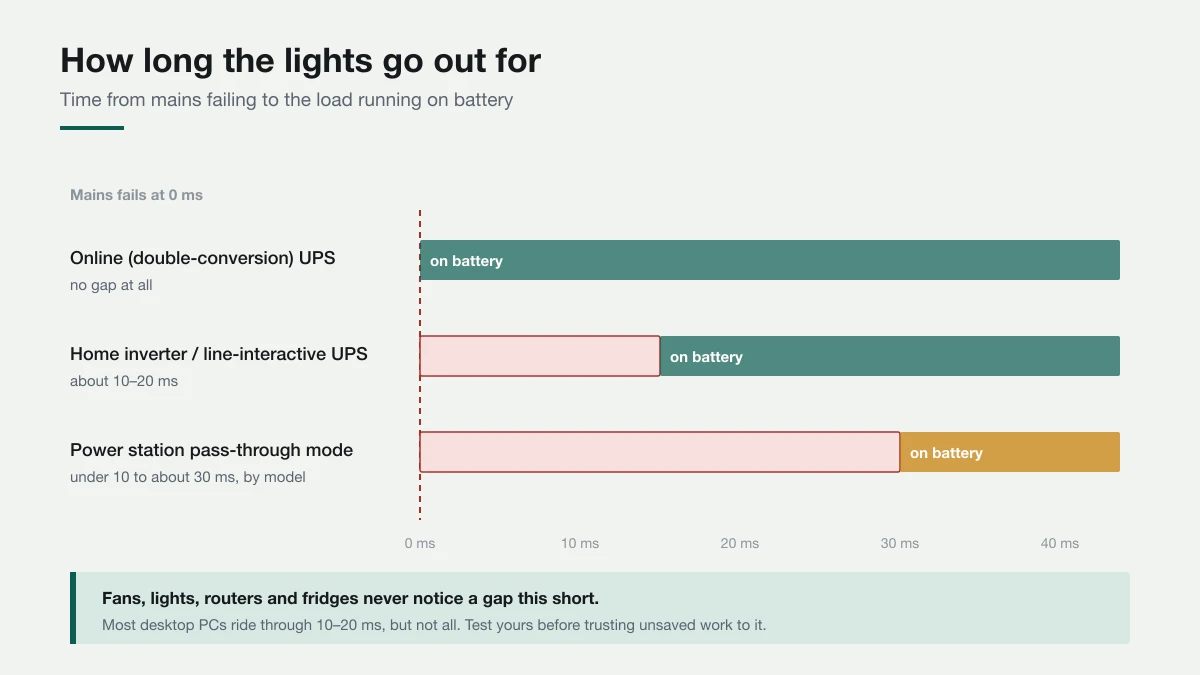
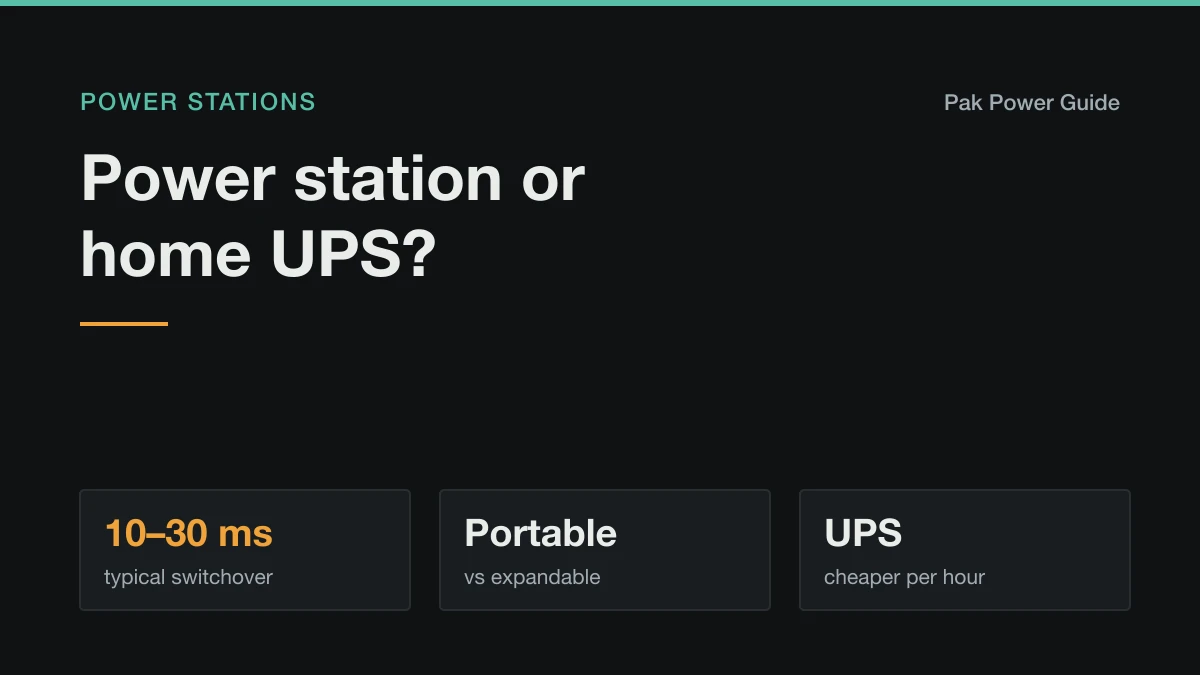
A home inverter typically switches to battery in about 10–20 ms, quick enough that lights barely flicker and most computers carry on. Many power stations offer a similar pass-through or UPS mode, with quoted switchover times from under 10 ms to about 30 ms depending on the model.
Fans, lights, routers and fridges do not care. Desktop PCs usually ride through a short gap but not always. If unsaved work matters, check the manufacturer's figure and test it by switching the wall socket off.
The hybrid many people end up with
Plenty of homes do both: a fixed inverter for the everyday fans and lights, and a small power station for the router and phones in the room where people actually sit, or for a CPAP overnight. The power station also covers the day the inverter is being repaired.
To compare what each costs to run through your own outages, including battery wear and fuel for a generator, use the generator vs battery cost calculator.
Work it out for your own setup
Common questions
Can a portable power station replace a home UPS?
For a few essentials during short outages, yes, as long as its continuous and surge ratings cover your load. For long daily outages across several rooms, a fixed inverter wired into a backup circuit with a larger battery bank is usually cheaper per hour of backup and switches over by itself.
Can I plug a power station into my house wiring?
Not directly. Feeding power into a socket with a double-ended plug can electrocute you or a line worker and damage the station. The safe way is an inlet and transfer switch fitted by an electrician, which some manufacturers sell as a home backup kit.
Does a power station work as a UPS for a computer?
Many have a pass-through or UPS mode that switches to battery in roughly 10–30 milliseconds. Most desktop PCs ride through that, but it is not guaranteed. Check the switchover time the manufacturer quotes and test it before trusting unsaved work to it.
Is a power station cheaper than an inverter and battery?
Per watt-hour, usually not. You pay for the integration, portability and lithium chemistry. A basic inverter with a lead-acid battery costs far less up front, while a separate inverter and LiFePO4 battery often gives more capacity for the same money as a large power station.