What Size Portable Power Station Do I Need? A Simple Sizing Method
Two numbers pick a power station: output watts for what can run at once, watt-hours for how long. A five-step method with worked examples.
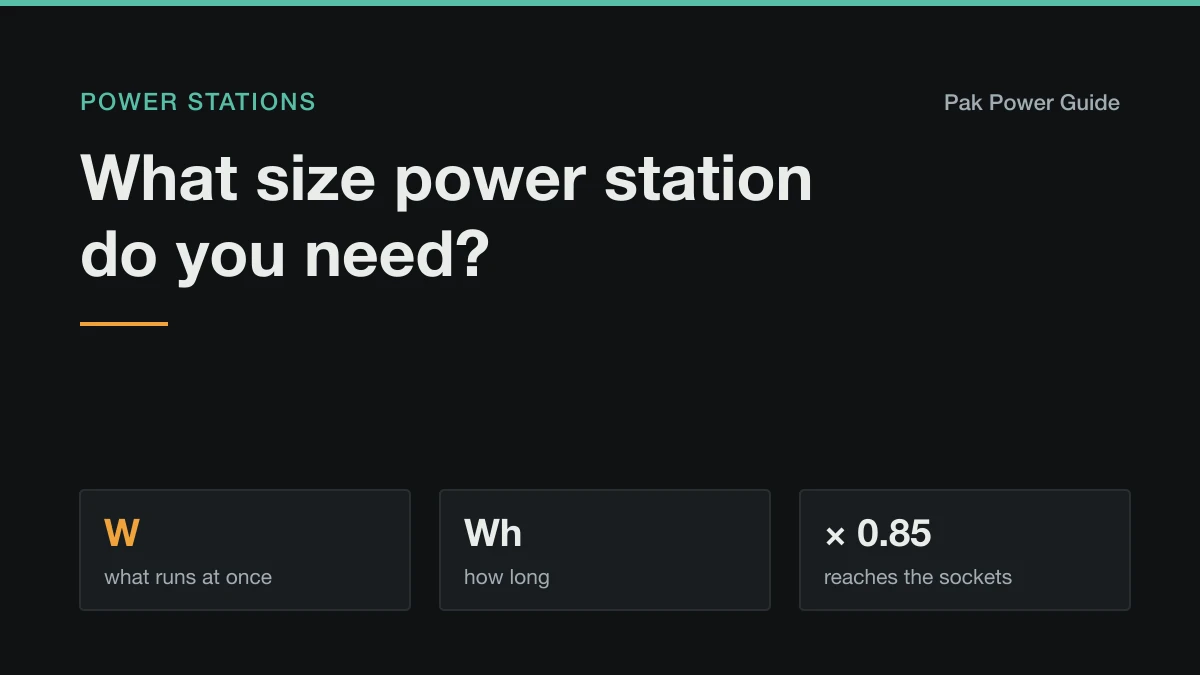
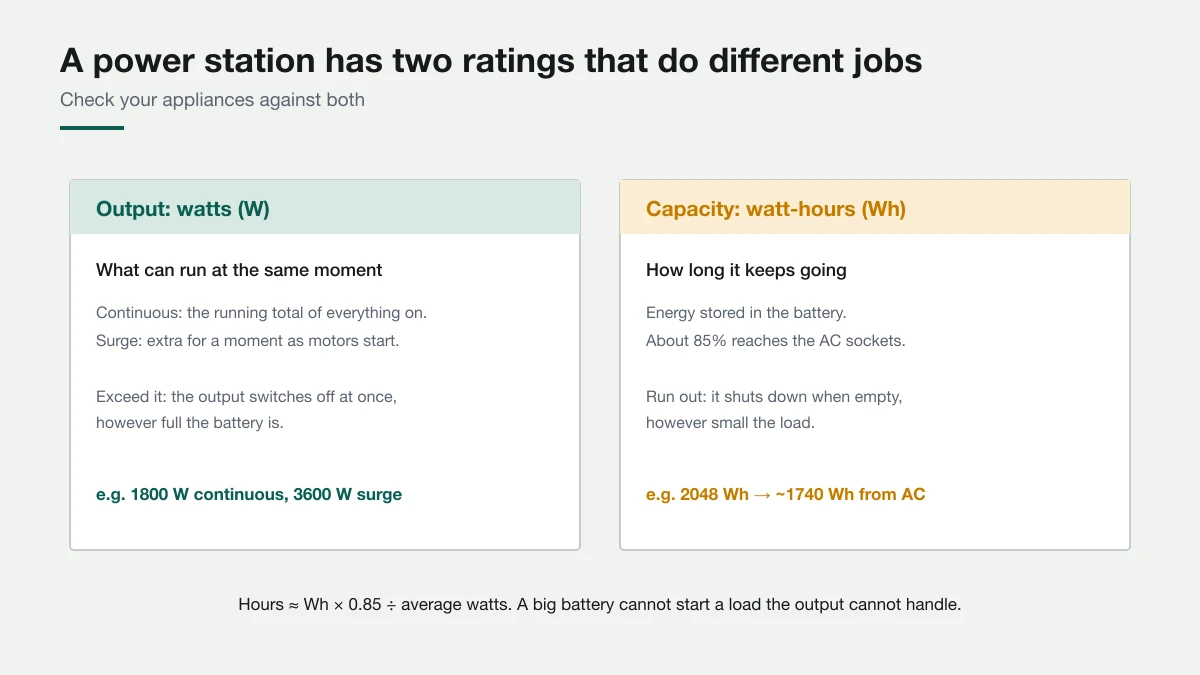
Power stations are sold by two numbers printed large on the box: watts of output and watt-hours of capacity. Picking the right one is a matter of checking your appliances against both, and allowing for the losses the box does not mention.
The five-step method
1. List what must run. Only what you genuinely need during an outage. Write down each item's running watts from its label, or measure it with a plug-in meter.
2. Add up what runs at the same time. That total must be below the station's continuous output, ideally with 20–25% to spare.
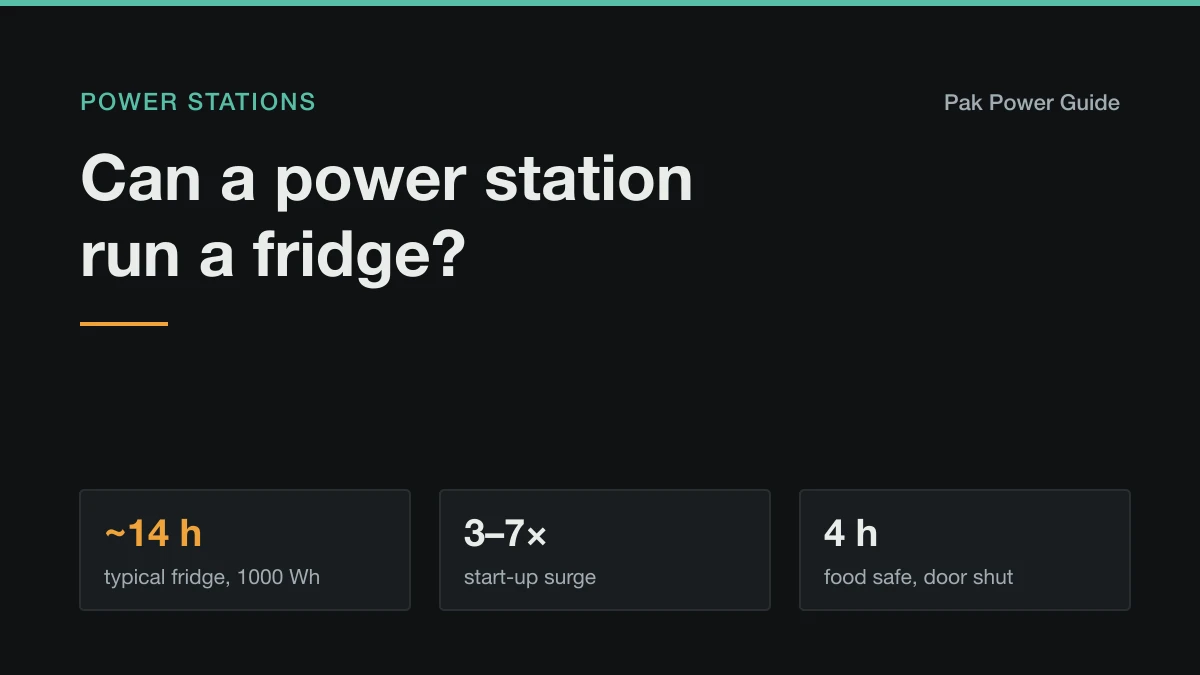
3. Find the biggest motor. Fridges, freezers, pumps and furnace blowers can pull three to seven times their running watts for a moment at start-up. The running total plus that one surge must be below the station's surge rating.
4. Work out the energy. For each item: watts × hours used. Fridges and freezers only run their compressor part of the time, so use about 40% of their watts, or their daily kWh from the energy label. Add everything up.
5. Allow for losses. Divide by 0.85 for inverter loss on AC loads. The result is the minimum watt-hours to buy. Add a margin if the station will sit in the cold or the outage might run long.
The inverter and power station size calculator does all five steps as you tick appliances.
A worked example
An evening and night without power, keeping the essentials going:
| Item | Watts | Hours | Energy |
|---|---|---|---|
| Fridge-freezer (40% duty) | 150 | 12 | 720 Wh |
| Wi-Fi router | 12 | 12 | 144 Wh |
| LED lights, 4 × 9 W | 36 | 5 | 180 Wh |
| TV | 80 | 3 | 240 Wh |
| Phones and a laptop | 60 | 3 | 180 Wh |
| Total | 338 W at once | 1464 Wh |
- Continuous output: 338 W, so almost any station passes.
- Surge: 338 W + a fridge start of roughly 750 W needs about 1100 W surge.
- Capacity: 1464 ÷ 0.85 ≈ 1720 Wh. A 2000 Wh station covers it with a margin; a 1000 Wh one would need the TV and laptop dropped.
What each size is good for
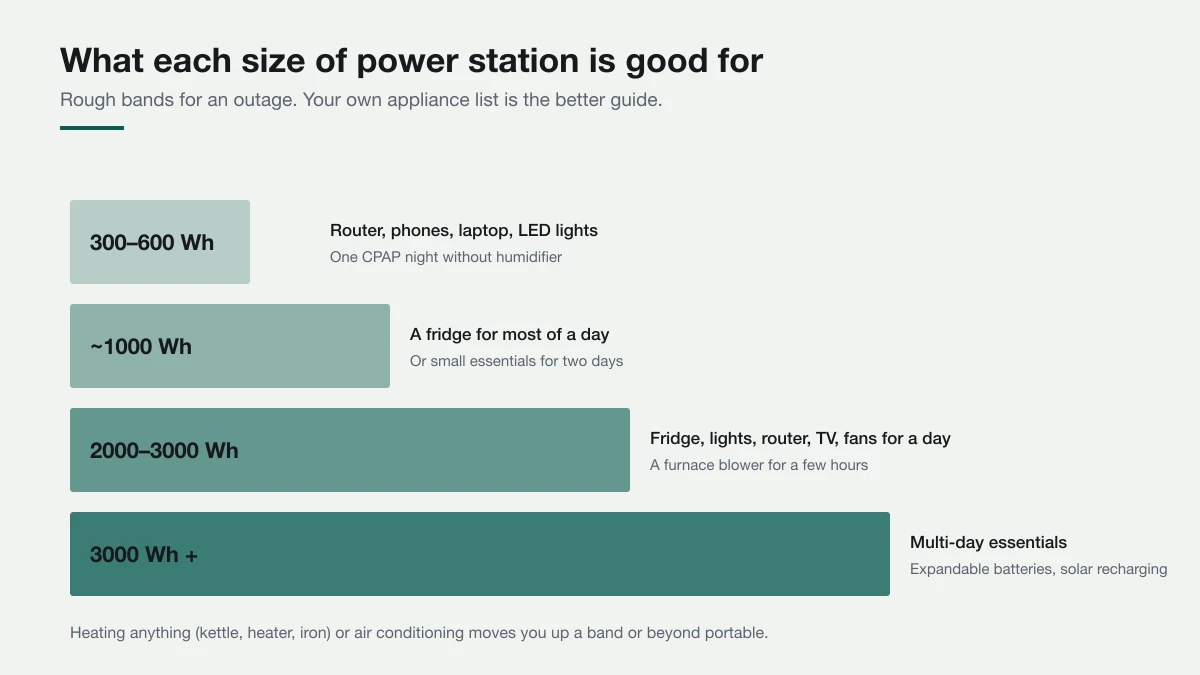
| Capacity | Typical use in an outage |
|---|---|
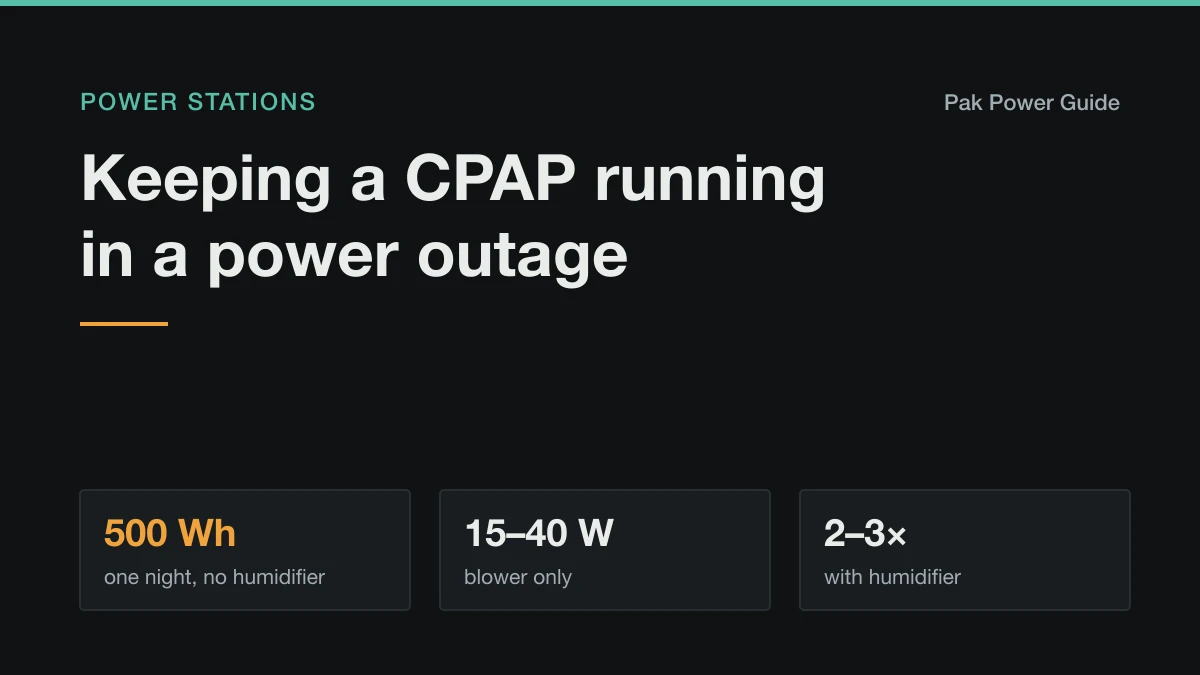
| 300–600 Wh | Router, phones, laptop, LED lights; a CPAP for a night without humidifier |
| ~1000 Wh | A fridge for most of a day, or small essentials for a couple of days |
| 2000–3000 Wh | Fridge, lights, router, TV, fans for a day; a furnace blower for a few hours |
| 3000 Wh+, expandable | Multi-day essentials, especially with solar recharging |
Things that catch people out
- Heating anything is expensive. Kettles, irons, hair dryers, space heaters and cookers draw 1000–2000 W. A 1000 Wh station runs a 1500 W heater for about half an hour.
- Air conditioning is possible only on the largest systems, and even an efficient inverter AC will flatten most portable stations within a few hours. See running an AC on backup.
- Socket limits. In 120 V countries a standard socket is limited to about 1800 W however large the station.
- Recharge time. A big station that takes ten hours to refill from the wall may not be full again before the next outage. Check its maximum AC and solar charging watts. For daily scheduled cuts, see the load shedding backup guide.
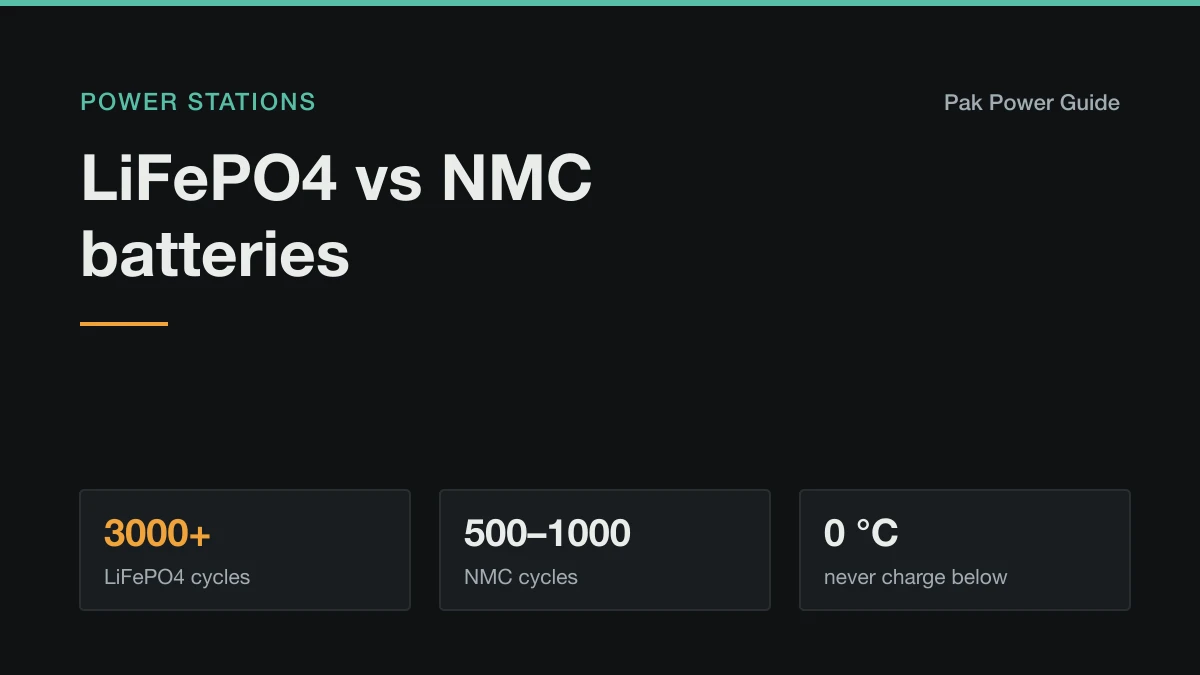
- Chemistry. LiFePO4 lasts thousands of cycles and NMC far fewer. The difference is explained in LiFePO4 vs NMC power stations.
Work it out for your own setup
Common questions
What size power station do I need for a house?
For essentials in an outage (fridge, lights, router, phones, a fan or TV), 1500–3000 Wh with 1500–2000 W output is typical for a day. Whole-house backup, including air conditioning, electric heating or a well pump, needs a far larger expandable system or a generator.
Is output watts or watt-hours more important?
Both, for different reasons. Output watts decide what can run at the same time and whether motors can start. Watt-hours decide how long. A station that fails either test will disappoint, which is why sizing starts with a list of your appliances.
How much of a power station's capacity can I actually use?
Through the AC sockets, plan on about 85% of the rated watt-hours, because the inverter loses the rest as heat. From the USB and 12 V outputs the loss is smaller. Cold weather reduces what you get as well.
Do I need a pure sine wave power station?
Practically every current power station already has a pure sine wave inverter. It matters for fridges, fans, medical devices and computers with active-PFC power supplies. Avoid very cheap units that list a modified or simulated sine wave.