Can a Portable Power Station Run a Refrigerator? (And for How Long)
Usually yes, if it can supply the start-up surge. How to estimate hours from your fridge's daily kWh, and how long food stays safe while you decide.
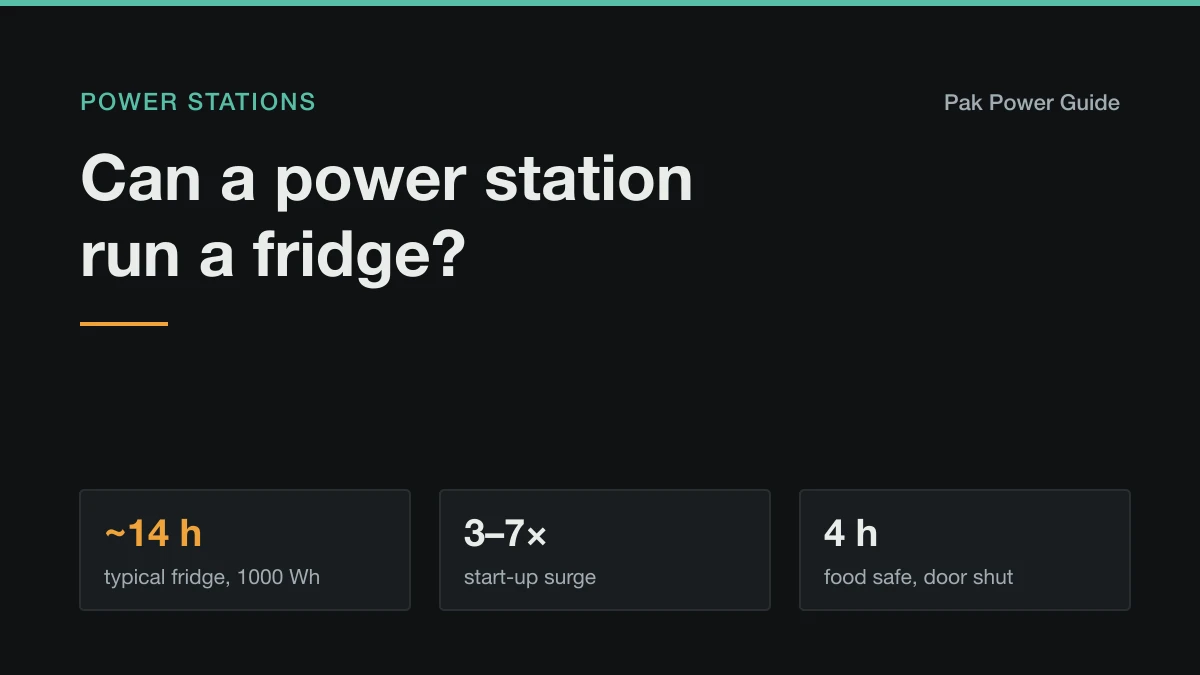
Yes, most power stations of 1000 Wh or more can run a household fridge, as long as two numbers work out: the station's surge rating has to cover the compressor starting, and its watt-hours decide how many hours you get.
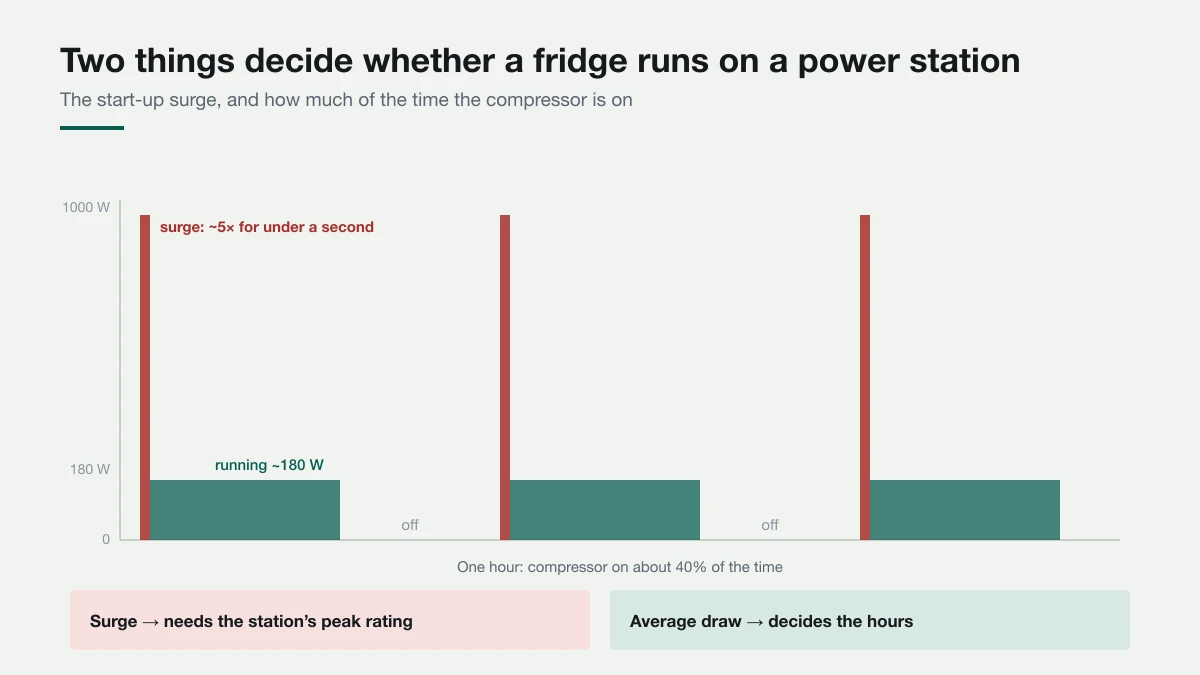
Step 1: can it start the compressor?
A fridge compressor that runs at 100–250 W can pull three to seven times that for a moment as it starts. That spike lasts well under a second, but if the station cannot supply it, the station shuts its output off, and it will try again every time the thermostat calls for cooling.
Check the station's surge or peak rating, not just its continuous rating. A typical full-size fridge-freezer is comfortable on a station quoting around 2000 W surge. Fridges marked inverter or variable speed start gently and draw far less at start-up, which makes them much easier to run on battery.
If the station trips as the fridge starts, that is surge, not capacity. More battery will not fix it.
Step 2: how many hours?
The rating label shows a fridge's maximum watts, but the compressor only runs part of the time. What matters is the average, and the easiest source is the energy label's yearly kWh figure.
- Daily energy: yearly kWh ÷ 365. A fridge rated 400 kWh a year uses about 1.1 kWh (1100 Wh) a day.
- Average draw: daily Wh ÷ 24. That fridge averages about 46 W.
- Usable energy: station watt-hours × 0.85, allowing for inverter loss.
- Hours: usable energy ÷ average draw.
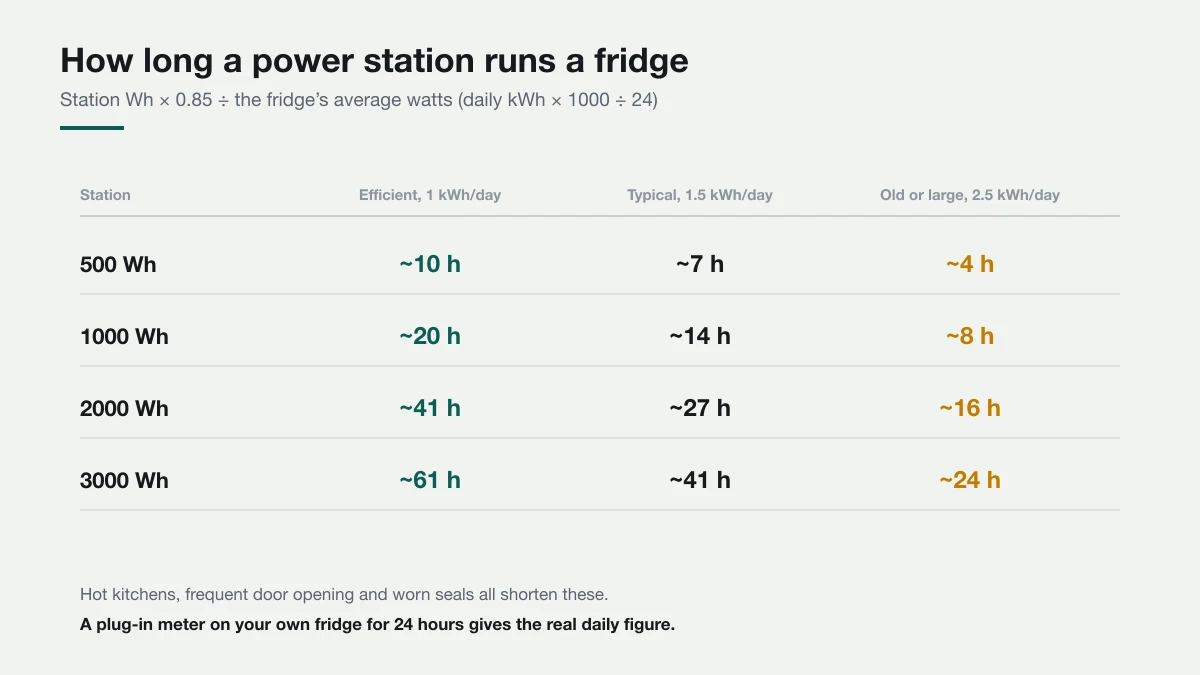
| Station | Efficient fridge (1 kWh/day) | Typical (1.5 kWh/day) | Old or large (2.5 kWh/day) |
|---|---|---|---|
| 500 Wh | ~10 h | ~7 h | ~4 h |
| 1000 Wh | ~20 h | ~14 h | ~8 h |
| 2000 Wh | ~41 h | ~27 h | ~16 h |
| 3000 Wh | ~61 h | ~41 h | ~24 h |
The labelled figure is measured in test conditions. A fridge in a hot kitchen, opened often, or with a worn door seal can use considerably more. The most reliable number is your own: a plug-in energy meter left on the fridge for 24 hours tells you exactly.
One more thing drains power stations: many have an AC eco mode that switches the output off when the load is low. A fridge idling between compressor runs can look like "no load", so turn that mode off or the fridge will quietly stop.
How long food is safe while you decide
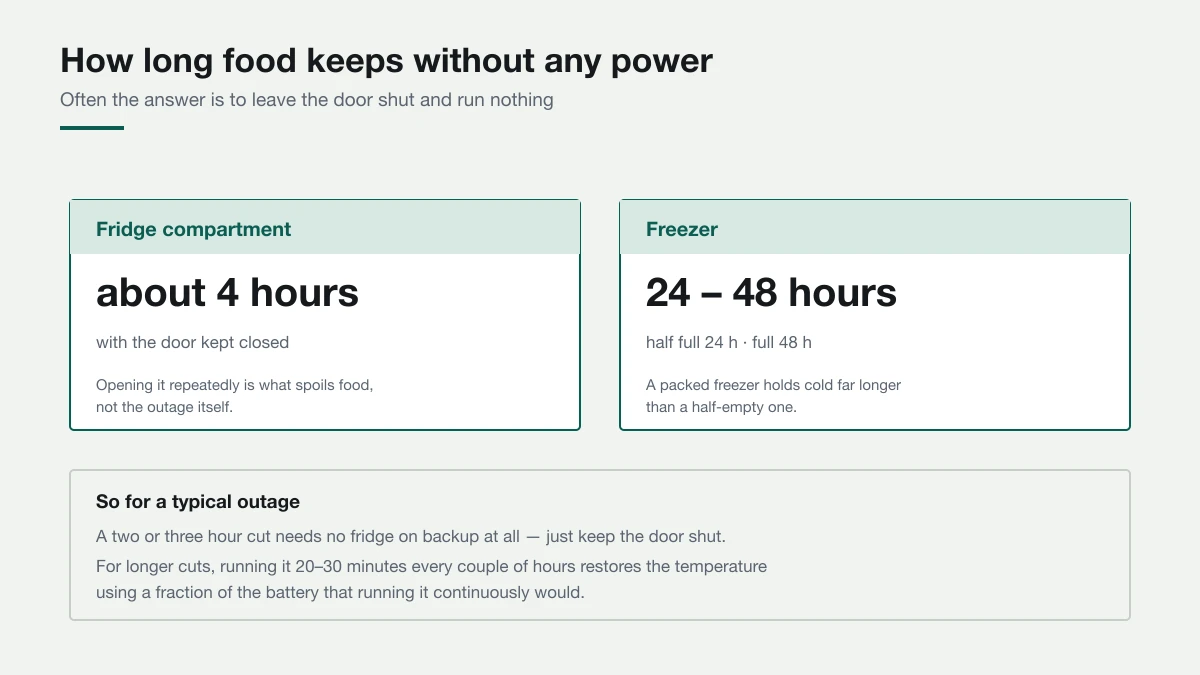
A closed fridge keeps food safe for about 4 hours, a full freezer for about 48 hours and a half-full one for about 24, according to US food-safety guidance. So a short outage may not need the battery at all, and a long one gives you time to plan.
That opens a useful option for small stations: run the fridge for an hour or two, then switch it off for a few hours, watching a fridge thermometer to make sure it stays at 4 °C (40 °F) or below. It stretches a small battery a long way, but it only works if you actually check the temperature.
Getting more hours from the same battery
- Keep the doors shut. Take out what you need for the next few hours in one go.
- Pre-chill before a forecast outage. Turn the thermostat colder a day ahead and fill empty space with bottles of water, which hold cold.
- Move the fridge out of the heat if you can, away from the cooker and direct sun.
- Recharge from solar during the day. A few hundred watts of panels can cover a fridge's daytime use on a sunny day. See charging a power station from solar panels.
The same surge and duty-cycle maths applies to a home inverter; that side is covered in can a UPS or inverter run a refrigerator.
Work it out for your own setup
Common questions
How long will a 1000 Wh power station run a fridge?
For a typical modern fridge-freezer using 1–1.5 kWh a day, roughly 14 to 20 hours. Take the station's watt-hours, multiply by 0.85 for inverter loss, and divide by the fridge's average draw, which is its daily kWh × 1000 ÷ 24. Older or larger fridges can use twice as much.
Why does my power station shut off when the fridge starts?
The compressor's start-up surge exceeded the station's surge rating. It lasts a fraction of a second but can be five times the running watts. A station with a higher surge rating, or a fridge with an inverter compressor that starts softly, solves it.
How long does food stay safe in a fridge without power?
US food-safety guidance is about 4 hours in a closed fridge, 48 hours in a full freezer and 24 hours in a half-full one. Keep the doors shut and check with a thermometer: the fridge should stay at 4 °C (40 °F) or below.
Should I run the fridge continuously or in bursts?
Continuously is simplest and safest. Running it for an hour or two every few hours stretches a small battery further, but only if a fridge thermometer shows it staying at 4 °C or below between runs.