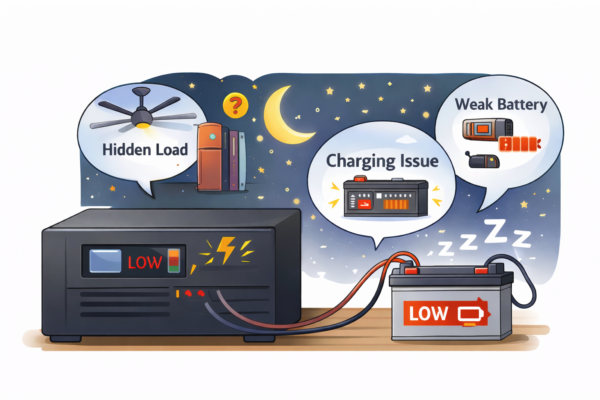
In Pakistan, many homes keep the inverter ready all night because load shedding can happen anytime. So when the battery looks “full” at night but in the morning it’s already low, it feels like the battery is dying for no reason.
Usually it’s not one single issue. Most of the time it’s a mix of:
-
Hidden load running the whole night
-
Battery capacity getting weak
-
Charging not reaching 100%
-
Wiring/settings causing extra loss
Below are simple, practical checks you can do at home to find the real cause.
Common inverter setups in Pakistani homes
Most households use one of these setups:
-
12V single battery: one 150–220Ah battery (very common in portions)
-
24V two batteries: two batteries in series (better backup for the same load)
-
Tubular battery: common choice, handles deep discharge better
-
Car battery on inverter: works temporarily but drains fast and gets weak quickly
-
Hybrid inverter (WAPDA + solar): settings matter a lot; charging/priority can confuse people
A 12V system can still give decent overnight backup for fans, lights, and Wi-Fi. If it’s not, something is off.
Hidden load is the number one reason
Most people think they’re running “one fan and Wi-Fi,” but the inverter line often feeds more things without you noticing. Overnight, even small loads add up because they run for 8–10 hours straight.
Common hidden loads at night
Check if any of these are on inverter power:
-
Another fan in a second room
-
Extra lights (washroom, hallway, outdoor)
-
TV, set-top box, speaker system
-
ONT + router + Wi-Fi repeater (24/7)
-
CCTV DVR + cameras (constant load)
-
Phone chargers left plugged in
-
Fridge/deep freezer (big battery killer)
-
Water dispenser, pressure pump controller, motor timer
Quick home test (no tools)
Tonight, try this:
-
Switch off everything you can.
-
Keep only one fan and Wi-Fi on inverter.
-
Take a photo of the inverter screen (battery bars/voltage).
-
Check again in the morning.
If backup becomes normal, the issue is mainly extra load, not the battery.
Battery shows “full” but can’t hold charge
A battery can show “full” right after charging but still have low real capacity. This is common when the battery is 2–3 years old, has faced heavy load shedding, or gets deeply discharged often.
Signs your battery is getting weak
-
Backup time has been reducing slowly over weeks/months
-
Battery drops quickly from full to half
-
Inverter hits low-voltage early and starts beeping
-
Battery feels warmer than usual while charging
-
Water level drops often (wet/tubular batteries)
Simple drop check (using inverter display)
If your inverter shows voltage or battery bars:
-
Fully charge the battery.
-
Turn on normal night load (1 fan + 1–2 LED bulbs).
-
Watch what happens in 5–10 minutes.
If it drops unusually fast, the battery capacity is likely weak.
Wrong battery type: car battery on inverter
This is very common in Pakistan because car batteries are cheaper and easily available.
Car batteries are designed for quick starting power, not long backup. On an inverter, they get deep discharged and lose capacity early. Result: overnight drain becomes normal for that battery.
If your battery is a “maintenance-free car battery” style (starter type), it’s a strong suspect.
Charging problem: battery never actually reaches 100%
Sometimes the battery is not charging properly, so you start the night at 60–70% without realizing it. In Pakistan, low WAPDA voltage (brownouts) can also affect charging.
Practical checks you can do
Check terminals and corrosion
-
Switch off inverter safely.
-
Make sure terminals are tight.
-
If you see white/green powder (corrosion), clean it carefully.
-
Loose terminals cause weak charging and extra heating.
Check cables
-
Very thin cables waste power and heat up.
-
If cables feel warm during load shedding, you’re losing energy there.
Check inverter settings
Many inverters have modes like UPS/Normal or battery types like Tubular/Flat. Wrong setting can reduce charging quality and shorten battery life.
Inverter self-consumption can drain the battery too
Even if you run very little load, the inverter itself consumes some power internally. Over 8–10 hours, that can become noticeable, especially if the battery is already weak.
No-load drain test (very useful)
-
Fully charge the battery.
-
Turn off/disconnect all output loads (no fans, no lights).
-
Keep inverter ON only.
-
Leave it for 6–8 hours.
-
Check battery level/voltage.
If it drops a lot with no load, then it’s either:
-
Battery is weak, or
-
Inverter is consuming too much / has an internal issue.
Wiring mistake: heavy points accidentally on inverter line
This happens when wiring is extended and later someone adds sockets/lights to the inverter circuit by mistake.
Easy way to find it
During load shedding, walk around and note what stays on:
-
Which lights stay on?
-
Which sockets work?
-
Does any heavy appliance socket work (fridge, kitchen socket, iron socket)?
If a fridge socket works on inverter, that alone explains overnight drain.
Battery water and maintenance (wet/tubular batteries)
If you have a wet/tubular battery and water level is low, capacity reduces and the battery gets stressed.
Simple safe checks
-
Check water only when battery is cool and inverter is off.
-
Plates should be covered (don’t overfill).
-
Use distilled water only (not tap water).
If water keeps dropping quickly, charging may be too aggressive or the battery is aging.
Quick checklist for tonight
Use this as a simple plan:
Step 1: Reduce night load
-
1 fan
-
Wi-Fi only
No TV, no extra lights, no charging.
Step 2: Take a photo of the inverter screen
This helps you compare the drop clearly.
Step 3: Do the no-load drain test next
If it drains even with no load, focus on battery health/inverter issue.
Step 4: Inspect basics
-
Tight terminals
-
No corrosion
-
Good cable thickness
-
Correct inverter mode
When to call a technician
Call someone if you notice:
-
Battery gets very hot while charging
-
Wires/terminals heat up
-
Burning smell or melted plastic
-
Battery drops extremely fast even with no load
-
Inverter shows errors or keeps beeping
Ask them to check:
-
Battery capacity test under load
-
Charging voltage/current
-
Hidden loads on inverter wiring
-
Cable sizing and connections