Can a Power Station Charge from Solar Panels? Setup Explained
How to match solar panels to a power station's input voltage and current, series or parallel wiring, cold-weather voltage, and realistic charge times.
Yes. Almost every power station has a solar input with a built-in MPPT charge controller, so panels plug in with the right cable and no separate controller. What trips people up is matching the panels to the input limits, and expecting the full rated watts.
Read three numbers on your station
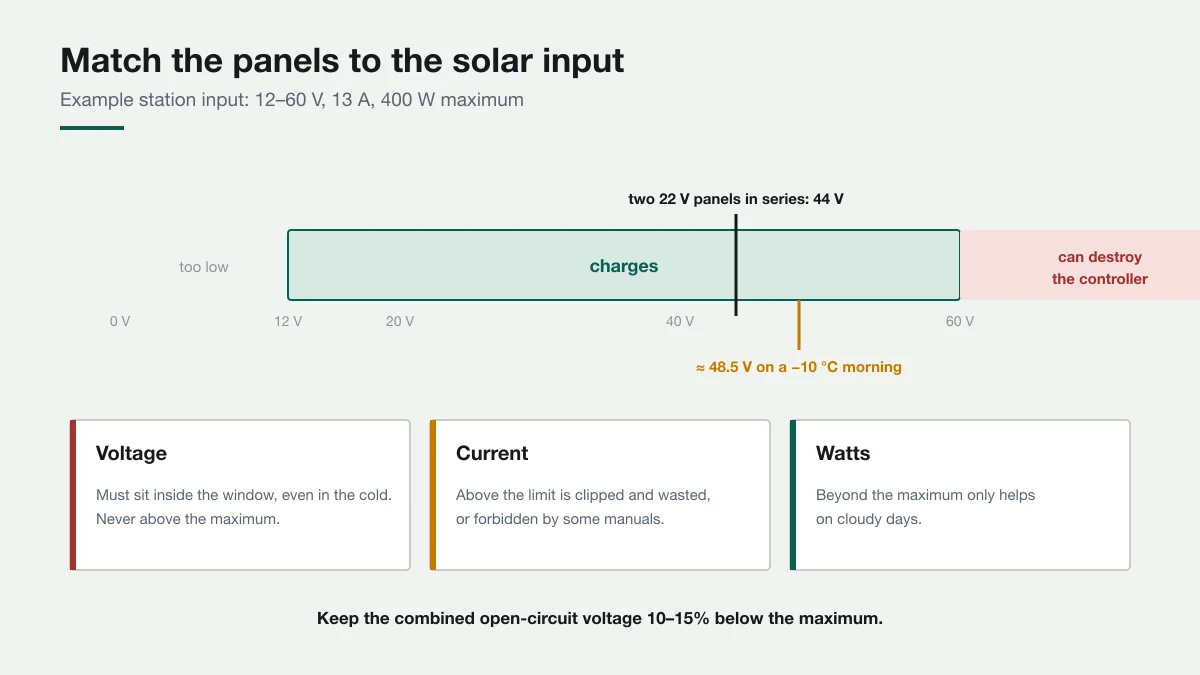
Every station lists a solar input specification, something like "12–60 V ⎓ 10 A, 400 W max":
- Voltage range: the panels' combined voltage must fall inside it. Below the minimum, charging never starts. Above the maximum, you can destroy the charge controller. This is the one limit never to exceed.
- Current limit: the most amps it takes. Panels that can supply more are simply limited, but some manuals forbid it, so check.
- Maximum watts: extra panel wattage beyond this is wasted in full sun, though it helps on cloudy days.
Series or parallel
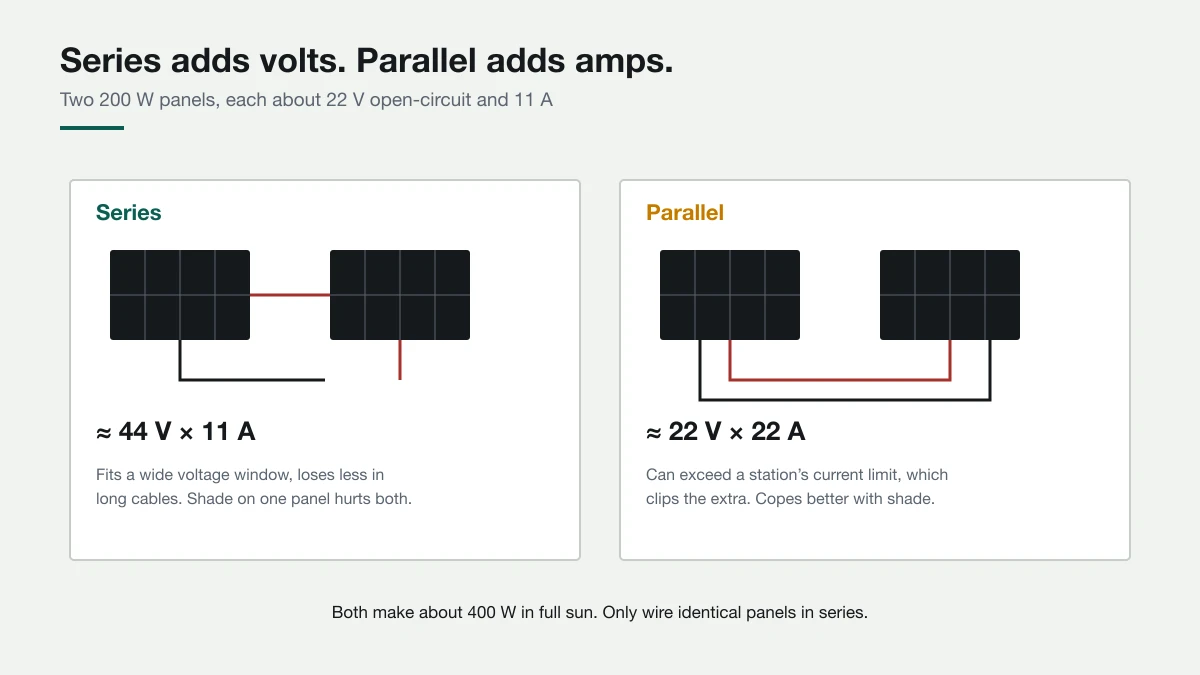
Take two 200 W panels, each rated about 22 V open-circuit (Voc) and 11 A short-circuit:
- Series: about 44 V, 11 A. Fits a 12–60 V, 13 A input.
- Parallel: about 22 V, 22 A. Exceeds a 13 A limit, so the station clips it and wastes power.
Series is usually the better match, and it loses less in long cables. Its weakness is shade: one shaded panel drags the whole string down. Only wire identical panels in series.
The cold-weather voltage trap
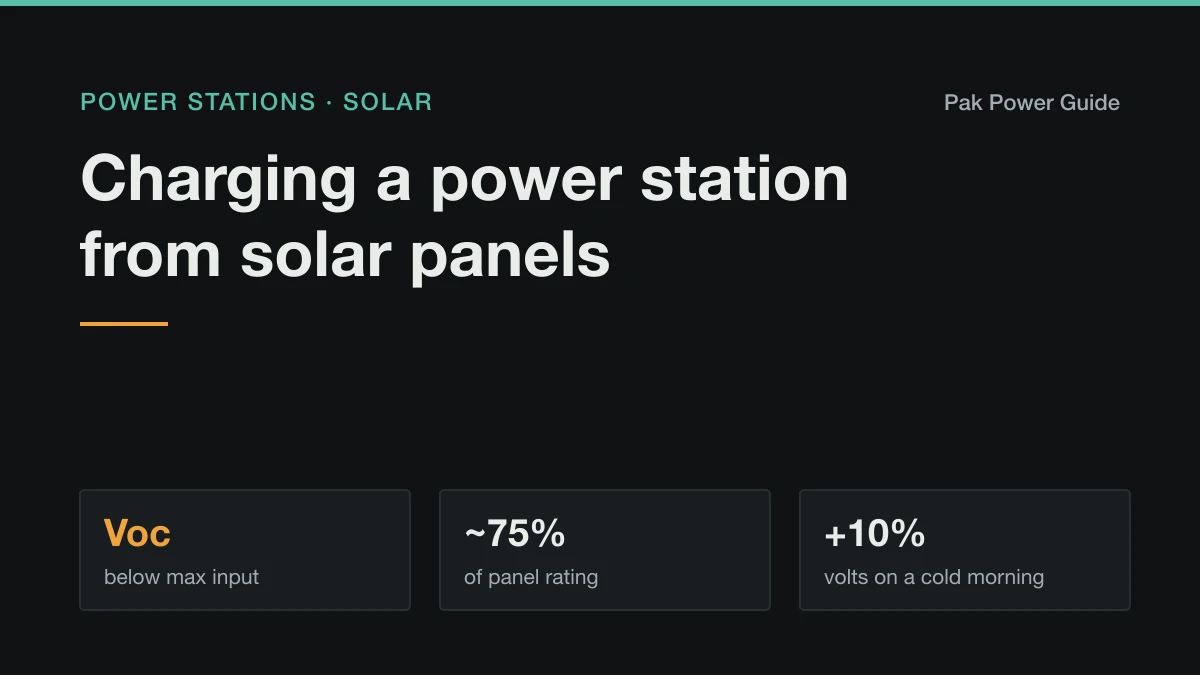
A panel's open-circuit voltage rises as it gets colder, typically by about 0.3% for every degree Celsius below 25 °C. On a frosty sunny morning at −10 °C, that is about 10% higher than the rating: a 22 V panel can briefly reach about 24 V.
So a string rated 54 V looks safe on a 60 V input, but on that cold morning it reaches about 60 V, right at the limit. Keep the combined Voc at least 10–15% below the maximum input voltage, more in cold climates.
Realistic charging time
Panels rarely deliver their rated watts. Heat, angle, dust and haze usually take 20–30%, so plan on about 75% of rated power in good sun.
Energy per day ≈ panel watts × peak sun hours × 0.75.
| Panels | 4 peak sun hours | 5.5 peak sun hours |
|---|---|---|
| 100 W | ~300 Wh | ~410 Wh |
| 200 W | ~600 Wh | ~825 Wh |
| 400 W | ~1200 Wh | ~1650 Wh |
So a 1000 Wh station on 200 W of panels will not fill in one ordinary day. Pointing the panels at the sun helps a lot with portable panels; for a fixed setup, the solar tilt angle calculator gives the best angle for where you live.
Cables and connectors
Panels use MC4 connectors. Power stations use XT60, Anderson, 8 mm (DC7909) or their own sockets. You need an MC4-to-station adapter cable, and a matching MC4 extension if the panels sit far away.
- Use 10 AWG (6 mm²) extension cable for runs over a few metres, to keep losses down.
- Check polarity before plugging in. Most stations are protected against reversed polarity, but not all.
- Rigid residential panels usually cost far less per watt than folding portable ones, if you do not need to carry them.
Getting the most from the sun
- Avoid partial shade. A shaded corner can cost far more than its share of the panel.
- Keep panels cool and clean. Prop portable panels up so air flows behind them.
- Charge during the day, use at night. Run daytime loads such as a fridge directly while the sun is up, so the battery is full for the evening.
For how panel output changes through the year, see solar output in winter.
Work it out for your own setup
Learn it by playing
Common questions
How many solar panels do I need to charge a power station?
Divide the energy you want per day by peak sun hours × 0.75. To put 1000 Wh back on a day with 5 peak sun hours you need about 270 W of panels; 400 W gives a comfortable margin. Then check the panels fit the station's input voltage and current limits.
Should I wire solar panels in series or parallel for a power station?
Series adds voltage, parallel adds current. Most power stations have a wide voltage window and a lower current limit, so series usually suits them, as long as the combined open-circuit voltage, including cold weather, stays below the maximum input voltage.
Can I connect more solar watts than the station's input rating?
The MPPT controller normally limits what it takes to its rated watts, so extra panel wattage only helps on cloudy days. Voltage is different: exceeding the maximum input voltage can destroy the charge controller. Follow your manual on both.
How long does it take to charge a power station with solar?
Roughly the station's watt-hours ÷ (panel watts × 0.75), in hours of good sun. A 1000 Wh station on 200 W of panels needs around 6–7 hours of strong sunshine, which on a typical day is more than one day's worth.