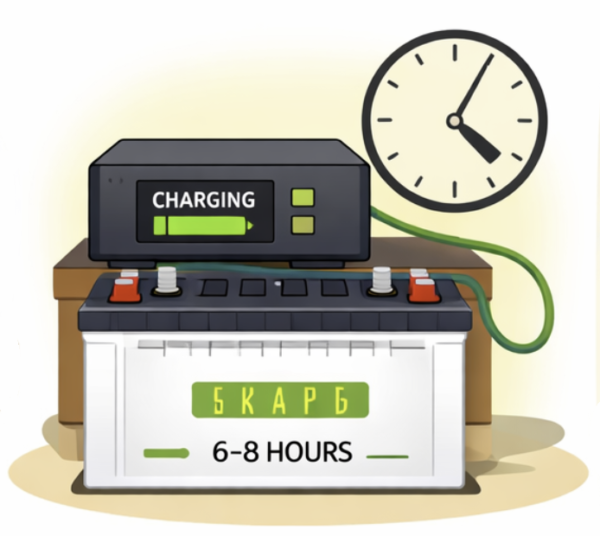
If you live in Pakistan, you already know the routine: light goes, UPS/inverter kicks in, then when bijli comes back you start watching the charging light like it’s a fuel gauge. Sometimes it feels like the battery takes forever to charge. Other times it reaches “full” quickly but still doesn’t give proper backup in the next load shedding slot.
The truth is: charging time depends on your battery size, charger/UPS current, battery condition, and how much load is running while it’s trying to charge.
Typical charging time ranges in Pakistani homes
In most homes, you’ll see one of these common setups:
-
Single battery UPS/inverter (usually 12V, 120Ah–200Ah lead-acid)
-
Two batteries in series (24V system, common for 1–1.5 ton AC “inverter UPS” setups)
-
Tubular lead-acid batteries (very common in Pakistan)
-
Dry/AGM batteries (less common, often in smaller UPS)
-
Lithium batteries (still not common, but growing)
For a normal tubular lead-acid battery:
Rough guide (lead-acid / tubular)
-
120Ah battery: ~6 to 10 hours
-
150Ah battery: ~8 to 12 hours
-
200Ah battery: ~10 to 16 hours
These are “real life” ranges, not perfect lab numbers. If your UPS charges slowly (low amp charging) or your battery is old, it can take longer.
What actually decides charging time?
1) Battery capacity (Ah)
Ah (amp-hour) is basically “how big the tank is.” Bigger Ah means longer charging time.
A 200Ah battery naturally takes more time than a 120Ah battery, even if everything else is the same.
2) Charging current (amps) of your UPS/inverter
This is the biggest factor people ignore.
Many local UPS units charge around 8A to 15A. Some bigger ones can do 20A to 30A. Some are even lower when they heat up or when voltage is unstable.
If your UPS charges at 10A, it will take much longer than a UPS charging at 20A.
3) How empty the battery is (depth of discharge)
Charging from 50% to 100% is much faster than charging from almost empty to 100%.
During heavy load shedding, batteries often get discharged too deep, and then they need more time (and more careful charging).
4) Battery health and age
An old battery can “show full” early because its actual capacity has reduced.
So it might charge quickly, but backup time becomes short. People think charging is fast, but the battery is just weak.
5) Load running while charging
If your fans, lights, TV, and router are running while the UPS is charging, part of the power is going to your house load, not to the battery.
So charging becomes slower.
6) Low voltage and unstable electricity
This is a Pakistan-specific pain.
When bijli comes back but voltage is low (like 170–190V), many UPS units reduce charging current or switch modes. Some stop charging properly. Your “charging time” then doubles without you noticing.
A simple way to estimate charging time at home
You can use a rough formula for lead-acid batteries:
Charging time (hours) ≈ (Battery Ah ÷ Charging amps) × 1.2 to 1.4
That extra 1.2–1.4 is because charging is not 100% efficient and also slows down near the top.
Example
-
Battery: 150Ah
-
UPS charging current: 10A
Time ≈ (150 ÷ 10) × 1.3 = 19.5 hours
Now you can see why many people never fully charge during heavy load shedding cycles. If power only stays for 3–4 hours and then goes again, your battery keeps living in “half charged” life, which also shortens its life.
Why charging slows down near the end
Lead-acid batteries charge in stages. The last 10–20% takes longer because the charger reduces current to protect the battery and avoid overheating/boiling.
So if your UPS shows “full” at 90–95% and you turn everything back on, the battery might not actually be properly topped up.
Practical checks you can do at home
1) Check the UPS charging amps (if your UPS shows it)
Some UPS/inverters have a display that shows charging current.
-
If you see very low amps (like 2A–5A) even when battery is low, charging will take forever.
-
If amps start high then drop quickly, it could be battery age or low voltage.
If your UPS doesn’t show amps, don’t worry. You can still do other checks.
2) Check battery water level (for tubular/wet lead-acid)
If you have a tubular battery with caps:
-
Turn off UPS/inverter
-
Open caps carefully
-
Plates should be covered by water (electrolyte)
Low water can cause heating and poor charging. Only top up with distilled water, not tap water.
If you notice strong smell or frequent “boiling” sounds, that can be overcharging or incorrect settings.
3) Feel the battery temperature during charging
A slightly warm battery can be normal. But if it gets hot, that’s not normal.
Hot battery during charging can mean:
-
Overcharging
-
Old battery
-
Wrong charger settings
-
Poor ventilation
Heat also increases water loss and reduces battery life.
4) Check load while charging
Try this simple test (when electricity is back):
-
For 30–60 minutes, reduce load (turn off heavy items)
-
See if charging becomes faster (UPS fan sound changes or charging indicator becomes stronger)
If charging improves when load is reduced, your UPS simply doesn’t have enough “spare power” to both run the home and charge quickly.
5) Watch how quickly battery voltage drops on backup
Even without a meter, you can observe:
-
If backup starts strong but voltage drops quickly / UPS beeps early, battery capacity is weak.
-
If battery reaches “full” quickly but backup is short, battery is likely aged or sulphated.
6) Check mains voltage (if you have a simple voltage meter)
A cheap plug-in voltage meter is very useful in Pakistan.
-
If voltage stays low most of the day, your UPS may charge slowly or not fully.
-
Some UPS units stop charging below a certain voltage.
7) Confirm correct battery type/setting on UPS
Some UPS/inverters have settings for:
-
Tubular / dry battery
-
Charging level (low/medium/high)
If set wrong, charging time and battery life both get affected.
Be careful: setting charging to “high” can charge faster but may overheat or boil a small or old battery.
When charging takes “too long” (common reasons)
1) Charging current is too low
Many UPS units have low charging amps by design. It protects batteries but takes time.
If you have bigger batteries (like 200Ah) with a low-amp UPS, “full charge” may take a full day.
2) Battery is near end of life
A weak battery can behave strangely:
-
Charges fast
-
Discharges fast
-
Voltage fluctuates
3) Low voltage supply
In many areas, the voltage after load shedding is weak, especially at peak times.
4) Loose or thin wiring
Loose battery terminals, rusty connections, or very thin wire can reduce charging efficiency.
Check for:
-
Loose nuts
-
Heating at terminals
-
Blackened connectors
Always switch off UPS before touching terminals.
What’s a “healthy routine” during load shedding?
-
Avoid discharging battery to zero every cycle.
-
Keep load reasonable (fans, lights, router) instead of adding iron/microwave/heater.
-
Let battery get long charging windows whenever possible (overnight charging is helpful).
-
For tubular batteries, maintain water and ventilation.
When to call a technician
Call someone if you notice:
-
Battery getting very hot
-
Strong acid smell
-
Visible swelling
-
UPS trips or sparks
-
Battery water reducing very fast
-
Charging never reaches full even with long electricity hours
These can be signs of charger fault, wrong settings, or a battery that’s unsafe to continue.
Quick takeaway
In most Pakistani home UPS setups, fully charging a lead-acid inverter battery can take 6 to 16 hours, sometimes more, depending mostly on battery Ah and UPS charging amps, plus the reality of low voltage and frequent load shedding.