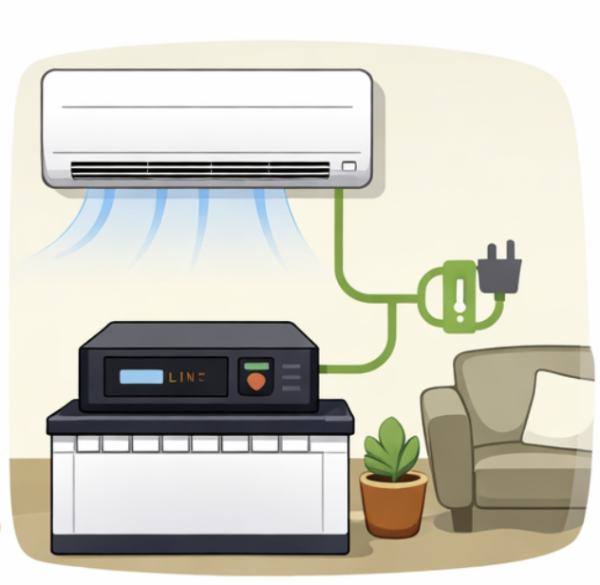
During load shedding, the first thought in many homes is: “If fans and lights work on UPS, can the AC also run?”
Sometimes yes — but in most typical Pakistani home setups, it’s either not possible, not safe, or it will give very short backup and stress your batteries badly.
The main reason is simple: an air conditioner is a heavy load, and it also has a big starting surge (a sudden jump in power) when the compressor kicks in.
Common UPS/Inverter Setups in Pakistani Homes
Most houses here have one of these setups:
-
Computer-style UPS (small box UPS): Usually 600VA–1200VA, meant for PC/router. AC is a hard “no”.
-
Home UPS (tubular battery + UPS/inverter): Commonly 1kVA, 1.5kVA, 2kVA with 1 or 2 batteries (12V each), often used for fans, lights, TV, WiFi.
-
Solar hybrid inverter: 3kW–8kW with battery bank (lead-acid or lithium). Better chance for AC, depending on size.
-
“Market inverter” + batteries: Sometimes modified wiring, sometimes no proper protection. Risky with heavy loads like AC.
If you have the typical 1kVA–1.5kVA UPS with one tubular battery, it’s usually designed for “light loads,” not compressors.
Why AC Is Hard on UPS/Inverters
1) High running power
A normal split AC (especially non-inverter type) can pull a lot of power while running.
Rough idea (can vary by brand, room heat, and voltage):
-
1 ton: often around 1000–1800 watts
-
1.5 ton: often around 1500–2500 watts
-
2 ton: often 2000–3500+ watts
Now compare that with a common UPS:
-
A 1kVA UPS often supports around 700–800 watts real load (because VA is not the same as watts).
-
A 1.5kVA UPS might support around 1000–1200 watts real load (depends on power factor and model).
So even the running load can exceed your UPS rating.
2) Starting surge (compressor kick)
When the compressor starts, power can jump 2x to 5x for a short moment.
That surge can:
-
trip the UPS,
-
cause beeping/overload error,
-
drop voltage badly,
-
or damage the UPS/inverter over time.
3) Waveform matters (pure sine vs modified/square wave)
Many local UPS units output modified sine wave (or even near-square wave). AC compressors and motors don’t love that.
Problems you may see:
-
compressor humming but not starting,
-
overheating,
-
higher amp draw,
-
noise from AC,
-
early failure of AC compressor or UPS components.
If you want any realistic chance, pure sine wave is the safer type.
Inverter AC vs Non-Inverter AC
Inverter AC (DC inverter)
These can reduce power after reaching the set temperature. In mild weather, an inverter AC might run at 600–1200W sometimes.
But don’t get too hopeful:
-
The compressor still starts.
-
In peak Karachi/Lahore heat, it may run near full power.
-
Many people forget the indoor + outdoor fans also consume power.
Non-inverter AC
Usually harsher on UPS because it runs ON/OFF with strong starting surges. This is the most difficult type to run on a typical UPS.
Practical Home Checks Before You Even Try
1) Check your UPS/inverter rating (VA and watts)
Look at the sticker/manual:
-
Example: 1500VA
-
Check if it also mentions watts (like 900W, 1200W)
If watts aren’t written, a rough safe estimate is:
-
Watts ≈ VA × 0.6 to 0.8
(Depends on UPS quality and load type.)
If your AC running watts are close to the UPS limit, it’s a bad idea.
2) Check the battery setup (how many and what size)
Look at your batteries:
-
Most tubular batteries are 12V
-
Capacity might be 120Ah, 150Ah, 180Ah, 200Ah
Common setups:
-
One battery (12V): very limited for heavy loads
-
Two batteries (24V system): better, less current for same power
-
Four batteries (48V system): much better for high loads (usually with solar/hybrid systems)
Bigger AC load means higher current draw, which heats wires and drains batteries fast.
3) Read the AC nameplate
On the indoor unit or outdoor unit sticker, look for:
-
Rated power (W)
-
Rated current (A)
-
Sometimes “Input power” or “Max power”
If it says something like 1800W or current like 8A–12A, that’s a red flag for small UPS.
4) Check your wiring and protection
Before heavy loads, check:
-
Proper MCB/breaker
-
Proper earthing
-
Cable thickness (thin wires heat up)
-
No loose connections (burn smell risk)
AC on UPS with weak wiring is a recipe for heat and damage.
A Simple Runtime Reality Check
Even if the UPS can technically run it, backup time is usually disappointing.
Example (very rough):
-
Battery: 12V 200Ah
-
Stored energy: 12 × 200 = 2400Wh
-
Real usable (losses + battery health): maybe 50–70% on lead-acid
If AC load is 1500W, backup might be:
-
2400Wh × 0.6 ÷ 1500W ≈ 1 hour
And that’s in ideal conditions. In real heat, older batteries, and inverter losses, it can drop a lot.
With two batteries (24V 200Ah total system) you have more usable energy, but AC still drains fast.
Also: deep discharging tubular batteries daily will shorten battery life.
Signs Your UPS/Inverter Is Not Handling the AC
If you try it (and you really shouldn’t without proper sizing), stop if you notice:
-
UPS overload beeps or trips
-
Lights/fans slow down when compressor starts
-
UPS gets very hot
-
Battery cables get warm/hot
-
Burning smell near UPS, battery terminals, or switchboard
-
AC outdoor unit makes humming sound but doesn’t start properly
These are not “small issues.” They mean stress and possible damage.
When It Can Work (More Realistically)
Running AC on backup is more realistic when you have:
-
Pure sine wave inverter/hybrid
-
At least 3kW+ inverter for a small AC (more for 1.5 ton+)
-
Higher voltage battery bank (24V/48V)
-
Healthy batteries (or lithium) with proper BMS if lithium
-
Proper cabling, breakers, and earthing
-
Preferably an inverter AC, used smartly (26–28°C, eco mode)
Even then, it’s usually better for short backup, not hours and hours.
Tips to Make It Easier During Load Shedding
If you’re trying to survive peak heat without killing batteries:
Use smart settings
-
Set temperature 26–28°C
-
Use eco mode
-
Keep doors closed, curtains down
-
Clean AC filters (dirty filters increase power draw)
Reduce the “starting shock”
-
Turn off other heavy loads before starting AC
-
Don’t start AC at the exact moment when electricity goes out (wait a minute if your system allows stable switching)
Consider alternatives during outages
-
Use ceiling fan + cooler for short outages
-
Use AC only for 10–20 minutes to cool the room, then switch to fans
-
If outages are long, a properly sized solar/hybrid setup is safer than pushing a small UPS
Bottom Line for Most Homes
If your setup is the common 1kVA–1.5kVA home UPS with one or two tubular batteries, running an air conditioner is usually not a good idea.
If you have a proper pure sine wave hybrid inverter (3kW+) and a strong battery bank (24V/48V), you may be able to run a small inverter AC, but backup time will still depend on battery size and heat load.