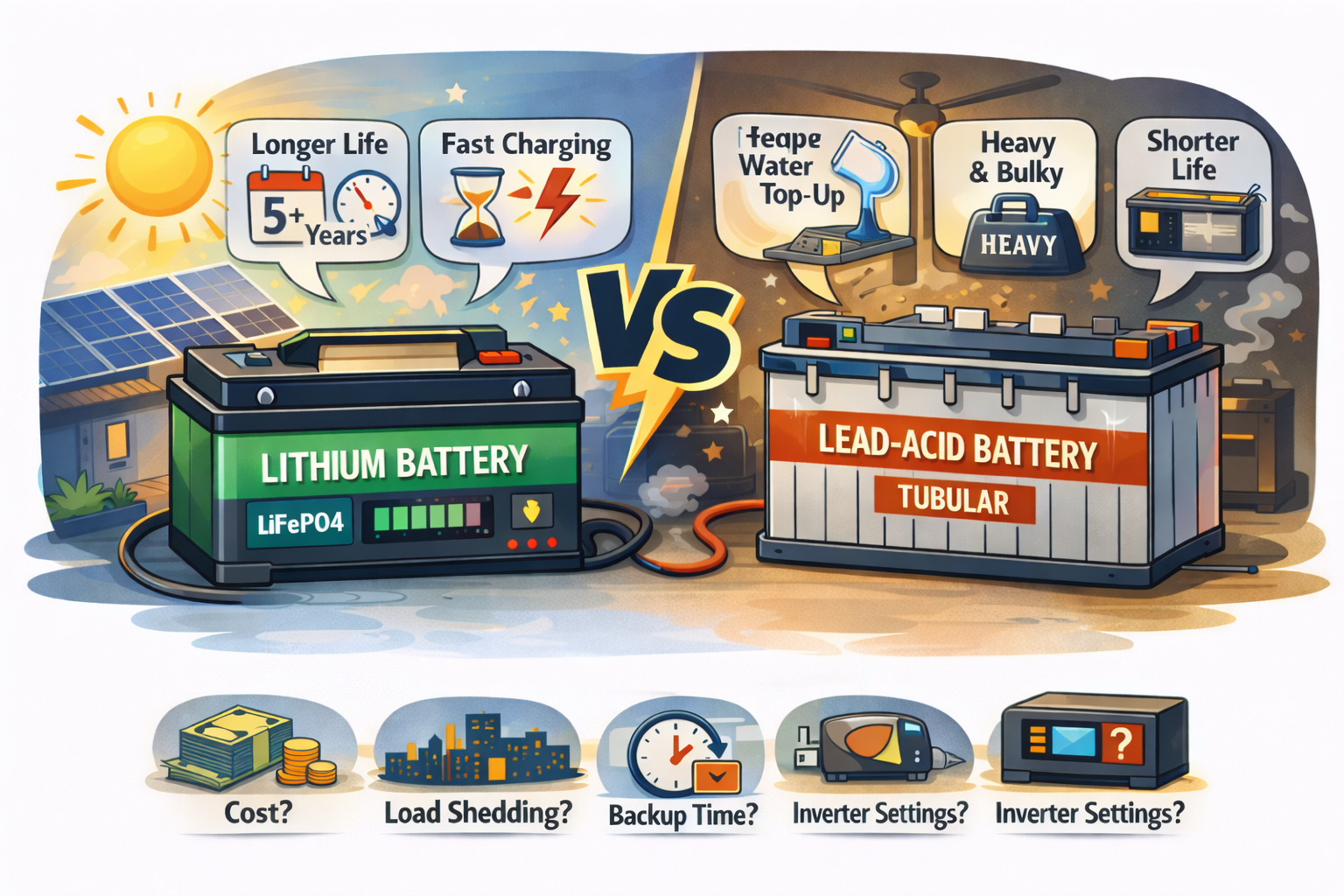
In Pakistan, load shedding makes UPS and inverter batteries feel like a daily need, not just a backup. In summers, fans run longer. In many areas, power also comes back with low voltage or frequent trips, which adds more stress to the battery.
Most homes still use lead-acid batteries (especially tubular). Now lithium batteries are getting popular, and many people ask the same thing:
Should you upgrade to lithium, or keep using lead-acid?
It depends on your load, your backup hours, and how often your battery gets deeply discharged.
Common UPS/Inverter Setups in Pakistani Homes
Most homes fall into one of these:
-
12V setup (single battery): One 150–220Ah battery with a UPS/inverter (common in portions).
-
24V setup (two batteries): Two batteries in series for better backup time and lower current draw.
-
Hybrid inverter (grid + solar): Works great, but settings matter a lot.
-
UPS wiring line: Fans, lights, Wi-Fi, and sometimes TV sockets are connected on the same backup line.
Hidden loads on the UPS line are very common, and they change how any battery performs.
Lead-Acid Batteries: What Most People Use
Lead-acid is the standard choice in Pakistan because it’s:
-
easily available
-
cheaper upfront
-
compatible with most UPS/inverters
-
repair/maintenance support is everywhere
The common problems people face
-
backup time reduces after 1–3 years (sometimes sooner in heavy load shedding)
-
tubular batteries need water top-up and terminal cleaning
-
deep discharge damages the battery faster
-
charging is slower, especially the last 20%
Many people start the night thinking the battery is full, but it’s not actually reaching 100% charging.
Lithium Batteries for UPS: What It Usually Means
For home UPS use, “lithium” usually means LiFePO4 (Lithium Iron Phosphate), not phone-type lithium cells.
LiFePO4 batteries usually come with a built-in protection system called BMS (Battery Management System). It helps protect from:
-
overcharging
-
over-discharging
-
overheating
-
short circuits
That BMS is a big reason lithium feels “more stable” for frequent load shedding.
Lithium vs Lead-Acid: Real-Life Differences
Backup time you actually get
Lead-acid loses usable capacity under heavy load, and voltage drops faster.
Lithium holds voltage better, so you often get more usable backup from the same rated capacity.
Battery life in daily load shedding
Lead-acid can last well if discharge is light. But repeated deep discharge shortens life quickly.
Lithium handles deep discharge better, so it usually survives daily long power cuts more easily.
Charging speed
Lead-acid charges slower. The last part (80% to 100%) takes time.
Lithium charges faster and more efficiently, which helps when the grid supply comes back for short windows.
Maintenance
Lead-acid (tubular/wet) needs water checks, cleaning, and ventilation.
Lithium usually needs less maintenance and stays cleaner.
Summer heat
Heat damages both types, but lead-acid suffers more when it’s hot and charging is aggressive.
Lithium with a good BMS protects itself better, but it still needs ventilation and should not be kept in a closed cabinet.
Weight and space
Lead-acid is heavy and takes more space.
Lithium is lighter and easier to place, especially in apartments.
Price
Lithium costs more upfront. Lead-acid is cheaper today, but may need replacement more often.
So the better question is:
Will lithium reduce replacements and headaches enough to justify the cost?
When Lithium Is Worth the Upgrade
Lithium is usually worth it if:
You face long load shedding daily
If your battery is deep discharging almost every day, lead-acid life drops fast. Lithium handles this routine better.
You run heavier loads
If your UPS line includes multiple fans, TV, long Wi-Fi runtime, or a computer, lithium generally performs more consistently.
You keep replacing lead-acid batteries often
If you’re replacing tubular batteries every 1–2 years, lithium can make sense over time.
You want less maintenance
No water top-ups, fewer corrosion issues, less mess.
When Lead-Acid Still Makes More Sense
Lead-acid is still a solid choice if:
Your load shedding is light or occasional
If you only use backup for short cuts, a good tubular battery can last fine.
You only run basic loads
One or two fans, lights, and Wi-Fi. No heavy electronics.
Your budget is tight right now
If upgrading means you will ignore wiring quality, cable thickness, or safety, it’s better to stay with lead-acid and fix basics first.
The Most Common Upgrade Mistake in Pakistan
People buy lithium and connect it to the same UPS without checking charging settings.
Many UPS/inverters are designed for lead-acid charging behavior. If the system is not compatible, you may face:
-
battery not charging fully
-
wrong battery level display
-
sudden cutoff because BMS protects the battery
-
reduced battery life
An upgrade is not just “battery change.” Charging compatibility matters.
Practical Checks You Can Do at Home Before Deciding
Check your real load at night
During load shedding, note what actually runs:
-
how many fans
-
how many lights
-
Wi-Fi only or Wi-Fi + ONT + repeater
-
TV or computer
Most people underestimate load. If load is high, lithium becomes more attractive.
Do a fixed backup-time test
Fully charge your current battery, then run a fixed load:
-
1 fan + Wi-Fi + 2 LED lights
Time how long it lasts. If it drops very quickly, your battery may already be weak.
Check how often your battery hits “low”
If your UPS reaches low battery most nights, you are deep discharging daily. That’s where lithium usually wins.
Check wiring and cable heating
Even the best battery won’t perform if wiring is poor.
During load shedding, carefully feel the battery cables near terminals:
-
cool/slightly warm is okay
-
hot cables mean loose terminals, thin wiring, or overload
Fixing wiring can improve performance even with lead-acid.
If You Decide to Go Lithium: What to Confirm
Prefer LiFePO4 for home backup
It’s more stable for UPS use.
Make sure BMS quality is decent
A weak BMS causes sudden cutoffs and charging issues.
Confirm inverter compatibility
Check if your UPS/inverter supports lithium charging settings, or has adjustable charge current and voltage.
Match the correct voltage
-
12V system: use a proper 12V lithium pack
-
24V system: use a proper 24V pack (or matched packs designed for series)
Avoid mixing random packs.
A Simple Way to Decide
If you use your UPS as a backup for short power cuts, lead-acid is fine.
If you use your UPS like daily power for hours every day, lithium is often worth it because it handles deep discharge better and charges faster.