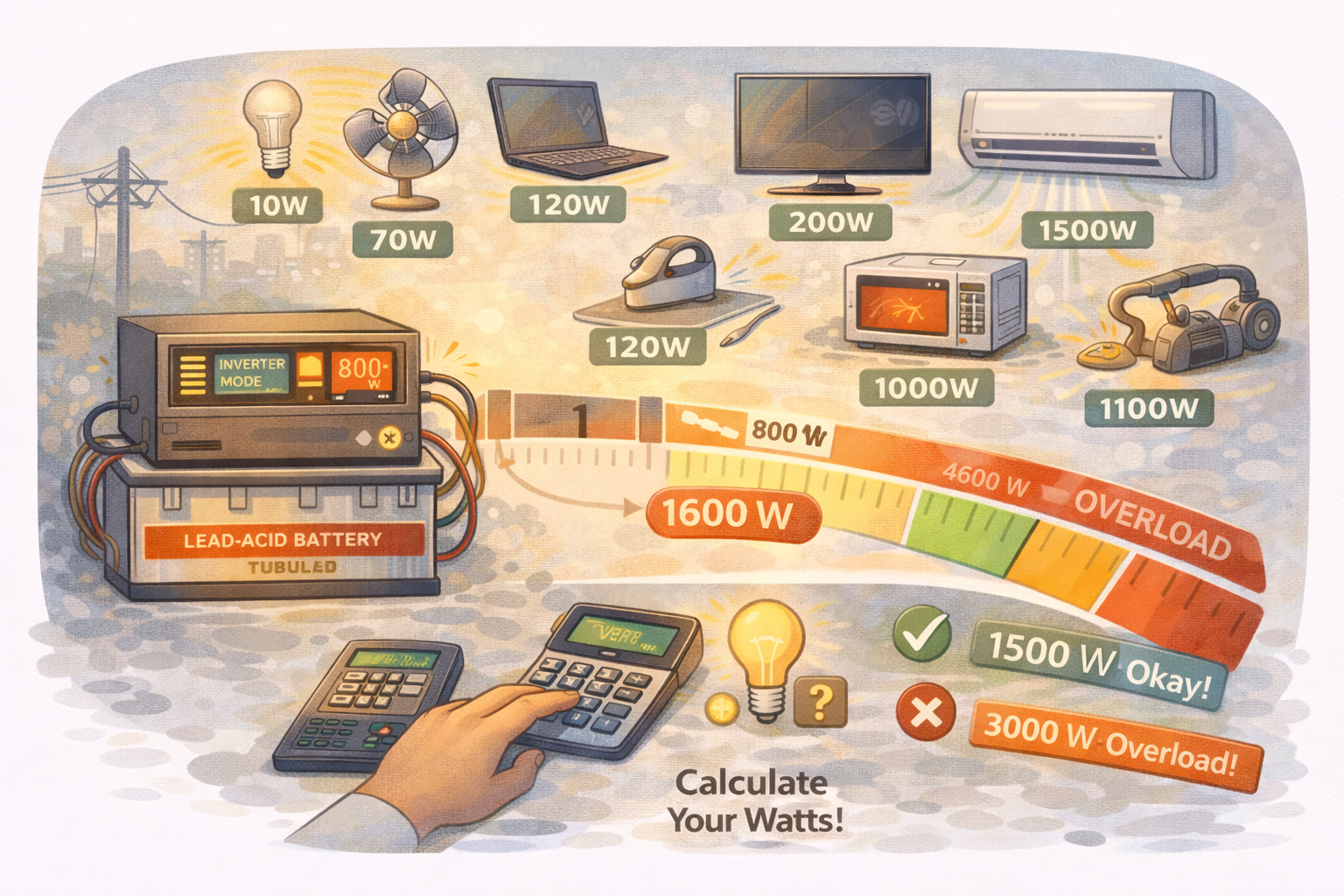
In Pakistan, power cuts can happen at any time. When the mains supply goes out (your local utility could be K-Electric, WAPDA/discos, or another provider depending on where you live), the inverter becomes the backup that keeps the house running.
Most people ask the same thing: “How many appliances can I run on my inverter?”
The answer is not a single number. It depends on:
-
how much power your appliances need right now
-
how long you want them to run (battery time)
-
whether any appliance has a motor that needs a starting surge
Once you understand these three points, you stop guessing and your inverter stops tripping.
The Two Limits Every Inverter Has
1) Load limit (watts) — what can run at the same time
This decides how many appliances can run together without the inverter beeping or shutting down.
If your inverter can handle 1200W and your house load is 1100W, you are very close to the edge. One extra device turning on can trip it.
2) Battery limit (time) — how long it can keep running
Even if your inverter can handle the load, batteries decide whether it runs for 30 minutes or 4 hours.
Many people buy a “big” inverter but keep small/old batteries, then get disappointed with backup time.
Common Inverter Setups in Pakistani Homes
Most homes have one of these:
12V system (single battery)
Usually used for Wi-Fi, lights, and maybe 1–2 fans. It can work, but it gets stressed quickly if you add more fans.
24V system (two batteries)
Very common in houses. More stable for multiple fans and basic backup.
48V system (four batteries) or larger banks
Used when people want longer backup and better performance under load. Also common with hybrid/solar inverters.
The higher the system voltage (24V/48V), the lower the current for the same load, which usually means less stress on wiring and batteries.
Step 1: Understand Your Appliance Types
Not all appliances behave the same on inverter power.
Light loads (easy)
-
LED bulbs
-
Wi-Fi router
-
phone chargers
-
laptops
-
small TV (varies)
These are usually safe on most inverters.
Motor loads (tricky because of starting surge)
-
refrigerator
-
water pump
-
washing machine motor
-
pedestal fans
-
ceiling fans (lower surge than pump, but still a motor)
Motors often need a short “push” to start. This starting surge is the reason inverters trip even when “watts look fine.”
Heating loads (usually avoid on normal home inverter)
-
iron
-
electric kettle
-
toaster
-
room heater
-
electric stove
These pull a lot of power continuously and drain batteries very fast.
Step 2: Know Your Inverter’s Real Power Rating
You may see ratings like:
-
1000W / 1500W / 2000W
or -
1000VA / 1500VA / 2000VA
If your inverter is in VA
VA is not the same as usable watts. A simple practical rule many people use:
Usable watts ≈ VA × 0.8
So:
-
1000VA ≈ 800W (rough)
-
1500VA ≈ 1200W (rough)
It’s not perfect, but it helps you plan safely.
Check the surge/peak rating too
For fridge and pump, surge matters. Some inverters have good continuous power but weak surge. That’s when they trip on motor start.
Step 3: Make a Simple Load List (No Fancy Tools Needed)
Write what you want to run during outages. Start with essentials.
Here are common rough watt estimates (your items can vary, but these are good planning numbers):
-
Ceiling fan: 60–80W each (older fans can be more)
-
LED bulb: 8–12W each
-
Wi-Fi router: 10–20W
-
TV: 60–150W (depends on size/type)
-
Laptop: 40–90W
-
Fridge (running): 150–300W (startup is much higher)
-
Water pump: 500–1500W+ (startup is higher)
Example: Typical “load shedding backup”
-
3 fans (70W each) = 210W
-
6 LED bulbs (10W each) = 60W
-
Router = 15W
-
TV = 100W
Total = 385W
A 1000W inverter can usually handle this load easily (power-wise). Now the next question is battery time.
Step 4: Estimate Backup Time From Batteries
A very simple battery energy estimate:
Battery energy (Wh) ≈ Voltage (V) × Capacity (Ah)
Example:
-
12V 150Ah battery → 12 × 150 = 1800Wh
-
Two 12V 150Ah batteries in series (24V system) → 24 × 150 = 3600Wh
But you don’t get 100% usable energy due to inverter losses and battery limits. A practical home assumption for lead-acid systems is 60–70% usable (less if batteries are old).
Example backup time
Load = 400W
12V 150Ah usable energy ≈ 1800Wh × 0.65 ≈ 1170Wh
Backup time ≈ 1170 / 400 ≈ 2.9 hours (rough)
If batteries are old or the load is higher, it can drop a lot.
Step 5: Why Inverters Trip Even When Your Total Watts Look “Within Limit”
Starting surge from motors
A fridge might run at 200W but start at 800–1200W for a moment. A pump can jump even higher.
If your inverter can’t deliver that surge, it trips.
Too many devices starting together
Example: fridge starts while a pump starts, or multiple fans start after a brief power flicker. Combined surge can trip the inverter.
Low battery voltage under load
Even if the inverter is powerful, weak batteries can’t supply the current needed. Voltage drops, inverter alarms, fans slow, and it may shut down.
Practical Checks You Can Do at Home
Check 1: Find the “essential load” that keeps life normal
During an outage, try running only:
-
fans
-
LED lights
-
Wi-Fi
-
phone charging
See if this meets your needs. Most homes don’t actually need heavy loads daily on backup.
Check 2: Reduce load and watch what improves
If fans are slow or inverter beeps:
-
turn off TV and extra fans
-
remove extension boards with many chargers
If performance improves quickly, your system is near its limit.
Check 3: Use a cheap plug-in watt meter (optional but very helpful)
If your inverter output is via sockets, a watt meter can tell you real usage for TV, router, laptop, etc. This removes guesswork.
Check 4: Watch inverter display (if available)
Many inverters show:
-
load percentage
-
output voltage
-
battery voltage
If battery voltage drops sharply when load increases, batteries are the weak point.
Check 5: Identify motor appliances and treat them separately
Fridge and pump should not be added casually. Test them one by one, when you can monitor.
If the inverter trips once on startup, don’t keep retrying. Repeated restarts are hard on both inverter and appliance.
A Simple “Safe Rule” for Most Homes
Safe everyday backup set
-
2–4 fans
-
a few LED lights
-
Wi-Fi router
-
TV (optional)
This is what most normal 24V home inverter setups are designed for.
Be cautious with these
-
fridge (needs good surge capacity and preferably pure sine wave)
-
water pump (needs much higher surge and strong wiring)
-
iron, kettle, heater (usually not worth it on batteries)