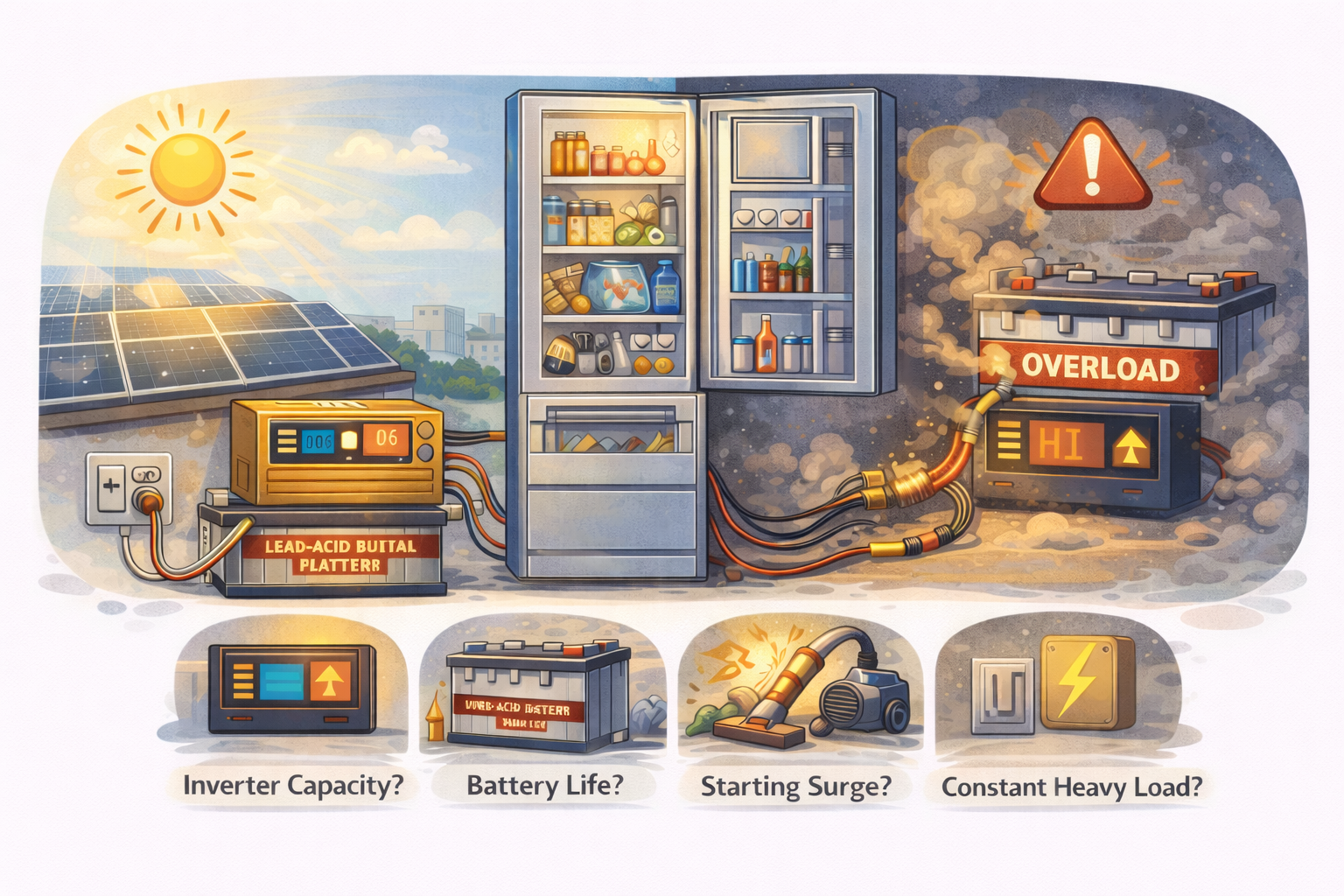
Load shedding in Pakistan can hit at any time. When the lights go, the first worry is usually the fridge: “Will my food go bad?” Many people try to run the refrigerator on a UPS or inverter, but the results are mixed. Some fridges run fine. Some make a loud humming sound, trip the UPS, or damage the batteries over time.
A refrigerator is not like a fan or LED light. It has a compressor motor, and motors behave differently on backup power.
Why a Refrigerator Is “Heavy” for a UPS/Inverter
The compressor needs a high starting surge
When the fridge starts, the compressor pulls a sudden high current for a short moment. This is called starting surge. Even if your fridge normally uses 150–300 watts while running, it can briefly demand 3–6 times more at startup.
That startup surge is what trips many UPS units. The UPS sees a sudden load and either shuts down or keeps clicking on and off.
Some inverters give “rough” power
Many home UPS systems are not pure sine wave. They produce modified or square wave output. Motors can run hotter and noisier on this type of power, and some compressors don’t like it at all.
Even if the fridge runs, it can be less efficient and may stress the compressor over time.
Common Home Backup Setups in Pakistan
Most homes fall into one of these setups:
-
Computer-style UPS (small) with 1 battery (12V) — used for Wi-Fi, PC, maybe 1 fan.
-
Home UPS / inverter with 1–2 batteries (12V or 24V) — used for fans, lights, TV, Wi-Fi.
-
Bigger inverter (24V/48V) with 2–4 batteries — sometimes runs a room AC, fridge, and more.
-
Hybrid solar inverter with batteries — usually better quality output and higher surge capacity.
A fridge is usually safe only on setups that can handle high surge and stable output.
When It’s Usually Safe to Run a Refrigerator
1) Your inverter is pure sine wave (or high-quality hybrid)
If the inverter is pure sine wave, the compressor motor generally runs smoother and cooler. That reduces risk.
If it’s modified sine wave, it can still work, but you should be more careful and monitor heat/noise.
2) Your inverter has enough surge capacity
Don’t look only at “watts.” Look at surge/peak rating.
As a rough practical guideline:
-
Small fridge (single-door): often needs at least 1000–1500W surge
-
Medium fridge (double-door / inverter fridge): often needs 1500–2500W surge
-
Big fridge/freezer: may need 2500W+ surge
These are common ranges, not a guarantee. Different models vary a lot.
3) Your battery bank is not tiny
A fridge can drain a small battery fast, and low voltage makes the inverter struggle.
-
1 x 12V battery setups usually struggle with fridges.
-
2 batteries (24V) is usually more stable.
-
More batteries = less stress and longer backup.
4) You are not running other heavy loads at the same time
If the fridge is on backup, avoid adding iron, microwave, kettle, water pump, or even too many fans. The fridge needs “room” to start.
When It’s Not Safe (Or Not Worth It)
1) Small UPS meant for computers
These are designed for clean shutdown, not motor loads. They often trip, beep, or overheat.
If you try anyway, you’ll likely kill the battery early or damage the UPS.
2) Modified sine wave inverter + sensitive compressor
Some fridges make a loud buzzing sound on modified sine wave. That’s a warning sign. It means the motor is not happy.
3) Weak batteries or old batteries
A weak battery causes low voltage under load. Low voltage can make the inverter cut off, and repeated cutoffs are hard on both inverter and compressor.
4) Fridge with stabilizer issues or low-voltage sensitivity
If your fridge struggles even on WAPDA without a stabilizer, it may struggle more on backup power.
Practical Checks You Can Do at Home
Check 1: Identify your inverter type
Look at the inverter label or manual. Search your model name and see if it says:
-
Pure sine wave
-
Modified sine wave
-
Square wave
If you can’t find it, check the product box/manual, or take a photo of the label and read it carefully.
Check 2: Find your refrigerator’s running watts (easy method)
If you have a plug-in watt meter (many people use them now), plug the fridge in and check:
-
Running watts after it stabilizes
-
Startup peak (some meters show max)
If you don’t have a meter, check the fridge nameplate. It may show amps (A). If it shows amps, a rough estimate is:
Watts ≈ Volts (220) × Amps
Example: 1.2A → ~264W running (rough).
Check 3: Try a controlled test during daytime
Do a test when you can monitor things (not at midnight).
-
Keep only essential loads on backup (Wi-Fi + a couple lights).
-
Turn off other heavy loads.
-
Switch to inverter mode.
-
Plug in the fridge (or let it start normally if already connected).
Watch for:
-
Does it start cleanly or does it trip?
-
Is there repeated clicking from inverter?
-
Is the fridge making unusual buzzing?
If it trips once, stop and don’t keep retrying. Repeated starts are worst for motors.
Check 4: Feel for overheating signs (simple but important)
After 15–20 minutes on inverter:
-
Touch the inverter body (should be warm, not burning hot).
-
Listen to the fridge compressor: smooth hum is okay, harsh buzzing is not.
-
Smell check: any burning smell = stop immediately.
Check 5: Check battery voltage drop (if your inverter shows it)
Many inverters show battery voltage.
If voltage drops sharply when the compressor starts, your battery bank may be too small or weak.
As a general idea:
-
12V systems dropping close to low-cut quickly is a bad sign.
-
24V systems are more stable for motor loads.
Check 6: Check the wire and plug quality
Loose plugs, thin wires, cheap extensions can cause voltage drop. Voltage drop makes starting harder.
For a fridge on inverter, avoid long thin extension wires. Use a solid wall socket with good wiring.
Best Practices If You Must Run the Fridge on Backup
Keep the door closed
This is the biggest “free” trick. If you keep the door closed, food stays cold for hours even without power. Every door opening makes the compressor work harder later.
Give it “rest cycles” if your batteries are small
If your backup is limited, you can run the fridge for a short time, then turn it off for a while. Many families do this during long load shedding.
Example approach:
-
Run 20–30 minutes every 1–2 hours (depends on weather and fridge insulation)
Don’t do this if your fridge has special rules, but for many normal fridges it works.
Avoid running it at the same time as water pump
The pump also has a big starting surge. If both start together, the inverter may trip.
Consider a dedicated circuit (if you have proper inverter wiring)
If your inverter has a backup circuit through a changeover, keep the fridge on a stable, properly wired line. Random plug juggling increases risk.
What About “Inverter Refrigerators”?
Some newer fridges are called “inverter” or “DC inverter” (means variable-speed compressor). These often have:
-
Lower starting surge compared to old fixed-speed compressors
-
Better efficiency
They can be easier to run on an inverter, but they still need stable power and enough surge headroom. Don’t assume it’s automatically safe on a small UPS.
Clear Warning Signs to Stop Immediately
Stop running the fridge on UPS/inverter if you notice:
-
Loud buzzing or rattling from the compressor
-
Inverter keeps clicking on/off
-
Inverter gives overload alarm
-
Plug or wire heating up
-
Burning smell
-
Battery voltage dropping too fast
These are signs you’re stressing the system.
A Simple Rule to Decide
If your setup is:
-
Pure sine wave, and
-
Enough surge capacity, and
-
At least 24V battery bank (2 batteries), and
-
Wiring is solid, and
-
Test run is smooth
…then running a refrigerator during load shedding is usually reasonable.
If you have a small computer UPS or a basic modified sine wave inverter with a weak battery, it’s safer to keep the fridge off, keep the door closed, and use backup for fans, lights, and Wi-Fi instead.